Benchmarking data available

30 Sep 2024

The following datasets have been published on the National Clinical Audit Benchmarking (NCAB) website, HQIP’s online portal which provides access to national audit performance data.
  • The Paediatric Intensive Care Audit. This data was updated on NCAB on 26 September 2024 from the PICANet report 2022 published on 14 December 2023, covering data up to December 2022.
  • The National Paediatric Diabetes Audit. This data was updated on NCAB on 21 August 2024 from the NPDA report published 10 April 2024, covering data from 1 April 2022 to 31 March 2023.

NCAB is an online portal, hosted by HQIP, which provides access to national audit performance data. Users do not need to register, and can access audit benchmarked data searchable by speciality, Trust, hospital or unit. For all datasets currently published, go to the NCAB site.

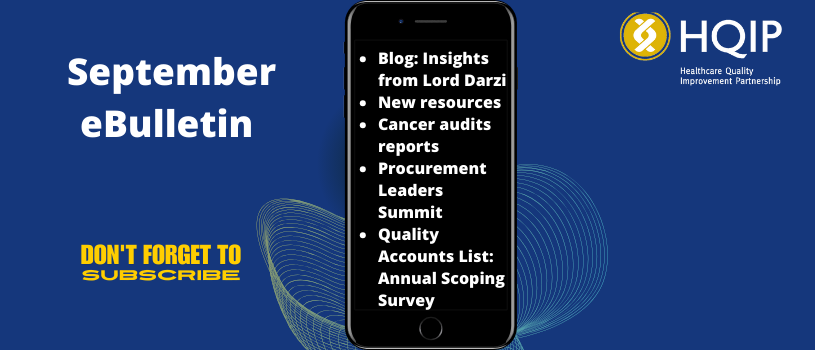
Latest news: September eBulletin

26 Sep 2024

Welcome to the latest round-up of clinical audit and programme news, events and updates from HQIP and other relevant healthcare organisations.

Contents

Read the eBulletin here.
Don’t forget to sign up: Keep up to date with our latest news, events and work programmes by subscribing to our mailing list today. You can also stay up-to-date by following us on X: @HQIP.

Key milestone for cancer care

25 Sep 2024

In September 2024, we were delighted to share the first State of the Nation (SotN) reports from six cancer clinical audits (primary and metastatic breast, ovarian, pancreatic, non-Hodgkin lymphoma & kidney), all of which are part of the National Cancer Audit Collaborating Centre (NATCAN). With insights into the care delivered, progress in relation to quality improvement, and recommendations for improvement, these reports are an invaluable resource for anyone involved in cancer healthcare.

“The national cancer audits play an important part in improving care and outcomes for patients”

NATCAN, which was commissioned by HQIP in October 2022, has since published quarterly clinical performance indicators, and held an informative online webinar to share the key messages from their findings, in October 2024. With more than 385,000 new cancer cases and around 167,000 cancer deaths in the UK each year, the national cancer audits play an important part in improving care and outcomes for patients, and these latest releases are a significant milestone for the Centre.

However, there’s an additional important story to tell about the collaborative nature of NATCAN; how, by bringing all the national cancer audits under one ‘umbrella’ organisation, this HQIP-commissioned programme can make the most effective use of the cancer data available and support improvements in the care provided to patients.

Organising clinical audits in this way creates a critical mass and capacity of experts

In addition to the latest information on the NATCAN website, you can read ‘An ′umbrella approach′ to audit: sharing, efficiencies and results’, a short article by HQIP which shares more information about this national centre of excellence. In it, we hear from Dr Julie Nossiter, Director of Operations at NATCAN, about the Centre’s aims, how it is unique, and its plans to share more timely and regular reporting. Read in full (page 19).

Blog: Insights from Lord Darzi’s independent investigation of the English NHS

20 Sep 2024

Re-establishing Quality as an organising principle of the NHS

Chris Gush, Chief Executive Officer, HQIP

Lord Darzi’s report candidly highlights key areas requiring urgent attention within the NHS. Those involved in, and connected to, healthcare delivery already know that the ‘system’ of care must function better for both patients and staff. We must improve access, elevate care quality, and boost outcomes for everyone. Shifting care closer to home, preventing illness, integrating services, and embracing technology are all critical—if expected—themes.

We welcome the report’s emphasis on amplifying the patient voice and giving patients more control over their care, on boosting productivity through improved operational management, and on the crucial need to reduce health inequalities. However, it remains unclear how policy and funding will address these areas and how the strategic challenges that have hindered progress to date will be overcome. We aspire to be part of these solutions.

We have selected three areas to comment on that align to our work:

  1. The importance of data-driven insights and identifying variances from evidence-based provision
  2. The emphasis on increasing patient and community engagement and patient empowerment
  3. Improving management within the NHS to enhance productivity and quality.

Clinical Audit: The powerhouse behind data-informed quality improvement

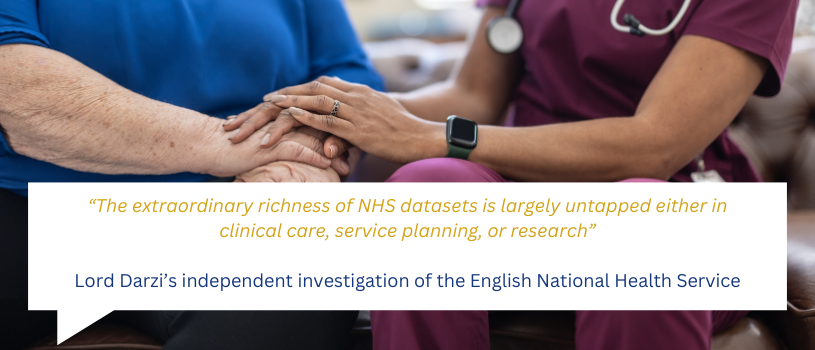
“The extraordinary richness of NHS datasets is largely untapped either in clinical care, service planning, or research” Paragraph 14

“… the availability of data—and in itself demonstrates the need to invest in measurement and transparency across all areas of the NHS” Paragraph 29

Clinical audit reports provide powerful, clinically curated, data-driven insights into the quality of care measured against evidence-based standards, with national benchmarking. A robust design and commissioning process, involving patient engagement, evidence-based guidance (e.g. NICE) and clinician collaboration drives this work.

Numerous clinical audits are referenced in the Darzi report and can continue to play a leading role in tackling the challenges that Darzi highlights.

  • Adherence to evidence-based clinical guidelines: A stark finding of the report is the “insufficient adherence to clinical guidelines” across many clinical specialties.

The key focus of clinical audit as a methodology is to provide data-driven insights of variance from evidence-based guidance, which enables sustained improvement in both patient outcomes and operational efficiency.

  • Addressing performance variability: Performance variability is a major issue. Darzi highlights troubling variations in elective care outcomes and persistent avoidable harm.

Clinical audit, as a methodology, national or local, can support teams to implement a stronger process reliability approach identifying, unpicking and helping reduce unwarranted variation from the standard as well as tracking the effectiveness of improvement strategies through data dashboards.

  • The need for national audits in wider settings: As Darzi reminds us, performance standards are currently heavily focused on hospitals, with insufficient attention to primary care, community services and mental health.

Collaborating with colleagues in primary care to expand clinical audit coverage to these areas would enable more comprehensive quality improvement. Data flow and sharing challenges in primary care are starting to be addressed by OPENSafely, as referenced by Darzi, laying the foundations.

Bringing together robust audit measures across acute, ambulance, primary and social care could elevate quality monitoring still further, for the benefit of population health management, triangulation and national sharing of good practices.

Amplifying the patient voice: A step towards equity

In some respects, particularly in its decision-making and systems, the patient voice is simply not loud enough” Paragraph 4

Darzi is correct in stating that the patient voice needs to be louder. Our patient engagement work shows that genuine co-production of services with patients is crucial for understanding what truly matters to them and for driving meaningful change. Partnerships with patient groups and charities ensure that marginalised voices are heard. However, some patient groups have repeatedly shared their experiences and are now fatigued by the process; they seek action rather than more consultation, as well as personal empowerment – particularly in critical moments like childbirth.

At HQIP, we embed patient engagement in every step of our commissioning processes for clinical audit, ensuring diverse voices—especially from underrepresented groups—are heard loud and clear. By amplifying patient voices, we push for equitable care improvements. But is this enough? Can we do more?

Lord Darzi emphasises that stronger patient engagement is central to creating truly patient-centred care and tackling health inequities. His report highlights the growing dissatisfaction, noting that “patient satisfaction with NHS services has steadily declined, with many feeling their concerns are not being heard.” In particular, the report draws attention to significant disparities in care, such as the threefold higher mortality rate among Black women during childbirth (MBRRACE audit). Addressing these inequities requires urgent action across all healthcare sectors, including cancer care, mental health, and children’s services. This focus on patient engagement aligns with the broader need to address social determinants of health, such as income and housing, which continue to drive disparities in healthcare outcomes.

Quality as an “organising principle”: Systems of quality management

“The problem is not too many managers but too few with the right skills and capabilities. International comparisons of management spend show that the NHS spends less than other systems” Paragraph 24

Darzi’s 2008 report made the case that raising the quality of care should be the organising principle of the NHS. The 2024 investigation report provides an analysis of the NHS’s current state in England, and “there is much work to be done if quality of care is to become the organising principle of the NHS once more”. As expected, ‘productivity’ is a term abundant in the report (59 mentions in the main report), with the key link to Quality for Patients made clear “a productive NHS can mean high quality care for all”.

Darzi’s report outlines deep challenges in leadership and operational processes, stressing that these are systemic, not individual failings. As Darzi outlines “managers are there to ensure efficient organisation and process so that clinicians can deliver high quality care to meet the needs of patients”.

Many of the elements Darzi talks about hint at the benefits of organisational Quality Management Systems (QMS), a term that many will be familiar with from the NHS Impact framework but which are also not yet optimised.

So, what might be the benefits?

  • Giving clinicians time back with ‘systems of work’ that function and streamline operations. QMS can help by providing a structured approach to improving processes, reducing waste and enhancing productivity. The QMS methods are not unknown, but not optimised.
  • Reducing unwarranted variation systemically, for example by embedding clinical audit standards in EPRs, providing real-time decision support bundles and/or order sets as well as real-time variance data. Darzi’s report acknowledges that the NHS is “in the foothills of digital transformation“, but if we could progress this, the productivity and quality gains could be exponential.
  • Effective process management: Ensuring that the NHS has experts in process design and control could further help streamline processes, reduce variability, and alleviate the workload on clinicians, enabling a more focused approach to patient care.
  • Culture of learning: A focus on system factors, rather than individual errors, fosters a culture of continuous learning and improvement enhancing patient outcomes, operational efficiency, and care consistency.

While the Darzi report sets out significant challenges, it also points to opportunities for systemic improvement. By leveraging clinical audits as a core tool for quality improvement, the NHS can address some of the critical issues highlighted in the report. HQIP stands ready to support this effort. Data-driven insights and patient voices must guide the NHS as it rebuilds quality as its core organising principle.

Talk to us about how we can help you: workwithus@hqip.org.uk

For more details, you can view the full report here.

New resources published Sept 2024

12 Sep 2024

We are pleased to announce that the following new resources have been published: These reports are available to view and download, along with all other reports, on our dedicated reports webpage.
Stay up to date: Join our mailing list to receive notifications when new reports are published.

Latest news: August eBulletin

30 Aug 2024

Welcome to the latest round-up of clinical audit and programme news, events and updates from HQIP and other relevant healthcare organisations.

Contents

Read the eBulletin here.
Don’t forget to sign up: Keep up to date with our latest news, events and work programmes by subscribing to our mailing list today. You can also stay up-to-date by following us on X: @HQIP.

Influencing Change case study

22 Aug 2024

Improving Diabetic Foot Infection Outcomes

Diabetic Foot Infection Team, Ashford and St Peter’s Hospitals

We are pleased to share an exemplar case study from the winner of the Influencing Change category of the Clinical Audit Heroes Awards (part of Clinical Audit Awareness Week 2024).

The team was recognised for their project which aims to improve outcomes for diabetic foot infection patients treated with outpatient parenteral antibiotics. The judges found that it was well structured, with multiple data measures, and improvement clearly demonstrated. Of particular note, were the interventions that had quality improvement ‘built-into’ them, as well as the extensive background research undertaken to identify best-practice.

The case study from the Diabetic Foot Infection Team can be viewed here.

Benchmarking data available

15 Aug 2024

The following dataset has been published on the  National Clinical Audit Benchmarking (NCAB) website, HQIP’s online portal which provides access to national audit performance data.

NCAB is an online portal, hosted by HQIP, which provides access to national audit performance data. Users do not need to register, and can access audit benchmarked data searchable by speciality, Trust, hospital or unit. For all datasets currently published, go to the NCAB site

New resource published August 2024

8 Aug 2024

We are pleased to announce that the following new resource has been published: This report is available to view and download, along with all other reports, on our dedicated reports webpage.
Stay up to date: Join our mailing list to receive notifications when new reports are published.

Benchmarking data available

30 Jul 2024

The following datasets have been published on the  National Clinical Audit Benchmarking (NCAB) website, HQIP’s online portal which provides access to national audit performance data.

NCAB is an online portal, hosted by HQIP, which provides access to national audit performance data. Users do not need to register, and can access audit benchmarked data searchable by speciality, Trust, hospital or unit. For all datasets currently published, go to the NCAB site

Latest news: July eBulletin

25 Jul 2024

Welcome to the latest round-up of clinical audit and programme news, events and updates from HQIP and other relevant healthcare organisations.

Contents

Read the eBulletin here.
Don’t forget to sign up: Keep up to date with our latest news, events and work programmes by subscribing to our mailing list today. You can also stay up-to-date by following us on X: @HQIP.

Public involvement in HQIP data access celebrated in showcase

24 Jul 2024

HQIP was proud to be one of a small number of organisations to feature at Health Data Research UK (HDR-UK)’s Transparency Showcase in May 2024. This showcase celebrated the impact of projects designed to improve the transparency of processes for accessing health datasets for research, through adoption of pan-UK Transparency Standards. Following a successful bid for grant funding from HDR-UK to develop meaningful public engagement in our data access processes, we were delighted to present our project outcomes and achievements at the event.

As commissioners of the National Clinical Audit and Patient Outcomes Programme (NCAPOP), HQIP is a custodian of data from across many healthcare disciplines. The high quality and national coverage of our circa 40 national audits and registries means datasets are sought-after for a wide range of, potentially transformational, research and other purposes.

Transparent and clear information about safe and secure access to health data is fundamental to building and maintaining public trust, and promotes accountability. This funding enabled HQIP to review its data access processes and work with members of our Service User Network (SUN) to co-design a sustainable model for establishing public involvement within our Data Access Request Group (DARG) – for which we are delighted to be recruiting at this time.

Kim Rezel, Head of Patient and Carer Engagement at HQIP, explains how we got started: “At HQIP, we have a Service User Network of around 100 patients and carers, who support our work in various ways. For this project, we put out a call for involvement, and received 15 expressions of interest. We then worked with these volunteers to identify three engaged and enthusiastic SUN members to join the project team”.

Three SUN members (Wendy Davis, Sarah Markham and Mike Molete) joined Kim, Claudia Snudden (Clinical Fellow), and Yvonne Silove (Associate Director and DARG member) from HQIP to form the project team. Throughout the project, SUN members were fully involved in co-creating all the outputs, providing lived experience and promoting the patient and public voice throughout. More information about how this project was undertaken, and its results (including the poster presented at the showcase event), can be found in the following International Journal of Population Data Science (IJPDS) abstract: Developing meaningful public involvement in HQIP’s data access processes and Data Access Request Group (DARG).

This exemplar project forges the way forward in how to meaningfully engage patients and service users in understanding how their data is used. Wendy Davis, SUN and public project member, shares her thoughts on its innovative approach: “This project was genuinely collaborative. We could all speak openly and easily, working together throughout the life of the project”.

We are delighted to have also published a new video recounting the project, produced as part of Clinical Audit Awareness Week 2024, which can be viewed on HQIP’s YouTube channel: HQIP Mutual Benefits of Patient and Public Involvement. More information on our Service User Network, and details of how to join, can be found on the HQIP website: www.hqip.org.uk/involving-patients/service-user-network.

If you would like to learn more about the wider HDR-UK Alliance and the showcase event, further details can be found in the corresponding conference proceedings, published by the International Journal of Population Data Science (IJPDS).

This work was supported by the Health Data Research Alliance and Health Data Research UK (HDRUK2023.0456), an initiative funded by UK Research and Innovation, Department of Health and Social Care (England) and the devolved administrations, and leading medical research charities.

thumbnail of PPI-DARG poster 0.5

Patient Safety case study

23 Jul 2024

Improving the in-patient care of people with Parkinson’s disease

Parkinson’s Disease Quality Improvement Project (QIP) Team at Northumbria Healthcare NHS Foundation Trust

We are pleased to share an exemplar case study from the winner of the Patient Safety category of the Clinical Audit Heroes Awards (part of Clinical Audit Awareness Week 2024).

This award celebrates their outstanding and innovative project to delivering “gold-standard” care for individuals with Parkinson’s Disease. The award-winning initiative by the QIP Team stands out for its multi-disciplinary approach, which ensures comprehensive support that prioritises patient experience, effectiveness and safety. By integrating various healthcare disciplines, the project addresses the complex needs of Parkinson’s Disease patients, enhancing the quality of care they receive.

The team’s dedication to improving patient outcomes and safety has set a new benchmark in Parkinson’s Disease care. Their initiative not only underscores the importance of collaborative healthcare, but also serves as an exemplary model for similar projects nationwide.

The case study from the Parkinson’s Disease Quality Improvement Project Team can be viewed here.

Tender: Medical and Surgical Clinical Outcome Review

12 Jul 2024

Applications closing date: 05 Aug 2024 12:00

The Healthcare Quality Improvement Partnership (HQIP) is seeking to commission an organisation that will support the delivery of the Medical and Surgical Clinical Outcome Review Programme (Med Surg CORP). The programme will initially be delivered for NHS-funded care in England, Wales, Northern Ireland and Jersey but may later extend to include Guernsey, Scotland Isle of Man and other Devolved Nations / Crown Dependencies. Further details can be found on the tenders webpage.

New resources published July 2024

11 Jul 2024

We are pleased to announce that the following new resources have been published: These reports are available to view and download, along with all other reports, on our dedicated reports webpage.
Stay up to date: Join our mailing list to receive notifications when new reports are published.