March’s edition of HQIP’s eBulletin is available now. It features the most recent clinical audit and quality improvement updates, including:
Latest report on paediatric diabetes
Benchmarking data published (NCAB)
The Big ‘C’ – Collaboration
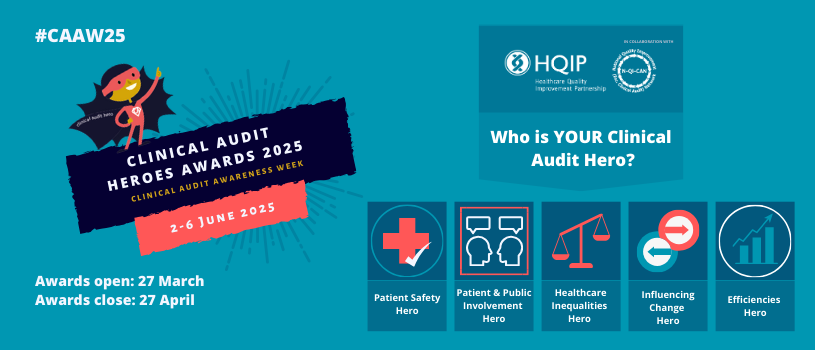
Clinical Audit Heroes Awards – NOW OPEN and Lunch & Learn events
New version of The Directory for 2025-26
Case study: Embedding patient voice in procurement
HQIP-commissioned maternity data used in research paper
Read the eBulletin here.
Don’t forget to sign up: Keep up to date with our latest news, events and work programmes by subscribing to our mailing list today. You can also follow us on LinkedIn and X: @HQIP
Data relating to maternity and perinatal care has been published on HQIP's benchmarking site, NCAB.
New resource published March 2025
13 Mar 2025
We are pleased to announce that the following new resource from HQIP-commissioned audits and programmes has been published. It includes an infographic, data and recommendations to support quality improvement:
Paediatric diabetes: care and outcomes 20234/24report – National Paediatric Diabetes Audit (NPDA)
All reports: All HQIP-commissioned reports can be accessed via our dedicated reports webpage.
Stay up to date: Join our mailing list to receive notifications when new reports are published.
Thank you to everyone who attended the online launch event on 12 March for Clinical Audit Awareness Week 2025 (#CAAW25), which will take place 2-6 June 2025!
We were delighted to welcome over 200 attendees who joined us to hear the speakers – Chris Gush (HQIP CEO), Professor Danny Keenan (HQIP Medical Director), and Vicky Patel (N-QI-CAN Chair) – share valuable insights on the role of clinical audit and quality improvement in driving change and improving patient care. They also provided information on how to get involved in this year’s #CAAW25 campaign and Clinical Audit Heroes Awards.
During the launch event, we announced the five categories for the Clinical Audit Heroes Awards 2025, which will open on 27 March and close on 27 April:
Patient Safety
Patient & Public Involvement (PPI)
Healthcare Inequalities
Influencing Change
Efficiencies
Further details, including the criteria for each category, will be announced in the week beginning 24 March 2025.
We also announced the dates and themes for each of the online Lunch & Learn events taking place daily from 12:30 – 1:30 pm during #CAAW25 (2-6 June), where we’ll announce the awards winners. To find out more about the awards, Lunch & Learn events, and key dates and activities, head over to the Clinical Audit Awareness Week and Clinical Audit Heroes Awards webpages.
Remember, if you plan to host your own #CAAW25 events and activities within your organisation, there is a free promotional toolkit available to support you! Stay tuned for further updates on our dedicated #CAAW25 webpage. We look forward to celebrating excellence in clinical audit and quality improvement with you!
Data relating to maternity and perinatal care has been published on HQIP's benchmarking site, NCAB.
Clinical Audit Heroes Awards 2025 – criteria
12 Mar 2025
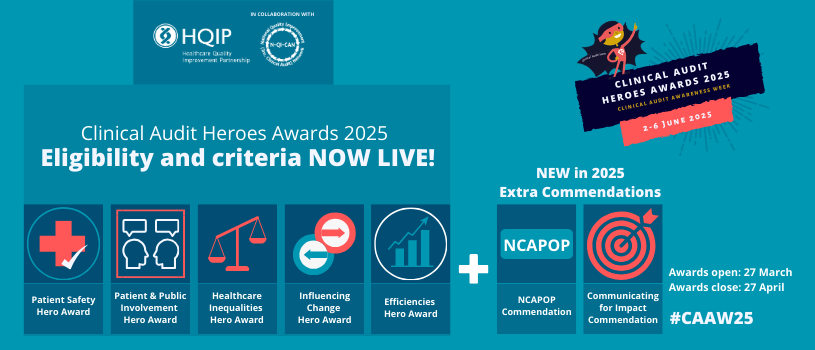
It’s time to get ready to enter Clinical Audit Heroes Awards 2025 – part of Clinical Audit Awareness Week (#CAAW25)! We’re thrilled to announce that the judging and eligibility criteria are NOW LIVE for all five Clinical Audit Heroes Awards categories. The awards, which are run in collaboration with N-QI-CAN, will open for nominations on Thursday 27th March and close on Sunday 27th April 2025 (23:59).
Now is your chance to showcase your project on clinical audit and quality improvement, and gain recognition for the difference you’re making. To find out more about the criteria and how to enter each award, click the links below:
Communicating for Impact Commendation – Recognising excellence in effectively communicating project impact.
Each nomination form for the five main categories will include optional questions for those wishing to be considered for these extra commendations. You can simply opt in for these additional commendations by completing these optional questions when submitting your nomination(s).
Winners will be announced during Clinical Audit Awareness Week (2nd – 6th June) at our daily Lunch & Learn online events. Full details and links to register for the Lunch & Learn events are now available on the dedicated Clinical Audit Heroes Awards 2025 webpage. You can also follow updates on the Clinical Audit Awareness Week main page, on social media (HQIP and N-QI-CAN on X and LinkedIn) using the hashtag #CAAW25, and by signing up to HQIP’s monthly eBulletins.
We look forward to celebrating the power of clinical audit and quality improvement in healthcare with you all.
Data relating to maternity and perinatal care has been published on HQIP's benchmarking site, NCAB.
Embedding patient voice in procurement case study
10 Mar 2025
HQIP manages a complex national clinical audit and outcome review programme, funded by NHS England and the Welsh government. Through rigorous specification-driven commissioning, HQIP facilitates the effective measurement of the quality of care and outcomes across a wide range of specialties.
The programme supports clinical pathway improvement and reduces variability from evidence-based standards of care – improving outcomes for patients. Over many years, HQIP has refined a process that ensures that patient, carer and public engagement is embedded throughout this commissioning process.
This case study outlines:
The approach we took to embedding patient and public involvement (PPI) systematically in all projects commissioned
Examples of the impact that this has had
The case study can be viewed by clicking the button below:
[button url=”https://www.hqip.org.uk/wp-content/uploads/2025/03/Case-study-Embedding-patient-voice-into-complex-procurement.pdf” target=”self”]Case study: Embedding patient voice into complex procurement[/button]
How HQIP could help you
As a not-for-profit and trusted partner of the NHS, we understand complex healthcare challenges and take a patient-focused, evidence-informed approach to providing high quality solutions.
So whether an organisation needs support with patient engagement, transformation strategy, improvement training, or value-based procurement support, we can help – with proven expertise across multiple areas of quality improvement.
Contact our expert team for a free, no obligation conversation: workwithus@hqip.org.uk
Data relating to maternity and perinatal care has been published on HQIP's benchmarking site, NCAB.
New study uses HQIP-commissioned data to identify ‘recurring red flags’ in maternity
7 Mar 2025
A powerful new retrospective study on perinatal mortality has used reports from MBRRACE-UK, commissioned by HQIP on behalf of NHS England, to identify the maternity services that are most consistently reporting higher-than-average deaths in England.
Published in February 2025 in the Journal of Public Health, this paper compares MBRRACE-UK perinatal mortality surveillance reports from 2015–21 with EPM rates for births occurring in 124 hospital trusts in England between 2013 and 2019. It identifies 23 (18.5% of 124) ‘red flag’ trusts most consistently falling into MBRRACE-UK red and amber bands, finding that seven trusts reported higher-than-average deaths in all seven years. With further findings considered within the context of contemporary inquiries, inspections, investigations and other outcome measures, this study concludes by stating that further research is needed to examine the reasons for the geographic proximity of most ‘red flag’ trusts, including any potential conflict around measures of clinical performance.
“Understanding how to react to data is the most important thing,” Adam Sewell-Jones, Executive Director of Improvement, NHS Improvement
Studies such as this highlight the critical importance of data from outcome reviews, clinical audits and registries, such as the National Clinical Audit and Patient Outcomes Programme (NCAPOP) commissioned by HQIP on behalf of NHS England, in improving healthcare and, in turn, saving and improving lives.
Read the study in full
P McDonagh Hull, T Boulton, B Lashewicz, Recurring red flags: a retrospective study of MBRRACE-UK Perinatal Mortality Surveillance (2015–21) to identify maternity services most consistently reporting higher-than-average deaths, Journal of Public Health, 2025, fdaf019: https://doi.org/10.1093/pubmed/fdaf019. Copyright/access rights: Journal of Public Health, Oxford University Press.
Based on UK wide data for babies born in 2022, this report states that the most common causes of stillbirth and neonatal death were unchanged, finding that congenital anomalies contributed to 17% of deaths.
It also includes the following key findings:
• Stillbirth rates decreased across the UK in 2022, but neonatal mortality increased
• There was wide variation in neonatal mortality rates
• Stillbirth and neonatal mortality rates decreased in almost all gestational age groups
• Inequalities in mortality rates by deprivation and ethnicity remain.
MBRRACE-UK is part of the Maternal, Newborn and Infant Clinical Outcome Review Programme (MNI-CORP), established to identify avoidable deaths so that the lessons learned can be used to prevent similar cases in the future, leading to improvements in maternal and newborn care for all mothers and babies.
Almost one in 100 UK births leads to a stillbirth or newborn death and up to 100 women die each year during or just after pregnancy
MBRRACE-UK/MNI-CORP is part of a wider programme of audits and outcome reviews, commissioned by HQIP (NCAPOP) on a range of clinical disciplines, from asthma to vascular care:
• All HQIP-commissioned reports.
Data relating to maternity and perinatal care has been published on HQIP's benchmarking site, NCAB.
My data, my health
6 Mar 2025
The importance of data sharing from a patient perspective
At HQIP, we have long-since advocated the value of data and patient voice in delivering evidence-informed healthcare improvement. But don’t just take our word for it. Find out what patients think in this exclusive interview with two public members of HQIP’s Data Access Request Group (DARG), which considers requests to re-use the healthcare data commissioned by HQIP.
Healthcare data is viewed as a gift by those considering access to it”
As commissioner of the National Clinical Audit and Patient Outcome Programme (NCAPOP), HQIP is responsible for the largest clinical audit programme of its type in the UK. This work results in an enormous amount of invaluable data that is used by healthcare providers to deliver targeted improvements. However, we also have a duty to re-use this data to bring about even greater public benefit where relevant, and so we run a stringent process to consider access requests from service planning, research and other similar projects. Being responsible for such data is something we do not take lightly. As such, we ensure that that any access granted is only given after the greatest of scrutiny. Critically, this involves members of the public, who add a unique – and vital – perspective to the decision-making process.
Since the data collected – whether access for secondary use is granted or not – belongs to patients, we have invited two public members of DARG to share their thoughts on what it means to them to be involved in this important work…
Let’s start with healthcare improvement more generally. It can be difficult to see the changes that are taking place to bring about data-informed improvements on a day-to-day basis, but do you have any experiences of this?
WENDY: When I was in hospital recently, I presented with symptoms that were initially put down to anxiety by the clinicians I saw. But one doctor came and said that they’d read a journal paper recently about how females can experience my health condition in atypical ways, and how these symptoms can be under reported. With this research in mind, they observed me, and determined that my symptoms did relate to my health condition. They were then able to identify the care that I needed. This, to me, was a clear example of how data and research are having a direct impact on healthcare.
If done correctly, there is absolutely a case for using healthcare data more”
PHIL: Over my 40 years in healthcare, I have seen many examples of how good data collection and evaluation has made a difference – though it can require determination to move away from ‘we’ve always done it this way’. In dementia care, for example, we’ve seen the introduction of Dementia Care Coordinators, a very positive change which came about by evaluating the experiences of those living with dementia. More recently, I’ve personally been involved in conversations with my doctor about a change in the approach to my medication, based on the latest research. So, yes, I am able to see the impact that data is having on healthcare.
In your view, what are the pros and cons of using healthcare data to inform research and improve care?
PHIL: Firstly, we need to remind ourselves that healthcare data belongs to patients. Then, the truth is that collecting data comes at a cost. These two factors mean that there is a moral obligation to use data for the benefit of patients wherever possible. However, I agree that this needs to be done carefully and safely.
Data provides a sound rationale for why we offer care in the way we do”
WENDY: Using data to inform care is incredibly important and powerful, but it needs to be approached with care. If done correctly, there is absolutely a case for using healthcare data more. In my experience, healthcare data is viewed as a gift by those considering access to it. Though I would like to see more case studies being shared with the public, to help us all to understand the stringent processes that are followed before releasing data for research, and the positive impact it has on patient care.
Why did you want to become involved in HQIP’s DARG; why is it important to you?
WENDY: I joined HQIP’s Service User Network (SUN) first, and was then offered the opportunity to join a short project to determine the feasibility of involving patients in decisions around access to data. We spoke to experts in patient engagement as well as other groups actively working with patients, to find out what worked well for them for use as inspiration for HQIP. When they advertised for public members to join DARG, I thought “I would love to be involved in that”, as I have real passion for health and data, and wanted to bring a patient perspective to the access process. For me, a big factor in patients getting involved is that they want to make a difference.
PHIL: As a frontline healthcare worker, I was involved in using clinical audit in its early days, and could see that data needs to form the basis for every single decision made. I joined DARG because I believe that data provides a sound rationale for why we offer care in the way we do, but I wanted to make sure that it is used primarily for the benefit of patients.
There is a moral obligation to use data for the benefit of patients wherever possible”
What does your involvement in DARG include; what do you do in practice?
WENDY: Regular meetings are held to decide on the latest tranche of applications for data. We are sent information in advance, which we review independently, from the perspective of a patient. Then, we actively participate in the meetings – which are pragmatic, thorough and methodical – to make decisions about whether to release the data or not. We very much work together as a group, collaborating alongside experts from a range of fields, to shine a light on each request from every possible viewpoint. All in all, I am confident that the decisions taken are solid and well thought through.
What works well, and what are the benefits of being involved?
WENDY: We are able to offer a unique viewpoint, asking ‘what is the benefit to the patient?’, learning every time we look at a request. We feel that we have had an impact on the process as well as the resultant research and, ultimately, healthcare. It’s like looking through a window, and then being invited to a seat at the table.
PHIL: I agree. Our discussions enable a robust decision to be made. There is no deference to status and everyone is happy to challenge, and that is very important. Patient involvement within HQIP’s data access process isn’t tokenistic. Our voice is heard, and our view is respected and accepted.
Conversely, what are the challenges and learning points?
WENDY: In hindsight, it would have been beneficial to trial taking part in a meeting, before joining DARG. It can be a little daunting as a non-clinical person but I remind myself that, if I’m asking, others may also be thinking the same thing. It’s important not to doubt yourself, as it’s vital to have a patient perspective in the room to ensure that the healthcare data available delivers maximum benefit for patients.
At HQIP, we couldn’t agree more. We see it as part of our mission to ensure that the data we commission is not only protected, but also put to good use. We know that researchers face complex and sometimes time-consuming barriers to accessing NHS data. Our aim is to help remove those barriers while upholding our responsibilities of patient confidentiality, data security and public trust. That means enabling researchers to ask better questions, produce stronger evidence, and ultimately influence how care is planned and delivered.
Meet our patient interviewees…Phil has over 40 years’ experience as a Registered Nurse. His career began in a NHS Acute Trust, where he specialised in Intensive Care before moving into hospital general management, spending the last 20 years as a Senior Lecturer at a UK University teaching Undergraduate healthcare students. He joined HQIP’s Data Access Request Group (DARG) in 2024 as a patient representative, following a diagnosis of Dementia with Lewy Bodies, a type of dementia caused by abnormal protein deposits in the brain. These deposits cause chemical changes in the brain, leading to problems with thinking, movement, balance and more, and makes daily activities increasingly difficult over time. Phil is also involved with the work of Dementia UK and the Alzheimers Society in advocating for those living with Dementia.Wendy is a parent, working full time as a Data Manager for a large private healthcare company. She has a number of complex heart conditions, including a mechanical heart valve, a pacemaker and Atrial Fibrillation. She also had a stroke three years ago, caused by Atrial Fibrillation. Wendy says her health has given her a deeper appreciation for life, and she is driven by a passion to make the most of every day. She joined HQIP’s Data Access Request Group (DARG) in 2024, and loves being able to represent the public in key decisions about health data. She also volunteers for the British Heart Foundation and the European Society of Cardiology.
How to access HQIP-commissioned dataIf you are a researcher working in health services, clinical science, policy analysis or population health, we invite you to explore what the NCAPOP programme can offer. It is a valuable tool for those committed to evidence-informed care, and we are dedicated to supporting you in accessing it. To ensure transparency and responsible data use, HQIP has put in place a clear and structured application process. This requires you to:
Outline the intended use and public benefit of your project
Provide evidence of appropriate governance and ethical approvals.
Applications are considered by HQIP’s Data Access Request Group. This multidisciplinary panel includes HQIP staff, information governance experts, clinical advisors and public members. The group assesses requests against legal, ethical and strategic criteria to ensure that patient data is used appropriately, lawfully and securely.We encourage early engagement with our team. If you are unsure whether NCAPOP data is suitable for your project, or you would like to discuss your proposal informally before applying, we welcome a conversation.Contact us: datasharing@hqip.org.uk.
As part of Breast Cancer Awareness Month, we take another look at the National Cancer...
Blog: Procurement Act 2023 leaves no room to ignore patient voice
2 Mar 2025
Judith Hughes, Associate Director of Procurement (MCIPS)
On 24 February 2025, the Procurement Act 2023 (PA23) goes live amid a wider backdrop of significant change and pressure in UK health and care. Public sector procurement enters a new era – and for the NHS, the patient voice can no longer be ignored.
Patient involvement has been very prominent in recent months, with increased social value obligations, PA23 requirements and Lord Darzi’s report. And this is only set to continue with the development of the 10 Year Health Plan for England, which aims to reduce the burden on NHS Trusts.
What’s changing – and the opportunities this brings
A key PA23 requirement is preliminary market engagement, a mandate for improving transparency and encouraging meaningful supplier interaction. The aim is to improve transparency and help ensure that providers understand the details of the tender exercise.
This brings greater opportunities for the NHS to incorporate much needed change into the procurement process. Ignoring this isn’t just bad practice, it’s a missed opportunity for efficiency, innovation, and cost savings.
Meaningful patient involvement leads to:
Smarter procurement – Solutions that better meet patient needs, encouraging adherence to treatments or uptake of new technologies.
Greater innovation – Diverse input leads to better, more relevant products, but also innovation of the clinical pathway itself.
NHS burden reduction – Better pathways of care mean better patient outcomes. Fewer failed procurements; saving money and resources.
Involving internal stakeholders and patients as part of that will now not only be valuable – it will also be essential to make the preliminary market engagement meaningful.
From 24 February, PA23 will bring a fundamental shift to NHS procurement. Against a backdrop of budgetary strain and rising patient dissatisfaction, one thing is clear: the NHS can no longer afford to ignore the patient voice in procurement.
Why is the patient voice so important?
Let’s look at the evidence around patient and public involvement and the need to have it built into procurement activities.
Lord Darzi’s report on the English NHS highlighted the lack of the patient voice:
Patient engagement. The patient voice is not loud enough.
The NHS should aspire to deliver high quality care for all, all of the time. That not only means care that is safe and effective but that treats people with dignity, compassion and respect, making their experiences as positive as they can be. Yet patient satisfaction with services has declined and the number of complaints has increased, while patients are less empowered to make choices about their care. A familiar theme in inquiries into care failings has been patients’ concerns not being heard or acted upon. The NHS is paying out record sums in compensation payments for care failures, which now amount to nearly £3 billion or 1.7 per cent of the entire NHS budget.
The 10 Year Health Plan for England, currently being drafted, will focus on three shifts that the Government, health service, and experts agree need to happen to create a health service fit for the future. These are:
Moving care from hospitals to communities
Making better use of technology
Focusing on preventing sickness, not just treating it
The patient voice is a key driver for this plan to work – and procurement professionals play a pivotal role in achieving these goals.
Involving the patients early in the design of the tendering process gives the opportunity to:
Have real life experiences help shape the requirement
Identify health inequalities
Understand what it is that patients want and the impact on them
Create an all-encompassing, fit for purpose specification
Highlight to providers how important the patient voice is, ensuring they design solutions with patients in mind
Improve outcomes
HQIP have been involving patients and carers in commissioning for many years with great success. This has enabled improvements in relevance, patient-centeredness and efficiency; maximising both value for money and social value through better patient outcomes.
How can you embed the patient voice under PA23 ?
I recently attended the HFMA/HCSA Procurement Forum, where the speakers honed in on the biggest issue facing NHS procurement professionals today – how to release cost savings for the NHS, whilst still delivering a high quality service.
Embedding the patient voice in service design significantly reduces the NHS burden by streamlining processes, enhancing efficiency, and driving cost savings. Prioritising patient-centred care not only improves outcomes but also optimises resource allocation, making healthcare delivery more sustainable.
It also meets the needs under PA23 for robust market engagement, making it clear to potential providers that the patient is at the heart of the requirement.
There are two key stages where patient engagement will now need to be an essential part of procurement with the launch of Procurement Act 23:
Pre-Procurement Preparation – This helps you to fully understand and engage with the market, develop your strategy and plan the procurement process effectively. Whilst this is not a new step in the process, it does allow for greater engagement with internal stakeholders and the patient to really set out the objectives and aims of the requirement. Internal stakeholders are the subject matter experts, but they don’t always engage with the patient to be able to incorporate that much needed voice!
Preliminary Market Engagement – This sets out the needs and benefits of your requirements. Including the patient voice as part of this will be a powerful tool to achieving a successful outcome. Potential providers will be armed with the right information to help them in their bid submission and understand how important the patient needs are.
Need to improve patient engagement ? Act now – or risk falling behind!
The NHS is under immense pressure to deliver cost savings without compromising quality. Ignoring the patient voice isn’t just poor procurement—it’s a failure in service design.
Is your organisation ready for PA23?
If not, we can help. HQIP’s procurement specialists have proven expertise in embedding the patient voice, ensuring compliance, efficiency, and long-term value. Doing this sustainably and valuably throughout the commissioning process can be complicated and time-consuming; it’s a journey that needs careful consideration at each stage.
If the patient voice isn’t yet integrated into your organisation’s procurement, our expert team can help you understand what to prioritise and how to gain the support of key stakeholders – ensuring readiness for the new market engagement requirements of Procurement Act 23.
HQIP is a not-for-profit, with a vision of improved health outcomes for all and a belief that patient and public involvement is imperative to healthcare improvement. We have healthcare procurement specialists with proven expertise of incorporating patient voice, working alongside our Patient and Carer Engagement team.
This tailored expertise enables us to support projects that require deep NHS system knowledge, providing opportunities for long-term value and sustainable improvements that the large generalist consultancies often miss.
Talk to us about how we can help you: workwithus@hqip.org.uk
Or learn more about developing a strategic approach to embedding patient voice in procurement in this recent blog.