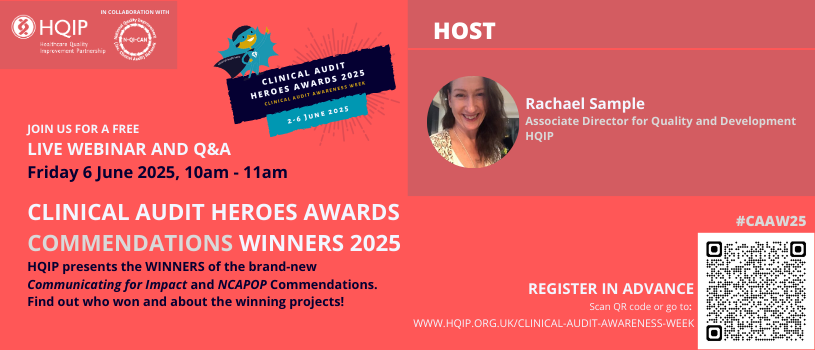
Friday 6 June 2025 | 10:00am–11:00am | Online via Microsoft Teams (pre-registration is required)
HQIP is delighted to invite you to attend our webinar for the Clinical Audit Heroes Awards 2025 – Commendations winners presentation. This live online event will introduce the Clinical Audit Heroes Awards 2025 Commendations winners — a highlight of Clinical Audit Awareness Week 2025 (#CAAW25). Join us as we celebrate excellence and announce the recipients of the brand-new commendations introduced this year!
Hosted by HQIP’s Rachael Sample, the session will showcase the best in national clinical audit practice and the teams and individuals who are driving change through data and communication. Standout projects will be recognised in the following categories:
NCAPOP Commendation – Celebrating projects that use National Clinical Audit Patient Outcomes Programme (NCAPOP) data to drive healthcare improvements
Communicating for Impact Commendation – Recognising excellence in effectively communicating project impact
The winners will present their projects and offer practical insights, key lessons learned, and inspiration to help you unlock the full potential of clinical audit in your own setting. As an attendee, you will:
Celebrate with the Commendations winners
Take away ideas for using data to influence change in your own organisation
Connect with a community committed to raising the bar for quality improvement in healthcare.
Whether you work in clinical audit, quality improvement, commissioning, policy, or patient engagement—this event is a must-attend for anyone passionate about improving healthcare through data and effective impact communication.
Register today
This is a FREE webinar, but advance registration is required.Register here to secure your place. We look forward to seeing you on Friday 6 June! Take a look at all of the exciting events planned 2-6 June 2025, and sign up here.
Data relating to maternity and perinatal care has been published on HQIP's benchmarking site, NCAB.
Latest news: May 2025 eBulletin
29 May 2025
May’s edition of HQIP’s eBulletin is available now. It features the most recent clinical audit and quality improvement updates, including:
Latest report
Clinical Audit Awareness Week 2025 – what’s on
Clinical Audit Heroes Awards 2025
HQIP wins Best Procurement Delivery at the GO Awards
Article – Untapped potential in NHS EPRs
Meet our team on stand E2 at NHS ConfedExpo!
Job opportunity – Associate Director
Non-Executive Trustee posts – last chance to apply!
Read the eBulletin here.
Don’t forget to sign up: Keep up to date with our latest news, events and work programmes by subscribing to our mailing list today. You can also follow us on LinkedIn and X: @HQIP
Data relating to maternity and perinatal care has been published on HQIP's benchmarking site, NCAB.
HQIP wins Best Procurement Delivery Award at the Go Awards
22 May 2025
Healthcare Quality Improvement Partnership (HQIP) is delighted to have won the Best Procurement Delivery Award at the UK National Go Awards 2025.
The awards ceremony celebrates the very best procurement achievements from across the UK’s public, private and third sector organisations. Our Best Procurement Delivery nomination focused on the creation of the National Cancer Audit Collaborating Centre (NATCAN) to host all NHS national cancer audits within the National Clinical Audit and Patient Outcomes Programme (NCAPOP). HQIP proposed an innovative umbrella approach to tendering, rather than commissioning individual projects.
NATCAN has made excellent progress since the start of contract. It places particular emphasis on patient engagement, with a patient and public involvement forum in place for each of the audits. Patients are contributing to the development of the work right from the start and are involved in the co-creation of outputs specifically designed to be public-facing and patient-friendly.
“I am beyond delighted for the HQIP team for winning this award. Only 2.5 years into the contract, NATCAN is already exceeding expectations. The Centre has been established as a centre of clinical, data science, methodological, and epidemiological expertise. The data now available is enabling the NHS to identify and address areas of variation in patient care. It’s great to see HQIP recognised and rewarded for the work that we do, with this award demonstrating our commitment to delivering better outcomes for patients.” Judith Hughes, HQIP Associate Director of Procurement
As well as winning the Best Procurement Delivery Award, HQIP was a finalist in two other categories:
Jon Williams, Senior Procurement Manager at HQIP, was a finalist in the Next Generation award category. Jon’s nomination recognised the tenacity and innovation that he has brought to his role since joining the organisation in 2021, and his commitment to social value.
The Best Procurement Team nomination recognised HQIP’s unique approach to value-based procurement, combining expertise in procurement, patient engagement, and quality improvement. It also notes the support that HQIP’s expert procurement team offer to other organisations, helping them to improve the value and outcomes of their procurement.
Our specialist healthcare procurement team provide:
Expert consultancy and bespoke training to embed quality, value, and patient voice into procurement
Flexible resourcing, from needs definition to contract award
Stakeholder, patient, and supplier engagement to shape procurement strategies and improve outcomes
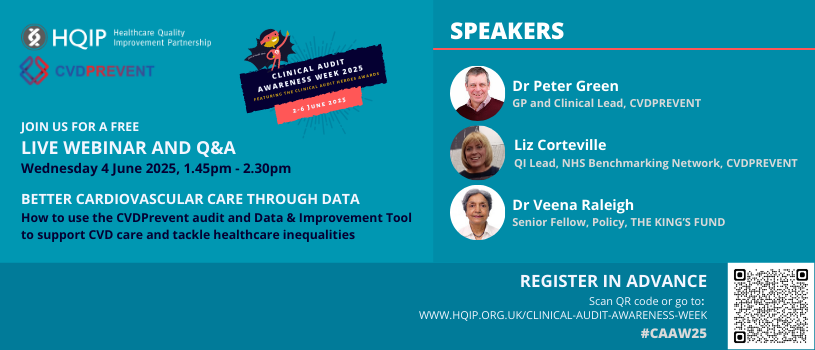
The webinar, which is hosted by HQIP and part of Clinical Audit Awareness Week 2025, will focus on using data to transform cardiovascular disease (CVD) care and tackle healthcare inequalities, and will showcase how the CVDPREVENT audit and the Data & Improvement Tool can help healthcare professionals make informed, equity-driven improvements in CVD care.
Panel experts:
Dr Peter Green, GP and Clinical Lead for CVDPREVENT
Liz Corteville, Quality Improvement Lead at CVDPREVENT
Dr Veena Raleigh, Senior Fellow in Policy at The King’s Fund
Don’t miss this opportunity to gain insights from experts and join the conversation on transforming care through better use of data.
Register today
This is a free, live webinar, but advance registration advance is required. Register here to secure your place. We look forward to seeing you on Wednesday 4 June! Also, take a look at all of the exciting events and activities planned Clinical Audit Awareness Week (2-6 June 2025), and sign up here.
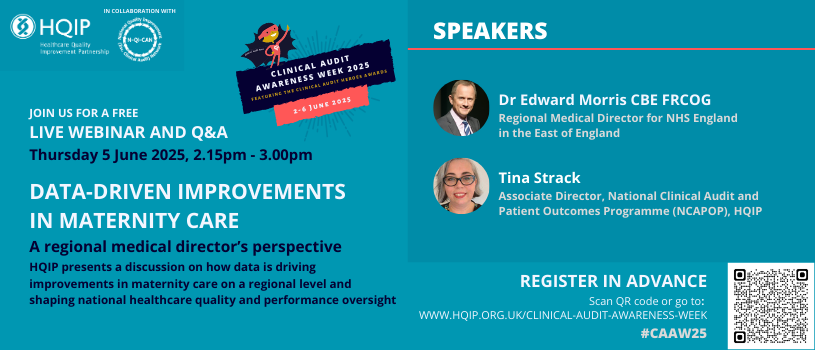
Join NHS England’s Dr Edward Morris CBE FRCOG, Regional Medical Director and Chief Clinical Information Officer, and HQIP’s Tina Strack, Associate Director at the National Clinical Audit and Patient Outcomes Programme (NCAPOP) to learn how data is transforming maternity care at a regional level. As Chair of the National Quality, Surveillance and Performance Committee, Edward will share insights into how data is shaping national strategies to enhance healthcare quality and performance.
Why attend?
Learn how data is being used to drive clinical quality and patient outcomes in maternity care at a regional level.
Gain insight from senior leaders at NHS England and HQIP.
This event is ideal for maternity clinicians, service managers, data analysts, commissioners, and patient advocates.
Register today
This is a free webinar, but advance registration is essential. Register here to secure your place. We look forward to seeing you on Thursday 5 June! Take a look at all of the exciting events planned during #CAAW25 (2-6 June 2025), and sign up here.
Data relating to maternity and perinatal care has been published on HQIP's benchmarking site, NCAB.
CANCELLED NHS IMPACT #CAAW25 webinar
18 May 2025
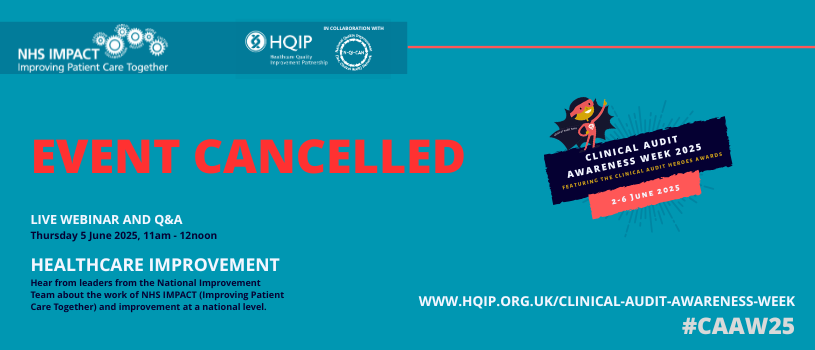
CANCELLED – Due to unforeseen circumstances, this event has been cancelled. All registrants have been notified.
NHS IMPACT and HQIP live webinar and Q&A on healthcare improvement, originally planned on 5 June 2025 as part of Clinical Audit Awareness Week 2025 (#CAAW25).
More from #CAAW25
Take a look at all of the other exciting events and activities planned for 2-6 June 2025, and sign up here.
Data relating to maternity and perinatal care has been published on HQIP's benchmarking site, NCAB.
The untapped potential in NHS EPRs got me thinking about the time we cut preventable VTE by 48%
13 May 2025
Turning clinical audit into action
By Clare Fountain
The Health Foundation recently released a timely piece on electronic patient records (EPRs) and NHS strategy. It makes a strong case for the potential of EPRs to deliver safer, more efficient care – if we can get the design, integration, and usage right.
Yet as the report makes clear, potential doesn’t equal impact. We still face major gaps in how data is shared and used at the front line.
Data needs to flow to those who need it, in real time, to support better decision making.
This got me reflecting on a project I led over a decade ago, during a sabbatical from the NHS at Baylor Health System in Texas (now Baylor Scott & White) in 2009-11. It was a different context, but the principles – especially around standardisation, reliability, and frontline usability – feel more relevant than ever.
Real-time guidance, not retrospective learning
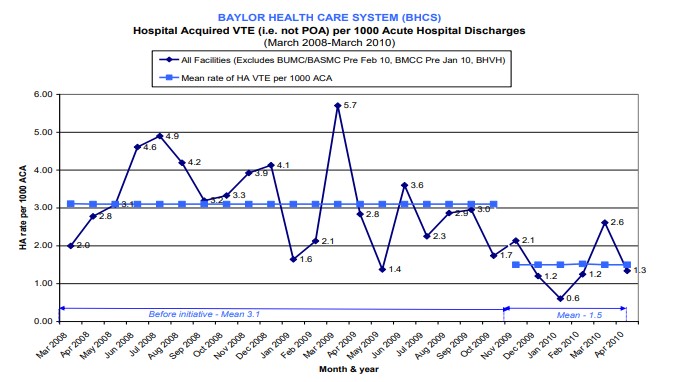
At Baylor, we set out to tackle the preventable harm caused by hospital-acquired venous thromboembolism (VTE). A familiar NHS initiative.
Instead of relying on static protocols or disconnected audits, we embedded a standardised, evidence-based VTE order set directly into the EPR – as a decision support tool. I worked with clinicians to turn US VTE guidelines into an algorithm, coded into the EPR. It was tailored in real time to each patient, triggered by their risk factors at admission.
The headlines:
The process was clinically-led, mandated by all 13 hospital Clinical Directors, and focused on process reliability, not just education.
We didn’t ask clinicians to remember the guidelines, we built them into the workflow – and so made it easier to do the right thing than not.
At the same time as standardising the default, clinicians could use their clinical experience to deviate, and document why.
The result? A 48% drop in hospital-acquired VTE
The impact of the initiative, documented in my MSc dissertation, was clear:
VTE prophylaxis prescribing became more consistent and appropriate (often chemical and physical prophylaxis combined)
Real-time data improved adherence and feedback loops
Hospital-acquired VTE fell by 48% in just six months
These results weren’t achieved through heroic effort or top-down compliance. They came from:
Standardising what we knew worked
Making it visible and useable at the point of care
Focusing on system reliability, not individual blame
It aligned well with improvement theories I’d studied, including Juran and Deming’s concepts of ‘designing in quality’ – standardise until you need to customise – and Nolan’s framework of reliability in healthcare systems.
When we moved beyond hoping clinicians would remember the latest, changing guidance and started designing for consistent performance, things changed.
The opportunity for the NHS
We’re seeing promising signs of clinical decision support in UK EPR systems – particularly in primary care, where tools like EMIS and SystmOne routinely include alerts, risk scores, and prescribing prompts. But secondary care adoption is more uneven.
While some trusts using systems like Cerner or EPIC are embedding real-time decision support, others are still grappling with fragmented workflows and inconsistent functionality. That’s a major opportunity: to standardise not just data collection, but decision support – and to design it into clinician workflows, just as we did at Baylor.
To make real-time decision support work reliably at scale, we need agreed definitions of what ‘good care’ looks like in each clinical scenario. Ideally these should be evidence-based, with clinician and patient input, regularly updated, and already widely recognised.
That’s where existing work done in support of national clinical audits could fit in.
The NCAPOP programme, commissioned by HQIP, already provides a rich set of measures grounded in clinical and patient consensus, often aligned with NICE guidelines. These aren’t just useful for retrospective performance reports – they could also be used to power real-time prompts and care pathways within EPRs.
Given that we already have these measures across a huge number of specialties, are we maximising their benefit? Could we move from collecting data retrospectively to using these same measures to support care as it happens?
Decision support tools may improve consistency and outcome of direct care, as my project showed. And the digital data they generate in doing so is then ripe for secondary use, such as comparative national clinical audit, and also for real time outcomes monitoring.
I’ve seen what’s possible when evidence is built into systems, not just policies. When standardisation reduces variation where we don’t need it, we free up doctors’ cognitive load to focus on clinical judgement for the complex and nuanced decisions where it matters most.
In the NHS today, we are reaching 100% EHR coverage. But reading the Health Foundation report made me wonder:
How do we enable this kind of intelligent, real-time support at scale across a health system with multiple EPR providers, local variations, and varied digital maturity?
Does AI bring new opportunity for real-time clinical decision support using national clinical audit measures?
I hope before too many more years pass that we will see for every national clinical audit:
Data captured once, in real time at the point of care
Data collated nationally, for benchmarking and equity analysis
Data interrogated locally, for variation and improvement
Measures used to support evidence-based care now, with real-time decision support
This isn’t about replacing audit. It’s about realising the full value of the work already being done – turning measures into daily decision support, in addition to retrospective systemic learning.
A role for HQIP and our partners
HQIP has been at the forefront of clinical audit for over 15 years. From the outset, we have championed the use of digital, point-of-care data as the gold standard for audit. But we now need to go further.
We are proactively engaging with EPR vendors to explore how audit measures could be integrated into their platforms. We want to work with clinical leaders, digital teams, and patient representatives to co-design decision support tools rooted in the very measures that national audits already use.
If we succeed, we can reduce unwarranted variation, drive up the quality of care, and generate real-time data that serves both direct care and systemic learning.
The Health Foundation’s call to action is clear. Real-time data is only valuable if it informs real-time decisions.
We already have the measures. We are rapidly acquiring the infrastructure. The missing link is intelligent design and shared commitment.
I have seen what is possible when evidence is embedded into systems, not policies. When we stop hoping clinicians will remember the latest guidance and start building reliability into the workflow, the results speak for themselves.
The question is no longer whether we can do this. It is whether we are willing to.
A new report from the Health Foundation’s NHS Productivity Commission calls for a greater focus...
New resource published in May 2025
8 May 2025
We are pleased to announce that the following new resource from HQIP-commissioned audits and programmes has been published, and includes an infographic, data and recommendations to support quality improvement:
UK Perinatal Mortality Surveillance 2023 report, Maternal, Newborn and Infant Clinical Outcome Review Programme (MBRRACE-UK)
This MBRRACE-UK Perinatal Mortality Surveillance report focuses on UK perinatal deaths of babies born in 2023. It finds that extended perinatal mortality rates across the UK continued to decline in 2023 (primarily driven by a reduction in stillbirths), highlighting continued progress in reducing perinatal mortality. However, it also underscores the need for targeted interventions to address disparities by socioeconomic status, ethnicity, and gestational age.
Read this report in full.
All reports: All HQIP-commissioned reports can be accessed via our dedicated reports webpage.
Stay up to date: Join our mailing list to receive notifications when new reports are published.
Data relating to maternity and perinatal care has been published on HQIP's benchmarking site, NCAB.
REGISTER NOW for Clinical Audit Awareness Week 2025 live webinars and Q&As
7 May 2025
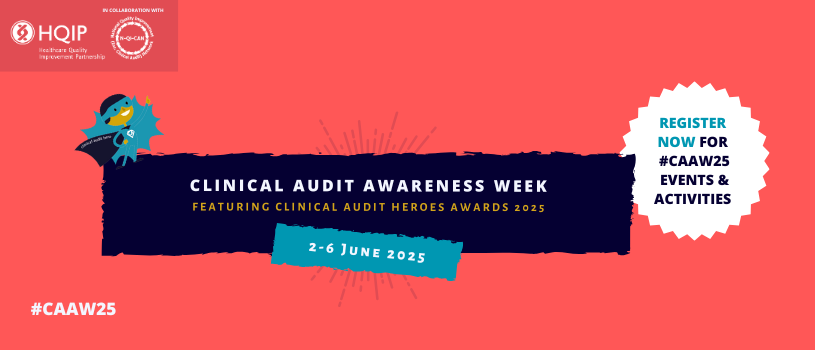
Clinical Audit Awareness Week 2025 (#CAAW25) is just around the corner! You’re invited to take part in an exciting, jam-packed agenda of events and activities from 2–6 June 2025, run by HQIP in collaboration with N-QI-CAN. All sessions are completely FREE, though please remember that advance registration is required for live webinars. Don’t miss this opportunity to engage, learn, and connect throughout the week!
LIVE WEBINARS:
Wednesday 4 June 2025, 1.45pm–2.30pm: Webinar and Q&A: Better cardiovascular care through data
With CVDPREVENT’s Dr. Peter Green, GP and Clinical Lead; Liz Corteville, QI Lead, NHS Benchmarking Network; and Dr Veena Raleigh, Senior Fellow, Policy, The King’s Fund (use this link to REGISTER IN ADVANCE)
Thursday 5 June 2025, 11am–12 noon: Webinar and Q&A: NHS IMPACT & HQIP’sHealthcare Improvement
Featuring NHS IMPACT’s Jody O’Brien, Collaboration and Partnerships Lead; and Amy Hodgkinson, Head of Deployment (use this link to REGISTER IN ADVANCE)
Thursday 5 June 2025, 2.15pm–3.00pm: Webinar and Q&A: Data-driven improvements in maternity care: a regional medical director’s perspective
With NHS England’s Dr Edward Morris CBE FRCOG & HQIP Associate Director Tina Strack (use this link to REGISTER IN ADVANCE)
Friday 6 June 2025, 10am–11am: Webinar and Q&A: Clinical Audit Heroes Commendation Awards 2025
With presentations by winning projects that 1) use NCAPOP data to drive healthcare improvements, and 2) communicate effectively (use this link to REGISTER IN ADVANCE)
OTHER ACTIVITIES & EVENTS DURING #CAAW25:
Don’t forget to register for the daily online Lunch & Learn events happening throughout #CAAW25 (2-6 June) and explore our resources page for other activities. Highlights include a new video on improving sepsis care, a live Q&A on HQIP’s X on balancing learning and patient safety, real stories of Patient & Public Involvement, a new podcast on tackling healthcare inequalities through clinical audit, and more!
Stay up to date on activities taking place during #CAAW25 by following HQIP and N-QI-CAN on X, and HQIP’s LinkedIn, or going to the dedicated #CAAW25 main webpage.
Data relating to maternity and perinatal care has been published on HQIP's benchmarking site, NCAB.
Join HQIP as a Non-Executive Trustee
7 May 2025
Closing Date for Applications: 30 May 2025, 17:00
Healthcare Quality Improvement Partnership (HQIP) is pleased to announce the recruitment of three new Non-Executive Trustees to join its Board. These voluntary positions offer a chance to help shape the national agenda for healthcare quality improvement. All of the opportunities are primarily remote, with around three meetings per year held in London.
We are currently seeking experienced and passionate leaders for the following trustee roles:
1. Senior Clinical Leader
We are looking for a senior NHS clinical leader – ideally a current or recent Medical Director or Deputy Medical Director – with a strong track record in improving quality, safety, and outcomes. This is an opportunity to bring clinical leadership to the forefront of national healthcare improvement efforts.
Find full details of the role and how to apply here.
2. Communications and Marketing Leader
If you are a senior professional in communications, marketing, or public affairs and understand the power of strategic messaging and storytelling, this role offers the chance to amplify HQIP’s mission on a national stage. Your expertise will help drive engagement and support meaningful change in healthcare quality.
Find full details of the role and how to apply here.
3. Integrated Care Board (ICB) Leader
We are seeking a senior executive within an Integrated Care Board who is committed to data-driven improvement and system transformation. This trustee role provides a platform to ensure that national audit intelligence supports integrated care priorities and leads to tangible outcomes across the NHS.
Find full details of the role and how to apply here.









 These results weren’t achieved through heroic effort or top-down compliance. They came from: