Job opportunity

28 Jun 2024

Marketing lead (12-month contract)

Closing date for applications: 7 Jul 2024 Location: Remote home working with occasional travel (expenses covered) Salary: £43-50k per annum, pro rata for part-time hours Details: 18-25 hours per week (flexible hours available)
Are you an experienced communications and/or marketing professional with a desire to craft impactful marketing strategies and materials? Do you have NHS experience and/or a good understanding of the health sector? We are seeking someone who has:
  • Significant senior experience in marketing roles, with a proven track record of successful campaigns and strategies
  • An understanding of the NHS and the UK healthcare sector
  • Skills in drafting and implementing a marketing strategy
  • Skills in the production of high-quality marketing / communications materials (ideally graphic design skills to enable production in-house).
Further information                                                  Find out more, including a job description and details of how to apply: www.hqip.org.uk/work-for-us/marketing-lead-12-month-contract. CVs sent without a completed application form will not be accepted.

Sustainability Hero award announced

28 Jun 2024

The winners of the Clinical Audit Awareness Week 2024 Sustainability Hero award have been announced today; congratulations to: WINNER: Zahra Shehabi, Dentistry, Barts Health NHS Trust The award recognises a project that aims to meet the NHS target of net zero by 2040/5 and sustainability awareness in dentistry, which is typically resource intensive. The judges felt that this was a truly descriptive, extensive project with multiple outputs that were extremely well summarised. There was a sound evidence base and clear methodology, setting out the journey from collecting data to making improvements. The team (pictured below) had this to say on their award win: “Everyone in the team was delighted to have won this award. The most rewarding thing about the sustainability quality improvement project has been working with different people from different specialities and levels of experience, and empowering others to get involved and make change happen. This collective effort was driven by our passion to ensure we provide dentistry without harm and reduce our contribution to the climate crisis!” COMMENDED: Adam Jones and Hiba Al-Diwani, University of Leeds / Leeds Teaching Hospitals Trust Recognised for their project which aims to reduce the climate impact of conscious sedation services provided by the Leeds Dental Institute. The judges commended this “excellent” project for identifying a need and then designing a clear project to address that need COMMENDED: Simon Tso and the Dermatology team, South Warwickshire University NHS Foundation Trust The group was recognised for a project that is designed to support the meeting of British Society for Dermatological Surgery (BSDS) guidance on environmentally sustainable skin surgery. The judges were impressed with the fact that it looked at ‘sustainability’ from multiple angles, as well as the fact that they had a clear project design and focus to their work. Further information about the awards: Clinical Audit Heroes awards.
The Clinical Audit Heroes Awards (part of Clinical Audit Awareness Week)

The Sustainability Hero award is one of five categories in this year’s Clinical Audit Heroes Awards. The winners of each award are announced at a series of daily Lunch & Learn events, hosted by N-QI-CAN, on each of the award topics from 24-28 June 2024. Details of these events (and recordings for those who wish to listen again, once they have taken place) – in addition to news of all the winners and a range of events and activities – can be found on the Clinical Audit Awareness Week webpage. And don’t forget to join in the fun by sharing online, using #CAAW24!

#CAAW24: Sustainable Change resources published

28 Jun 2024

As part of Clinical Audit Awareness Week 2024, which is designed to share the value of clinical audit and quality improvement in enhancing patient outcomes, we are pleased to share a range of valuable resources from HQIP, the clinical audit community, and the broader healthcare sector, focusing on Sustainable Change in Healthcare:
  • Embedding sustainability into healthcare quality improvement is an approach to improve health outcomes whilst minimising the environmental, social and financial impacts. Sustainable quality improvement highlights potential waste in resources and any health and social inequalities. NHS trusts are assessed by the Care Quality Commission on their environmental sustainability. Tools are available on the Institute for Healthcare Improvement website that can assist healthcare organisations to highlight areas of opportunity in lowering their carbon emissions from care delivery.
In addition, the following resources from HQIP are also useful:
  • Article: In IN FOR THE LONG HAUL, Vicky Patel, Chair of National Quality Improvement incl. Clinical Audit Network (N-QI-CAN), explores how to take an effective and sustainable approach to clinical audit – Cornerstone2024.pdf (article on pages 28-31).
  • Case study on a 2022 Clinical Audit Awareness Week winning project from the Sustainable Respiratory Care Audit Team at Newcastle Hospitals NHS Foundation Trust on their project designed to reduce the environmental impacts of healthcare – Sustainable Respiratory Care Audit 2022 case study.
Note that this list is intended to signpost to relevant useful resources but, for those published outside of HQIP, we are unable to take responsibility for them – please contact the provider direct if you have any questions.

Influencing Change Hero award announced

27 Jun 2024

The winners of the Clinical Audit Awareness Week 2024 Influencing Change Hero award have been announced today; congratulations to: JOINT WINNER: Diabetic Foot Infection Team, Ashford and St Peter’s Hospitals The team was recognised for their project which aims to improve outcomes for diabetic foot infection patients treated with outpatient parenteral antibiotics. The judges found that it was well structured, with multiple data measures, and improvement clearly demonstrated. Of particular note, were the interventions that had quality improvement ‘built-into’ them, as well as the extensive background research undertaken to identify best-practice. Case study here. JOINT WINNER: Infection Prevention & Management Team, University Hospitals NHS Plymouth Trust Recognised for their project which aims to improve urinary catheter care and management. The judges felt this was a clearly structured clinical audit with real changes in practice including an electronic form and guidance at the point of care. Clear improvement was evidenced, with reduced catheter use and reduced avoidable infections. Further information about the awards: Clinical Audit Heroes awards.

The Clinical Audit Heroes Awards (part of Clinical Audit Awareness Week)

The Influencing Change Hero award is one of five categories in this year’s Clinical Audit Heroes Awards. The winners of each award are announced at a series of daily Lunch & Learn events, hosted by N-QI-CAN, on each of the award topics from 24-28 June 2024. Details of these events (and recordings for those who wish to listen again, once they have taken place) – in addition to news of all the winners and a range of other events and activities – can be found on the Clinical Audit Awareness Week webpage. And don’t forget to join in the fun by sharing online, using #CAAW24!

#CAAW24: Influencing Change resources published

27 Jun 2024

As part of Clinical Audit Awareness Week 2024, which aims to highlight the value of clinical audit and quality improvement in enhancing patient outcomes, we are excited to share a range of valuable resources from HQIP, the clinical audit community, and the broader healthcare sector, focusing on Influencing Change and Improvement in Healthcare:
  • Clinical audit helps identify areas for improvement in patient care and outcomes by comparing current clinical practice to evidenced based standards. The National Institute for Health and Care Excellence (NICE) are experts in evidence-based best practice who consider both clinical effectiveness and value for money when evaluating new health technologies and producing guidance for healthcare practitioners to deliver the best care.
  • All NCAPOP projects aim to have a positive impact on patient care and the national, system, local and public key impacts are reported on each year. The 2024, 2023, 2022, 2021, 2020 and 2019 compendium of NCAPOP impact reports can all be found here.
  • To aid local quality improvement (QI), HQIP have reshaped NCAPOP outputs to include tools to support this at a trust level. A QI guide has also been created to signpost healthcare services to a broad range of QI tools and advice on how to implement them. Further to this, is an information governance in local quality improvement guide.
  • Another NHS England programme designed to improve patient care is Getting It Right First Time (GIRFT). By undertaking an in-depth review of specialities along with a broad data gathering and analysis exercise, they are able to highlight both underperformance and excellence of individual trusts. The GIRFT team then supports trusts through an implementation phase of report recommendations that tackle unwarranted variation and lead to improved productivity, efficiency, and capacity.
In addition, the following resources from HQIP are also useful:
  • Article: In Avoiding ‘lost in translation’, Jill Stoddart, Director of Operations (National Clinical Audit and Patient Outcome Programme) at HQIP, discusses how you can use national healthcare data to support meaningful change – Cornerstone2024.pdf (article on pages 14-18).
  • Case study on a 2023 Clinical Audit Awareness Week winning project from Cambridge University Hospitals NHS Foundation Trust on using data from the National Clinical Audit Benchmarking (NCAB) site to provide a single place to access and evaluate national audit and registry data 24/7 – Influencing Change CUH 2023 case study.
  • Case study on a 2023 Clinical Audit Awareness Week winning project from Cambridgeshire Community Services on their Peer-to-Peer clinical record keeping auditing programme – Influencing Change CCS 2023 case study.
Note that this list is intended to signpost to relevant useful resources but, for those published outside of HQIP, we are unable to take responsibility for them – please contact the provider direct if you have any questions.

Healthcare Inequalities Hero award announced

26 Jun 2024

The winners of the Clinical Audit Awareness Week 2024 Healthcare Inequalities Hero award have been announced today; congratulations to: WINNER: Roger Blake and Stephanie Baker, Learning Disability Team, East Suffolk and North Essex Foundation Trust Awarded for their project which aims to raise awareness of constipation in people with learning disabilities and supports communication around this important issue, which can lead to hospitalisation and even death. The judges were impressed with the co-production approach taken by the team as well as the improvements demonstrated. The team had this to say on their award win: “We are delighted to receive a Clinical Audit Heroes Award and for the recognition given to this important subject. We will continue with our audit/ quality improvement journey until we can be re- assured that patients with a learning disability who come into contact with ESNEFT have medical input for constipation” COMMENDED: Lorna Dawson and the Health Literacy Team, South Tyneside and Sunderland NHS Foundation Trust Recognised for their project which improves the accessibility of health information and helps to overcome inequalities caused by health literacy, which can create a barrier to people engaging in their care. The judges were impressed with this project’s approach to collaboration and inclusivity, as well as its innovation. COMMENDED: Health For Homeless Team, Cornwall Partnership NHS Foundation Trust The team was recognised for their project which aims to improve outcomes for those experiencing homelessness by implementing a countywide Multi Agency Pop Up (MAPU) mobile outreach programme. The judges were impressed with the holistic approach taken, supporting both the mental and physical health of patients. Further information about the awards: Clinical Audit Heroes awards.
Clinical Audit Awareness Week

The Healthcare Inequalities Hero award is one of five categories in this year’s Clinical Audit Heroes Awards. The winners of each award are announced at a series of daily Lunch & Learn events, hosted by N-QI-CAN, on each of the award topics from 24-28 June 2024. Details of these events (and recordings for those who wish to listen again, once they have taken place) – in addition to news of all the winners and a range of other events and activities – can be found on the Clinical Audit Awareness Week webpage. And don’t forget to join in the fun by sharing online, using #CAAW24!

#CAAW24: Healthcare Inequalities resources published

26 Jun 2024

As part of Clinical Audit Awareness Week 2024, which aims to highlight the value of clinical audit and quality improvement in enhancing patient outcomes, we are pleased to share a range of useful resources from HQIP, the clinical audit community, and the broader healthcare sector focusing on Healthcare Inequalities: Health inequalities are known to cause unjust and preventable differences in health outcomes so it is essential that health services address the needs of these underserved communities. Accurate and reliable data is required in order to identify barriers in current practice so it is essential that ethnicity and deprivation are included in National Clinical Audit and Patient Outcomes Programme (NCAPOP) specifications. For more information on this, please see Improving Health Inequality Data in the National Clinical Audit and Patient Outcomes Programme and the accompanying infographic. The following NCAPOP programmes have reported on healthcare inequalities:
  • National Lung Cancer Audit – State of the Nation report – There was a gradient in the proportion of patients with lung cancer who came from the most deprived to the least deprived areas (1=Most: 25.8%, 3=19.9%, 5=Least: 15.1%).
  • National Paediatric Diabetes Audit – Report on Care and Outcomes – Despite improvements in outcomes and use of technologies across different ethnicities and areas of deprivation, inequalities remain evident. In terms of rtCGM use, the inequality gap by deprivation has reduced however the difference in use between Black and White children with Type 1 diabetes has widened from 8.6% in 2021/22 to 14% in 2022/23.
  • Fracture Liaison Service Database – Annual Report – Indices of multiple deprivation (IMD) bring together 37 separate indicators that each reflect a different aspect of deprivation experienced by individuals living in an area. IMD is used to identify those living in the most and least deprived areas. The most deprived IMD, in line with Core20PLUS5, were less likely to have a timely bone health assessment (57% vs 66%) or DXA (25% vs 33%), lower falls assessment (52% vs 60%), recommended bone therapy (48% vs 57%) and follow up at 16 weeks (38% vs 46%).
  • Mothers and Babies: Reducing Risk through Audits and Confidential Enquiries across the UK – A comparison of the care of Black and White women who have experienced a stillbirth or neonatal death – Major or significant issues were found with antenatal care provision for 83% of black women compared with 69% of white women. 33% of black women and 54% of white women had major or significant care issues during postnatal and bereavement care. 67% of black mothers and babies and 46% of white mothers and babies had major or significant issues identified with respect to pathology. 75% of black parents and 66% of white parents had major or significant issues identified at follow-up or during review of their care and that of their babies.
For Clinical Audit Awareness Week 2024, HQIP is releasing a new blog on health inequalities. In Yes We Can, Professor Danny Keenan, Medical Director at HQIP, explores the importance of national clinical audit in addressing health inequalities: www.hqip.org.uk/blog. In addition, the following resources from HQIP are also useful:
  • Article: In Mind the (health) gap, Dr Josie O’Heney, 2021/22 National Medical Director’s Clinical Fellow at HQIP, discusses the role of data and quality improvement (QI) in addressing health inequalities – Cornerstone2023.pdf (article on pages 14&15).
  • Case study on a 2023 Clinical Audit Awareness Week commended project from Sandwell & West Birmingham NHS Trust on an audit of homeless patients – a population which has high rates of substance and alcohol dependence, hepatitis C and multiple morbidity, compared to the general population – Health Inequalities SWB 2023 case study.
  • Report: In Spotlight on the Early Years from HQIP, we aim to identify cross-cutting lessons relating to early years healthcare with a focus on health inequalities and variation in care – Spotlight on the Early Years – HQIP.
Note that this list is intended to signpost to relevant useful resources but, for those published outside of HQIP, we are unable to take responsibility for them – please contact the provider direct if you have any questions.

Patient and Public Involvement Hero award announced

25 Jun 2024

The winners of the Clinical Audit Awareness Week 2024 Patient and Public Involvement Hero award have been announced today; congratulations to: JOINT WINNER: Rebecca Goadsby, Dementia Liaison Nurse, Northampton General Hospital NHS Trust Awarded for patient engagement activities which the judges called a “top priority” project that demonstrated genuine impact, with carers involved continuously, including providing input into reports, focus groups and webinars. JOINT WINNER: Gemma Harris, People Participation Co-ordinator (PPC), Norfolk & Suffolk Foundation Trust  Recognised for work to increase lived experience in quality improvement projects, emphasising co-production and improving access to – and building – improvement skills. The judges felt that this project demonstrated a variety of engagement methods and, in particular, applauded an objective to train patients and carers to become more involved. COMMENDED: Patient and Carer Advisory Group, The Royal Marsden NHS Foundation Trust The group was recognised for their patient/carer-driven project to help patients manage their cancer diagnosis and treatment and improve their quality of life. The judges felt that this was a real-world project based on real-world need. With a large number of people surveyed, they were impressed with the findings, which were translated into accessible outcomes such as information screens to signpost to key information. COMMENDED: Jessica Moss, Quality Improvement Lead, National Audit of Care at the End of Life (NACEL) Recognised for a project which directly sought the views and experiences of bereaved people in the design of an audit tool. The judges were impressed, not only with the support available to patients and carers, but also the on-going process of feedback. There was involvement from the very beginning, and this was clear from the impact demonstrated. COMMENDED: Sandra Willis, Clinical Specialist Paediatric Occupational Therapist, Northumbria Healthcare NHS Foundation Trust Recognised for patient engagement in the development of a website to provide universal support and advice for parents, carers, children and young people, and professionals. The judges applauded the many different methods of engagement utilised, stating that it is an innovative project that is hugely beneficial to a large number of people. Further information about the awards: Clinical Audit Heroes awards.
The Clinical Audit Heroes Awards (part of Clinical Audit Awareness Week)

The Patient and Public Involvement Hero award is one of five categories in this year’s Clinical Audit Heroes Awards. The winners of each award are announced at a series of daily Lunch & Learn events, hosted by N-QI-CAN, on each of the award topics from 24-28 June 2024. Details of these events (and recordings for those who wish to listen again, once they have taken place) – in addition to news of all the winners and range of other events and activities – can be found on the Clinical Audit Awareness Week webpage. And don’t forget to join in the fun by sharing online, using #CAAW24!

#CAAW24: Patient and Public Involvement resources published

25 Jun 2024

As part of Clinical Audit Awareness Week 2024, which aims to highlight the value of clinical audit and quality improvement in enhancing patient outcomes, we are excited to share a range of valuable resources from HQIP, the clinical audit community, and the broader healthcare sector, focusing on Patient and Public Engagement:
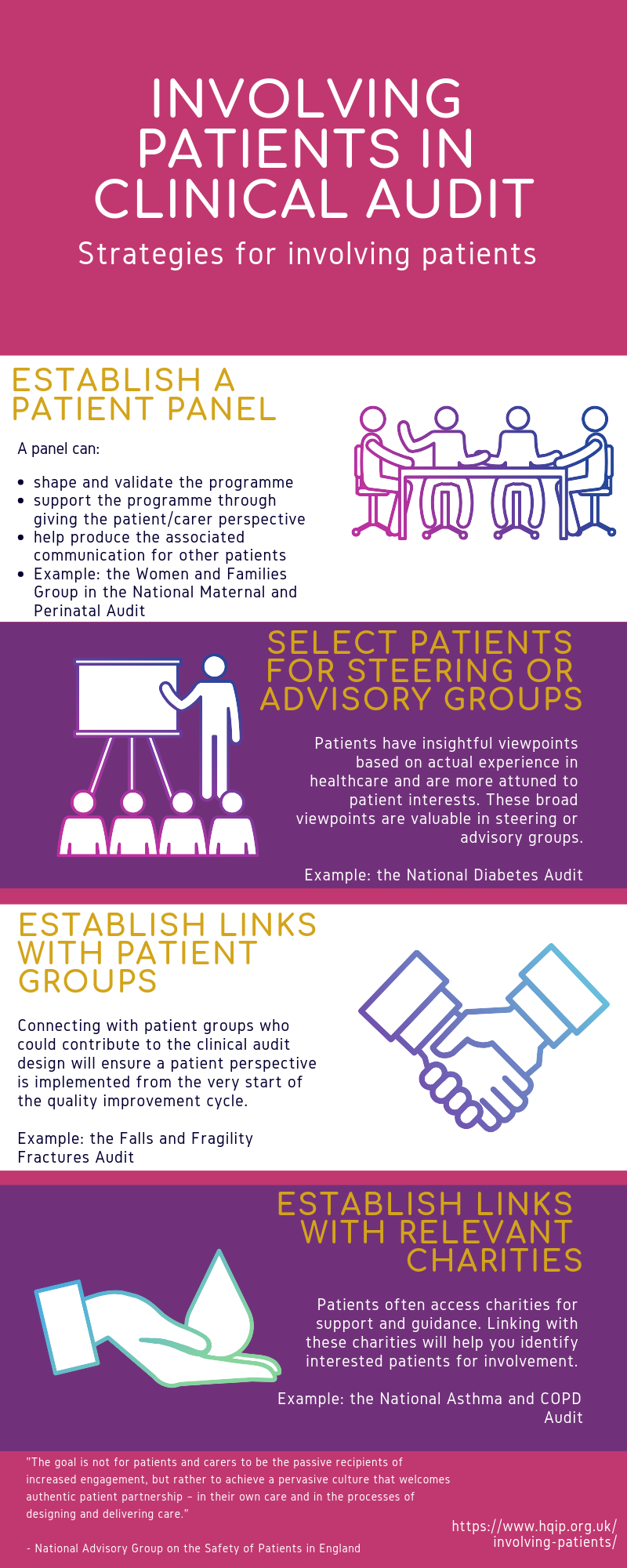
  • Involving patients and carers is at the heart of everything we do at HQIP. This includes commissioning, resource development and governance structures. There are many ways to involve patients in clinical audit and we have a range of case studies which demonstrate the effectiveness of this.
  • Prior to the finalisation of topic specification, patient and carer feedback is collated from a range of engagement activities such as focus groups, questionnaires and representation at specification development meetings. The National Maternity and Perinatal Audit, Sentinel Stroke National Audit and the National Vascular Registry are just a few examples of this.
  • Once the specification is finalised, the topic is put out to tender and 10% of the final score relates specifically to patient and public involvement (PPI).
  • A key area where patients and carers can contribute feedback is in the resources produced by each project. Infographics are regularly published alongside audit reports to highlight key findings and recommendations in lay terms. Some examples of this include the National Diabetes Audit – National Diabetes Footcare Audit, the National Paediatric Diabetes Audit and the Medical and Surgical Clinical Outcome Review Programme- Prison Healthcare.
  • If you have lived experience as a patient or carer and would like to be involved in an advisory capacity to help improve the quality of healthcare services, please join the HQIP Service User Network (SUN).
  • Article: In CONGRATULATIONS ON YOUR ENGAGEMENT!, Kim Rezel, Head of Patient and Carer Engagement at HQIP, discusses how can we involve patients to improve healthcare – Cornerstone2023.pdf (article on pages 18-21).
  • Article: In Patient and Public Engagement in Practice, we hear from two award-winning projects about how engaging patients and carers is a win-win for healthcare providers and patients alike – Cornerstone2024.pdf (article on pages 4-8).
Note that this list is intended to signpost to relevant useful resources but, for those published outside of HQIP, we are unable to take responsibility for them – please contact the provider direct if you have any questions.

Patient Safety Hero 2024 award announced

24 Jun 2024

The winners of the Clinical Audit Awareness Week 2024 Patient Safety Hero award have been announced today; congratulations to: WINNER: Parkinson’s Disease QIP Team, Northumbria Healthcare NHS Foundation Trust Awarded for their project, which takes a multi-disciplinary approach to support the delivery of a “gold-standard” of care for people with Parkinson’s Disease. They demonstrated both innovation and impact far beyond the boundaries of their organisation. With a focus on patient experience alongside effectiveness and safety, this project was praised for its multi-disciplinary approach and patient engagement (using visual display to communicate key messages). COMMENDED: Department of Gastroenterology, Sandwell West Birmingham NHS Trust The team was recognised for their project which aims to improve inpatient Parenteral Nutrition (PN) which carries a relatively high risk of line infection. The judges were impressed with the shared learning and evidence-informed approach taken, utilising data to build a case for dedicated resource for sustainability going forward. Further information about the awards: Clinical Audit Heroes awards.
Clinical Audit Awareness Week

The Patient Safety Hero award is one of five categories in this year’s Clinical Audit Heroes Awards. The winners of each award are announced at a series of daily Lunch & Learn events, hosted by N-QI-CAN, on each of the award topics from 24-28 June 2024. Details of these events (and recordings for those who wish to listen again, once they have taken place) – in addition to news of all the winners and a range of other events and activities – can be found on the Clinical Audit Awareness Week webpage. And don’t forget to join in the fun by sharing online, using #CAAW24!

#CAAW24: Patient Safety resources published

24 Jun 2024

As part of Clinical Audit Awareness Week 2024, designed to highlight the value of clinical audit and quality improvement in enhancing patient outcomes, we are pleased to share a range of valuable resources from HQIP, the clinical audit community, and the broader healthcare sector, focusing on Patient safety:
  • The Patient Safety Incident Response Framework (PSIRF) is a new approach to responding to patient safety incidents and a major step towards establishing a safety management system across the NHS. This is mandatory for services provided under the NHS Standard Contract including acute, ambulance, mental health, and community healthcare providers. To help organisations prepare transition to PSIRF, a preparation guide has been developed.
  • Case studies show the direct action taken in response to patient safety events recorded by organisations, staff and the public, and how their actions support the NHS to protect patients from harm. One example, from NHS England, of direct action is how the retained surgical instrumentation and complex procedures involving multiple teams and equipment lead to the development of NatSSIPs2.
  • National Safety Standards for Invasive Procedures (NatSSIPS) are intended to enable safe, reliable and efficient care to every patient having an invasive procedure. A NatSSIPS summary and infographic have also been developed to distribute within trusts. NatSSIPs now recommends that Standard Operating Procedures (SOPs) or Local Safety Standards for Invasive Procedures (LocSSIPs) be developed locally, based on NatSSIPs 2. Checklists are the recommended tool to support teams in following the NatSSIPs and LocSSIPs, and to support team behaviours. However, checklists alone are not a solution in themselves and are dependent on the system and culture in which they are used.
  • Article: In Safety in Numbers, Tina Strack, Associate Director for Quality and Development (NCAPOP) at HQIP, explores the importance of taking a holistic, evidence-based approach to patient safety – Cornerstone2023.pdf (article on pages 7-9).
  • Webinar: Patients and PSIRF: Changing culture (rcp.ac.uk) – in the webinar, experts from the Royal College of Physicians discuss how the patient safety incident response framework (PSIRF) is changing the culture amongst healthcare workers and what this means for individuals.
  • Guidance to support root-cause analysis (used in local patient safety investigation) can be found in A guide to quality improvement tools.
Note that this list is intended to signpost to relevant useful resources but, for those published outside of HQIP, we are unable to take responsibility for them – please contact the provider direct if you have any questions.

Blog: Yes we can

24 Jun 2024

The importance of national clinical audit in addressing health inequalities

Professor Danny Keenan, Medical Director, HQIP

We all know instinctively that health inequalities are complex. Why a person who lives in an affluent area, or is white, is likely to have better health outcomes than their more deprived, or non-white, counterpart (for example) is difficult to unpick. But unpick it, we must. However, in doing this, we are not faced with a blank sheet of paper. We have data, which can support a better understanding of the issues and help us to tailor solutions. And that’s where national clinical audit comes in. For HQIP, as commissioner of the National Clinical Audit and Patient Outcomes Programme (NCAPOP) on behalf of NHS England, we understand the potential value of this vast font of knowledge (the NCAPOP is the largest of its type in the UK) in addressing health inequalities. In November 2023, we published a report on Improving Health Inequality Data in the NCAPOP, to explore the barriers to health inequality data being routinely reported within the programme. Written by our then-Medical Director’s Fellow, Dr Alice Bradley, this report found significant variations in the reporting, analysis, and use of health inequality data among different audits. Now that a little time has passed since this report was published, I want to reflect again on its findings, to ensure that the important messages within are kept to the fore and, more importantly, that the recommendations are implemented.
This is a call to arms. We must utilise our collective initiative and resources to collect the data needed to enable insights in relation to ethnicity and deprivation
The report drew from two previous studies where we, with previous Fellows, looked at the outputs from a random group of NCAPOP audit reports, to identify which, if any, analyses were being performed in relation to the influence of ethnicity and deprivation on patient outcomes. Clearly, we were hoping to gain insights into any differing outcomes relating to these factors. However, we found there to be less focus on their influence than we had hoped. There was much good practice to support insights into the influence of gender and age – but much less in relation to deprivation, and even less, to ethnicity. Accordingly, we surveyed our audit providers to explore why this might be. From formal and informal discussions, we understood that they had much interest in understanding inequalities in relation to ethnicity and deprivation, but barriers persisted nonetheless. Alice piloted, and then undertook, a definitive survey to explore what these barriers might be. There was very good compliance in the survey from the audit providers, which supported a variety of findings. As might be expected, some issues are more easily solved than others. Therefore, it’s easier to consider them in terms of those that can be more easily overcome, alongside those that are more complex. Issues that can be more easily overcome can be summarised as follows:
  1. When using routine data sources:
    • Poor or incomplete coding
    • Difficulties with categorisation
    • Miscoding, with different codes used for the same patient on different occasions.
  2. When using bespoke data:
    • Time pressure on clinical staff
    • Engagement challenges with patients
    • Consent issues.
The more complex areas can be grouped as follows:
  1. Small numbers problem: At the analysis stage, this makes data analysis statistically inaccurate. Furthermore, there are concerns that small numbers at reporting stage may make data identifiable. There is currently a lack of guidance on how to aggregate small numbers.
  2. Population data: There is a lack of population statistics to allow comparisons to be made at the analysis stage.
  3. Costs: It was clear that detailed analysis along the lines of ethnicity and deprivation would increase the costs, increasing the resources required for clinical audits.
Several of these areas can be addressed together with our audit providers. This would include changing the specifications for new and renewed programmes within the NCAPOP, so that the recording of ethnicity and deprivation is paramount. However, as is clear from the findings, many of the themes will require multiple agencies working together to bring about change. This would involve a fundamental shift for all. However, this has been achieved previously and, if we work together, I believe we can do it again – when we were faced with the COVID-19 pandemic, everyone came together and made quick and significant strides to tackle difficult problems. The same approach is possible for health inequalities. While there are significant local projects that are making in-roads, this issue is worthy of a major push to update coding so that all involved, especially patients, will benefit from the targeted improvements that will arise from much more detailed information.
Data providers had much interest in understanding inequalities in relation to ethnicity and deprivation, but barriers persisted nonetheless
A digital solution is the obvious approach to take. We must not rely on frontline staff working harder. The systems we use routinely must be used to solve this problem. With the significant roll-out of electronic records, there must be a way of incorporating information about ethnicity linked to NHS number, and about deprivation linked to postcode? And if this could be extended to linking between primary and secondary care, there would be even greater benefits. NHS Digital, now incorporated into NHS England, has already improved coding. This was a very important step that enables us to pick out, not just the ‘big picture’ differences in care and outcomes between different ethnic and socio-economic groups, but also the more nuanced differences. If we work together with agencies such as NHS England, the Welsh Government, the Model Health System, the UK Health Security Agency and the Office for Health Improvement and Disparities, we can move on to develop strategies to address more complex issues, such as the small numbers problem associated with health inequality data outlined above.
When faced with the COVID-19 pandemic, everyone came together to tackle difficult problems. The same approach is possible for health inequalities
I want to end on a note of caution. Whatever strategies are developed, we must recognise that there will always be a population that is transitory or who want to remain private, for whatever reason. While difficult to include in national data collection, it is imperative that they are accommodated by whatever system we introduce to improve health inequalities. In summary, while there’s no denying that health inequalities are complex, appropriate data collection can help us to understand these complexities. As such, this blog is a call to arms. We must utilise our collective initiative and resources to gather the data needed to enable these insights to take place, particularly in relation to ethnicity and deprivation. Then we will be able to ‘blow the lid off’ health inequalities, and peer inside to understand why differences exist. More importantly, we can make changes to health and care – as well as other – services to transform and save many, many lives. I, for one, am ready for this challenge – and I know that the whole healthcare sector is too. Yes we can. This blog was released as part of Clinical Audit Awareness Week 2024; for more information, go to: www.hqip.org.uk/clinical-audit-awareness-week.

Further information