
Blog: In for the long haul

29 Feb 2024

Taking an effective and sustainable approach to clinical audit

Vicky Patel, Chair, National Quality Improvement (incl. Clinical Audit) Network (N-QI-CAN)

“Any commissioner or provider of health and care has a duty to review and monitor the quality of the services delivered, making improvements, where appropriate, that are sustainable. The clinical audit community fully supports this responsibility, and there are a number of exemplar projects that have made a difference to patient care and outcomes that take sustainability into consideration. However, this comes with challenges, and these need addressing if we are to enable teams to strengthen and future-proof our systems. Here, we outline some considerations and approaches that could support you in overcoming these challenges… Firstly, there’s the sheer volume of clinical audits that health and care organisations are eligible to participate in, in order to review, monitor and improve health and care. This highlights resource issues that, if not understood and addressed, can impact on the ability to be both effective and sustainable. Then, even once resources are in place, there are a number of other considerations to take into account… Clinical audit topic selection is based upon the health and care priorities for our nations at a national level, and for our local communities at a local level. Patients and service users should be involved to bring a ‘lived experience voice’ to the topics for inclusion but, most importantly, they should inform the metrics for measurement. They can provide the ‘what matters to me’ that we need to embed into our decision-making, to improve and further strengthen health and care. But, once we know what the clinical audit programme should include, how do we ensure that it delivers on what it sets out to achieve effectively? Principles of Best Practice For many years the clinical audit community has promoted Preparation and Planning as the most important stage to take time to get right. The other stages will be more easily achieved if we have planned and prepared for the right data being collected in the right way at the right time – and then validated, triangulated and translated for the right audience(s), to inform timely decision making. For example, we need to ensure that the workforce has the capability and capacity to implement an improvement plan and evidence the impact. We also need to plan for measuring over time, to ensure the improvements implemented have sustained impact. The National Quality Improvement (incl. Clinical Audit) Network (N-QI-CAN) encourages health and care staff to not see each clinical audit as an additional workload or task, but to find ways to embed the activity as business as usual. Make a pledge to undertake a Quality Improvement (QI) project after reviewing the processes for participating in each clinical audit in your programme. This supports a focus on reducing the data burden and releasing resources for taking action for improvement as well as evidencing the impact on improving patient and service user outcomes. Also, don’t forget to share your learning with each other, celebrating success. With most organisations experiencing a high number of projects on their programme, this could all feel like an overwhelming task, but take it one step at a time. Focus first on the highest priority section of your programme. Follow the ‘Do One Thing’ approach, start with Just One Clinical Audit and consider the following top tips:
  • When planning, don’t start at the beginning. Identify where the vision is going to take you and where the journey will end. If this is a national audit, agree where the priority fits within the local picture. Clarify the drivers both nationally and locally. Buy-in at all levels is key.  Link the clinical audit topic to the wider QI plans and work streams within your own organisation and across the system. If the QI function is not part of your team, protect some time with those colleagues and align the clinical audit to patient pathways and other QI workstreams, to ensure the wider improvement plan includes the clinical audit and a move towards continuous measurement. Additionally, ensure that any further QI as a direct result of the clinical audit measurement, is taken forward collaboratively with all relevant stakeholders.
  • Build your team and supporters. Identify and engage an individual who will be the ‘Clinical Champion’ for the clinical audit. In addition, identify and include leadership roles for those who will be the decision makers. They need to sponsor the project, committing to actively reviewing the outcomes and resourcing actions needed to improve. There will also be further individuals who will need to undertake QI projects as part of training programmes, curriculums, revalidation, appraisals and Personal Development Plans.  Implement local processes to involve and engage them in improvement work that matters, and which is a priority for the organisation and local system.
  • Embed data identification, collection, validation and submission into everyday practice. Implement processes to ensure that all eligible audit or QI cases are identified for inclusion, to ensure a valid review of the selected population. Build in a validation process to confirm that the data for submission is accurate. Confirm which roles will take responsibility, and ensure deadlines are made known and committed to. Then, map the dataset and work with your Informatics team to automate the extraction of metrics from existing systems, working to add further fields to collect data where they don’t currently exist. Consider building forms and reports within Electronic Patient Records (EPRs) to prospectively collect the data that can be extracted electronically, where these don’t already exist. Leave any metrics remaining that may have to be collected prospectively at the point of contact or retrospectively from case notes. For organisations not yet on EPRs, consider designing an electronic form to collect the data and use software with queries set up to analyse the data automatically. Confirm the skills required to collect and interpret the information. You will need to establish the project team based upon capability as well as capacity.
  • Plan and agree both the timeline and process for review of data and actions for improvement, moving to a proactive rather than reactive approach. Forward plan the clinical audit timeline of data submission as well as publication releases of data and reports. Agree in advance the forums where the data will be reviewed and discussed with the right level of roles to inform decision making for QI plans. Plan in wider triangulation with data and information, to understand the context and further inform actions required to improve. Make contact with relevant partner organisations within the local system and agree how to take forward a QI plan across the system that improves both health and care along the Patient and Service User pathway. This should support effective and efficient access of data and reports, to inform decision making and enable timely action on improvements.
  • Evidence the impact. Identify at the start what measurement needs to be built in, to evidence the impact of any changes made. For a number of national clinical audits that continuously collect and present data over time, this is already incorporated into the design of the audit – but there may still be measures you want monitoring in more real time locally. For local audits and those that are not continuously measuring and monitoring, consider what available metrics you can access to evidence the impact. Where these are not already available, take action to build this in. Ensure that there is a focus on timely identification of unwarranted variations, continuous decision-making and an improvement journey; not just on one point in time.
Clinical audit agreement processes So, to bring this full circle, we should go back to the beginning and urge you to consider these two questions when potential audit topics are identified:
  • Why this topic?
  • Why now?
Determine the real driver behind the selection, and who is driving it. Is there an urgency to measure and improve now? Make informed decisions on a truly prioritised clinical audit programme. Place additional emphasis on sustainability in terms of cost, efficiency and environment, while still achieving the best possible outcomes, keeping patients safe and providing the best experience for each individual patient at the time of need. Consider utilising Clinical Audit as a tool for measuring the impact of adopting technologies that can release efficiencies in the system while improving health outcomes and experience for patients and service users. This model of thinking and action-taking aligns with the NHS IMPACT strategy. It links clinical audit with wider Quality Improvement while automating data where possible, to free up resources to influence improvements that are sustainable across the pathway. In summary, a clinical audit should be sufficiently resourced to ensure both efficiency (in relation to undertaking the project) and effectiveness (in relation to delivering on its purpose). In other words, for sustained improvements to be achieved, clinical audit resources must be available throughout all stages. Furthermore, taking the time to effectively plan and prepare each clinical audit to measure health and care that address all the domains of quality – effectiveness, safety, experience (responsive and person-centred), well led, sustainably resourced and equitable – alongside data-driven discussions and decision-making on improvement plans, will contribute to future-proofing our healthcare system. To conclude, it is imperative that we work collaboratively across our systems to implement sustainable improvements, measuring over time to evidence the impact of any change in practice or service. If we focus on ensuring sustainability, any changes made will be embedded in practice and support the achievement of all domains of quality, both now and into the future. ————— National Quality Improvement (Incl. Clinical Audit) Network (N-QI-CAN) N-QI-CAN is a professional network of colleagues undertaking clinical audit and other healthcare improvement work across England, which was founded in 2000 (originally as the National Audit Governance Group). They have over 1000 active members from more than 500 organisations that provide care to patients in the NHS and hospices, which are organised across twelve regional networks. To find out more, visit the N-QI-CAN website.”

More like this

This article is one of a number of articles written for CORNERSTONE, HQIP’s free publication, designed to support Quality Improvement. This article was featured in the 2024 edition, which features other articles on patient engagement, benchmarking, and the using health data to influence change (among other topics). For more information, go to www.hqip.org.uk/magazine.

Clinical Audit Awareness Week: Online launch event

23 Feb 2024

We will be launching #CAAW24 at a short online event on Wed 27 March from 12:30 – 1:00 pm.

Speakers will include Chris Gush, HQIP CEO, and Professor Danny Keenan, who will share the broader value of clinical audit and details of how to enter the Clinical Audit Heroes Awards. You need to register to get a link to attend this event. This can be done in advance or on the day itself (please allow a few minutes for the link to be sent through): Clinical Audit Awareness Week launch event registration and details. If you need support to register for, or attend, this event, please contact communications@hqip.org.uk.

Visit our dedicated Clinical Audit Awareness Week webpage for more information about the wider campaign.

Clinical Audit Awareness Week 2024 – Promotional Toolkit

23 Feb 2024

Clinical Audit Awareness Week #CAAW24 (24-28 June 2024) is a national annual campaign, featuring the Clinical Audit Heroes Awards, that promotes and celebrates the impact of clinical audit in healthcare. While it is hosted by HQIP in collaboration with N-QI-CAN, it is the clinical audit, quality improvement and wider healthcare communities (and the multitude of events and activities that you organise), that make this event a success.

To support #CAAW24 activities in your organisation, we have created a toolkit of resources you can download and share (further resources will be added over the course of #CAAW24, so do check back for updates). This includes:

Social media and digital resources

Join in the celebrations by sharing what you’re doing on social media using the hashtag #CAAW24. From an email signature and event poster through to social media headers and posts, check out what’s available: #CAAW24 toolkit

Content for sharing

We provide suggested content that can act as a template to help you share your news around #CAAW24: #CAAW24 toolkit

Say thank you

Show your appreciation and say thanks to your colleagues. You can give them a certificate to let them know how much you appreciate their support; send them a thank you card or postcard, or you can email your thanks with an e-card: #CAAW24 toolkit

Further information

Further information on the wider Clinical Audit Awareness Week campaign can be found on our dedicated #CAAW24 page here.

New resources published February 2024

20 years of the National Joint Registry

3 Feb 2024

How the NJR benefits hospitals. 

The National Joint Registry (NJR), which is hosted by HQIP, was founded in 2002 and started collecting data to monitor the performance of hip and knee replacement surgery in England and Wales in 2003. Since then, they have expanded their scope of both joints and territories covered. Elaine Young, Chris Boulton and Deirdra Taylor from NJR’s Management Team, explain more about the Registry’s interactive reporting tools and the benefits they offer to hospitals…

The NJR has invested in the development of a wide range of interactive reporting tools over the years for both hospitals and surgeons. Most of these can now be accessed through our dynamic software reporting platform NJR Connect – Data Services, which includes Annual Clinical Reports on joint-related procedure performance outcomes.

Supporting best practice

We support local clinical governance through the provision of hospital- and surgeon-level reports, providing an independent assessment of the safety and effectiveness of local practice compared to national benchmarks. We alert hospital Medical Directors of any adverse patterns in patient outcomes attributable to their hospital and provide data and analysis to support local investigation of root causes for raised alerts. In 2022, we launched the NJR implant scanning app to support medical device implant checking during an operation, to help prevent the occurrence of ‘never events’ where incompatible implants are inadvertently used in patients. Every six months, a comprehensive analysis is undertaken of the performance of all surgical units undertaking joint replacement in the NJR’s operational areas. Each hospital, regardless of their performance, receives a comprehensive in-depth analysis of their practice, including a list of all revisions and deaths. This regular reporting mechanism enables hospitals to reflect on best practice and address any issues relating to worsening outcomes.

Regular reporting mechanism enables hospitals to reflect on best practice and address any issues relating to worsening outcomes

NJR annual clinical reports (hospital-level reports)

Annual Clinical Reports are provided for all hospitals submitting data to the registry, enabling a detailed analysis of activity and outcomes across joint replacement services. This also provides Medical Directors with a summary of the performance outcomes for each surgeon operating in their units. This is supplemented by analyses that provide indications for revision across their hospital so that trends can be identified, in addition to a summary of how individual surgeons are contributing to a hospital’s overall outcomes. This data is supplemented by customisable reporting tools within our NJR Connect platform, as well as a detailed appendix of individual patient outcomes, which means that data can be analysed locally. In summary, key benefits include:

  • The ability to monitor and identify ‘never events’ such as use of the wrong implant, or wrong body side (and increasingly prevent them from happening with use of the NJR scanning interface).
  • Poorly performing units and surgeons are identified and supported to improve.
  • Poorly performing implants are identified and this information is escalated to regulators.

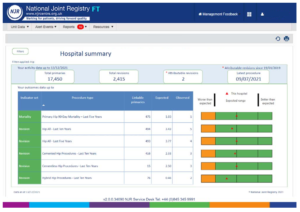
Example extract from NJR Management Feedback reporting function in NJR Connect – Data Services

Price benchmarking

With a view to improving the cost effectiveness of joint replacement surgery, the NJR’s implant price benchmarking service gives hospitals the information they need to benchmark the price they pay for hip, knee, ankle, elbow and shoulder implants against the ‘best’ national prices achieved across all hospital implant procurement services. This service enables hospitals to drill down into their pricing data, including the additional capability to give surgeons individual reports relating to their own implant use. The NJR’s enhanced implant price-benchmarking service, EMBED, supports hospitals to understand, in greater detail, their use of joint replacement implants in terms of cost, evidence and trends in comparison to the national picture. This service provides clinicians, management, procurement and finance teams with an objective set of data and analysis to inform their decision-making. With a focus on cost and value alongside procedure outcomes, it also underpins the Getting It Right First Time (GIRFT) and NHS England’s Model Health System initiatives.

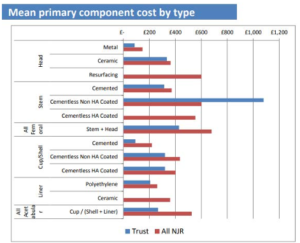
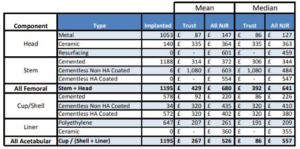
A sample of the EMBED price bench-marking report

Shared decision-making in a clinical setting

Patient information and knowledge is vital for hospitals to ensure understanding, confidence, manage expectations and contribute to shared decision-making. We publish hospital-level information about patient outcomes following joint replacement surgery that enables patients to understand what to expect from their treatment and to inform their decision about where to be treated: The National Joint Registry – Surgeon and Hospital Profile (njrcentre.org.uk).

We also produce guidance from NJR’s Annual Report to provide patients with digestible data on the type and quality of joint replacement surgery undertaken, to increase patient awareness and patient choice: The National Joint Registry reports (njrcentre.org.uk).

The NJR patient support tool

Additionally, the NJR Patient Decision Support Tool is a freely available online tool that was developed using NJR data on hip and knee surgery, to help those considering joint replacement surgery to better understand the risks and benefits of having a hospital procedure. The patient enters simple details such as age, sex, height, weight, general health and how their joint disease affects them. The tool then uses NJR data from similar patient experiences to calculate how much better the patient will be likely to feel after surgery. The tool also calculates the risk of death after surgery, as well as the likelihood of repeat surgery being needed. Patients with a better understanding of their surgical procedure, their own risk level, and what will be happening to them are likely to be better prepared for their hospital procedure and to thereafter have better outcomes. The Patient Decision Support Tool is an example of how both patients and surgeons can make informed decisions jointly in their hospital consultation time, as an important part of patient-centred medicine. Developed as part of NJR’s supported research programme, it has been accessed by many tens of thousands of patients across over 110 countries to better understand their risks and benefits before surgery. With this brief overview, we hope we have given a flavour of some of the benefits that the NJR delivers to hospitals. By recording, monitoring, analysing and reporting on performance outcomes in joint replacement surgery, we are committed to supporting a continuous drive to improve service quality and enable research analysis – and, ultimately, improve patient outcomes.

About the National Joint Registry

Described as a global exemplar of an implantable medical device registry, the National Joint Registry (NJR), which covers England, Wales, Northern Ireland, the Isle of Man and Guernsey continues to be the largest orthopaedic registry in the world, with an international reputation and over 3.7 million procedure records submitted. They collect information on hip, knee, ankle, elbow and shoulder joint replacement surgery and monitor the performance of joint replacement implants.

More information: www.njrcentre.org.uk

This article was originally featured in HQIP’s quality improvement magazine, CORNERSTONE – to see more articles on topics such as healthcare inequalities and sustainability in healthcare, go to: www.hqip.org.uk/wp-content/uploads/2023/11/HQIP_Cornerstone_2024.pdf.