The July edition of HQIP’s eBulletin is out now! It features the latest news and updates relating to clinical audit, outcome reviews and data-informed healthcare improvement, including:
What’s new?
BMJ Leader blog: The role of data in strategic commissioning
Article: How AI could help clinical audits and registries
Case study (CAAW26 Strategic Impact Award): Thrombolysis in Acute Stroke Collaborative
Healthcare sector news
NHS Quality Strategy puts evidence at the heart of improvement
Modern Service Frameworks (MSF): Sepsis and cardiovascular disease
A chance to revisit – did you see?
Clinical Audit Awareness Week recordings and resources now available
Latest reports and data
In other news
Benchmarking data – Epilepsy12
Job opportunity: Communication Content Manager, National Joint Registry (NJR)
Don’t forget to sign up: Keep up to date with our latest news, events and work programmes by subscribing to our mailing list today. You can also follow us on: LinkedIn and X: @HQIP
Data relating to maternity and perinatal care has been published on HQIP's benchmarking site, NCAB.
How AI Could Help Clinical Audits and Registries
27 Jul 2026
Artificial intelligence is hard to avoid at the moment. Every week seems to bring another announcement or new tool. While most of the attention has been on large language models like ChatGPT, AI covers a much wider range of technologies, many of which could have practical uses in healthcare.
As part of Clinical Audit Awareness Week 2026 (CAAW26), Chris Boulton, National Joint Registry (NJR) Director of Operations, looked at how AI could support clinical registries, where it has the greatest potential, and some of the challenges that still need to be addressed.
“Like many organisations, we’re trying to separate the genuine opportunities from the hype. AI is developing quickly, but that doesn’t mean every new idea will improve healthcare. Our job is to understand where it can make a practical difference and where existing approaches remain the better option.
The National Joint Registry (NJR), which is hosted by Healthcare Quality Improvement Partnership (HQIP), exists to improve patient safety by recording, monitoring, analysing and reporting the outcomes of joint replacement surgery. Since it was established in 2003, it has become the largest joint replacement registry in the world, holding more than 4.65 million procedure records and receiving around 250,000 new records every year.
That scale creates opportunities that simply didn’t exist a decade ago. The NJR already supports implant surveillance, clinical audit, research and quality improvement. As the volume of data continues to grow, AI offers another way of analysing that information and finding patterns that would otherwise be difficult to detect.
My CAAW26 presentation focused on a few key areas where AI could make the biggest difference.
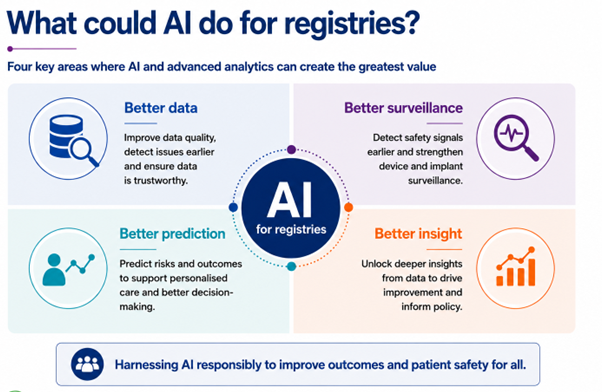
Improving data quality
Good analysis starts with good data. Large datasets inevitably contain missing information, inconsistencies and records that need checking. Finding those records can take a lot of time.
AI could help identify records that deserve closer inspection. It may spot unusual coding patterns, unexpected combinations of values or anomalies that suggest something has gone wrong during data collection. That would allow data teams to focus their time where it is most needed.
Better insights
Clinical registries contain huge amounts of information, and much of the value comes from understanding how different pieces of that information fit together.
AI could help identify patterns and relationships that are difficult to spot using conventional analytical techniques alone. That could generate new insights into patient outcomes, implant performance and variation in practice, helping us ask better questions, focus future research and communicate findings more effectively to clinicians, patients and other stakeholders.
Improving surveillance
Monitoring implant performance is one of the NJR’s core responsibilities. The registry already uses established statistical methods to identify potential patient safety concerns. AI has the potential to add another layer by recognising patterns across millions of records and highlighting areas that warrant further investigation.
Any potential safety signal would still need careful statistical analysis and clinical review before conclusions were drawn, but AI may help identify those signals earlier.
Better prediction
One of the most exciting possibilities is using registry data to improve prediction. By analysing millions of procedures, AI may help estimate things like the likelihood of revision surgery, complications or recovery after an operation. As more data becomes available, those predictions have the potential to become increasingly accurate.
Better prediction gives patients and clinicians more information before decisions are made. It won’t remove uncertainty, but it can help people make better informed choices.
The same technologies could also make registry information easier to access and understand. That could include answering questions from patients, producing tailored summaries for clinicians or presenting information in a more accessible way.
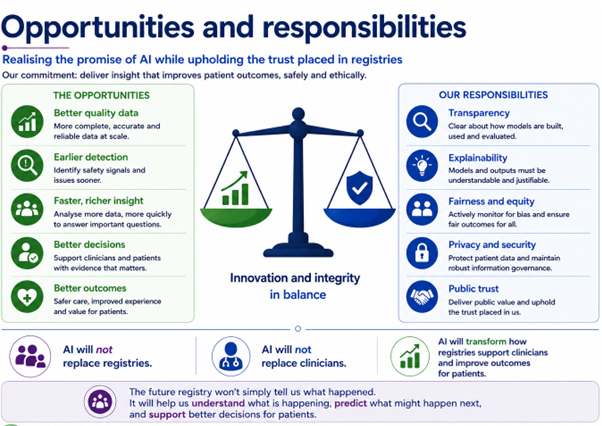
Governance and trust
Technology is only one part of the picture.
Any use of AI within the NJR has to be supported by strong governance, clear accountability and robust information governance. Patient confidentiality, cyber security and transparency remain just as important as they are today.
We believe AI models need to be properly evaluated, monitored and understood before they are used to interpret data. Public trust will be just as important as technical performance, and we want trust to be one of the guiding principles of the NJR’s AI strategy.
Developing the NJR’s approach
Earlier this year, we established an AI and Analytics Working Group, led by Professor Mark Wilkinson from the University of Sheffield, to help develop the registry’s AI roadmap. The group is bringing together clinicians, data scientists, academics and registry staff to explore where AI can genuinely add value, learn from organisations already working in this area and identify practical applications worth developing further. That includes improving analytics and surveillance, as well as supporting reporting, stakeholder communication and routine administrative tasks.
AI is moving quickly, and nobody knows exactly how it will change healthcare over the next decade. There will be plenty of new ideas, and not all of them will stand up to scrutiny.
For us, the priority is straightforward. We’ll continue exploring where AI can improve the registry, evaluate new approaches carefully and adopt them where they make a real difference. The aim is the same as it has always been: using high quality data to improve patient safety and support better care.”
Further resources from HQIP
Innovation webinar and other webinars from Clinical Audit Awareness Week 2026 – recordings and slides available
Discover more about how HQIP supports organisations to use clinical audit and healthcare data to drive improvement – from strategy development to implementation or training
Guidance and other resources to support improvement
NCAB is an online portal, hosted by HQIP, which consolidates results from a range of audits across the NCAPOP programme. Users do not need to register, and can access audit benchmarked data searchable by trust, hospital or unit. To view all datasets currently published, visit the NCAB site.
Published in partnership with Patient Safety Learning. Ensuring patients receive the right care at the...
Audit, Registry and Outcomes Data: At the Heart of Strategic Commissioning
20 Jul 2026
Dr Iain Smith, HQIP Associate Director, Association for Clinical Audit, Registries and Quality Improvement (ACAR-QI), features in BMJ Leader Blog this month, on why audit, registry, and outcomes data must sit at the heart of strategic commissioning:
“Integrated Care Boards (ICBs) play a crucial leadership role in the English NHS. They are responsible for managing health systems across large geographical footprints and ensuring that services are planned and delivered to meet local population needs.1
The UK government’s new NHS modernisation bill confirms strategic commissioning, the process of planning, purchasing and monitoring services, as the central purpose of newly reconfigured ICBs.2–4 As ICBs move towards their role as strategic commissioners, they will focus on optimising resource use to improve population health; reduce inequalities; improve access to services; and deliver high quality outcomes for patients.2 3
To support ICBs in this role, is a strategic commissioning framework comprised of four key steps: understanding the local context; developing long-term population health strategy; delivering value-for-money outcomes; and evaluating impact of commissioning decisions.3
Key to success as a strategic commissioner is the need to demonstrate measurable outcomes and improvement. Clinical audit and registry data must therefore play a major role at the heart of strategic commissioning.
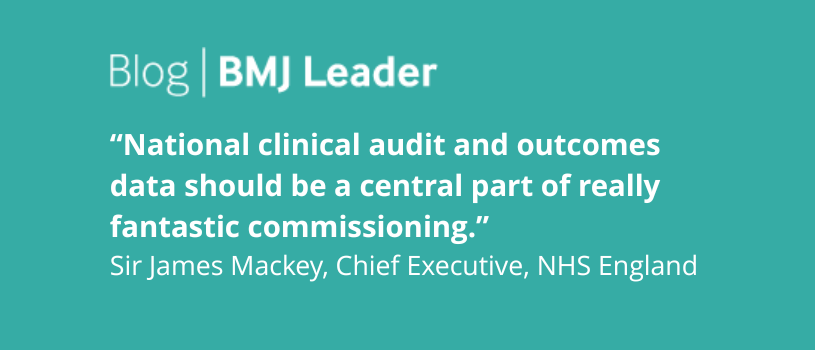
National clinical audit and outcomes data should be a central part of really fantastic commissioning. They can provide ICBs an evidence base for a data-driven approach to decision making and help providers to drive improvement and demonstrate commissioned outcomes are being delivered.” Sir James Mackey, Chief Executive, NHSEngland, at Clinical Audit Awareness Week 2026
Clinical audit, registries and understanding the local context
Strategic commissioners must develop a deep understanding of their local population and its health and care needs.3 Clinical audit and registries provide condition and pathway specific data on care processes, outcomes, variation and inequalities across providers and geographies. Audit and registry data contribute benchmarked comparisons between local providers, ICBs, regions and national averages – helping commissioners identify where outcomes, access or care processes differ from expected standards.5 6
For example, reducing lives lost to cardiovascular disease (CVD) is an identified priority in the NHS ten-year health plan for England.7CVDPREVENT is a national primary care audit using routinely extracted GP data to identify undiagnosed, undertreated or overtreated patients with high-risk cardiovascular conditions.8 This can support ICBs to understand population need, inequalities and prevention opportunities at place, neighbourhood and practice level.
Clinical audit, registries and developing population health strategy
Strategic commissioners need to develop evidence-based population health strategies that link health with broader socioeconomic outcomes to improve equity and support prevention.3 Strategies need to translate into outcomes that matter for patients, such as fewer heart attacks or strokes and effective care pathways.7
The National Audit of Cardiac Rehabilitation (NACR) supports planning of cardiovascular prevention and rehabilitation services by monitoring access, equity, quality and outcomes.9 Whereas, the Sentinel Stroke National Audit Programme (SSNAP) captures whole-pathway stroke data supporting long-term strategy for hyperacute stroke, thrombectomy and rehabilitation.10
Audit data and value-based healthcare
Strategic commissioners must prioritise funding and maximise value.3 Delivery of strategic outcomes will be supported through allocating resources informed by data and population health priorities. Metrics from audits and registries can be included in contracts and transformation programmes. For example: the National Emergency Laparotomy Audit (NELA) links improved outcomes with shorter length of stay and potential savings;11 the National Hip Fracture Database (NHFD) supports the best practice tariff for hip fracture care in England;12 and the National Joint Registry (NJR) shows continued reduction in revision surgery and improved outcomes.13
Clinical audit, registries and evaluating impact
Strategic commissioners need to monitor whether decisions improved outcomes, reduced inequalities, improved access and delivered value.3 Clinical audits and registries are designed to identify where care meets standards and where improvement is needed. They enable repeated measurement and can support quality improvement cycles.14 15 Registries capture longitudinal data, and many audits publish periodic data, allowing commissioned changes to be tracked over time.5 By using audit and registry data, commissioners can evaluate the impact before and after pathway redesign, investment or service reconfiguration.
Making it happen – access to data and linkage across datasets
Audit and registry data offer meaningful clinical process and outcome metrics. The data however can sit in different places – such as individual audit provider websites. Furthermore, for strategic commissioning, ICBs must consider activity, workforce and finance data – which can also sit in separate places.
Bringing datasets together supports a more rounded view of outcomes, safety, variation, equity, and value – not just lower cost. This points to an enhanced role for digital tools such as secure data environments (SDEs) and open access platforms such as National Clinical Audit Benchmarking (NCAB) and NHS Open Model Health System (OMHS).
NCAB provides benchmarked results from the National Clinical Audit and Patient Outcomes Programme (NCAPOP).16 OMHS provides benchmarked data on quality, productivity and outcomes, including from selected national clinical audits.17 Both NCAB and OMHS are open platforms providing benchmarked public data.17 18 This matters for strategic commissioning because ICBs are expected to make evidence-based, transparent decisions.
SDEs are platforms that control who can access data, what they can access, and what they can do with it. They allow approved users to work securely with de-identified data and enable access to health and care data for research and analysis.19 20 SDEs reduce the need for ICBs to negotiate bespoke data flows and make evaluation of commissioning decisions easier.
National clinical audits and registries can help ICBs move from broad strategic intent to measurable commissioning action – showing where need is greatest, where variation exists, and whether commissioned changes are improving outcomes equitably over time. Making audit and registry data available through SDEs and open access platforms would help ICBs use national audit and registry data as core strategic commissioning assets.”
Discover more about how HQIP supports organisations to use clinical audit and healthcare data to drive improvement – from strategy development to implementation or training
Guidance and other resources to support improvement
Davey N, Shearer H, Matthew D, et al. Clinical audit and quality improvement: rivals, partners, or one and the same? Frontiers in Health Services 2026;Volume 6 – 2026 doi: https://doi.org/10.3389/frhs.2026.1768450
NHS England. Model Health System London, UK: NHS England; n.d. [Available from: https://open.model.nhs.uk.]
HQIP. National clinical audit data features in open access NHS Model Health System London, UK: Healthcare Quality Improvement Partnership; 2026 [Available from: https://www.hqip.org.uk/news/open-mhs-launch/.]
“Whether supporting patients to survive, recover, or live well, improving outcomes is the primary reason why healthcare services exist. And, of course, understanding how best to achieve that, in an efficient and sustainable way, is crucial in today’s NHS.
It starts with understanding what is happening; knowing what is working well, and what is not. Measuring outcomes accurately, and at national scale, is a fundamental part of what HQIP does. Through the National Clinical Audit and Patient Outcomes Programme (NCAPOP) and the National Joint Registry, we run the audits, outcome reviews and registries that provide insights into much of the national picture. They produce some of the most reliable data anywhere in the NHS on how care is delivered.
However, the Quality strategy is candid that measurement is only part of the route to improved outcomes. The harder step is helping the system to absorb what that data shows, and act upon it – which takes, and deserves, significant support and attention. That is why – through dedicated improvement activities via our programmes and national initiatives such as Clinical Audit Awareness Week – we have been focusing much of our effort into translating evidence into action. So, we are heartened to see that this new strategy puts real weight behind outcomes being understood and acted upon, not simply recorded.
A few points stand out. The strategy treats clinical audit, outcome measurement and registries as national infrastructure, rather than a technical detail. It keeps the focus where it belongs: on the outcomes of care (on patients and their lives) rather than the process of delivering care. It is also clear about the fact that this evidence only proves its worth once it reaches the people who can act on it, whether in a clinical team, a trust board or an integrated care board. And it takes a whole pathway view of care, which is where much of the variation that prevents systemic improvement tends to sit. These are the issues that national clinical audit was built to address, covering the areas that the strategy prioritises – from cardiovascular disease and sepsis through to maternity, mental health and care for children and young people.
This is not new ground for us. For thirty years, national clinical audit has measured the outcomes of care and shown the NHS where patients do well and where they need change. A good deal of what the strategy describes already exists in some form. HQIP’s audit data is available through the NHS Open Model Health System. Our benchmarking tool lets trusts see how their outcomes compare with others across the country. Our recommendations repository brings together the key changes that national audit reports identify are needed. And much of our effort goes into turning all of this into insight that boards, commissioners and clinical teams can actually use – which is the shift from measurement to action that the strategy is asking for.
As such, there’s plenty to build on. There’s also work to do. The NHS quality landscape is broad and has developed over many years, with a wide range of audits and registries operating alongside the HQIP national programme. Their methods, their approaches, their routes for escalation and their assurance currently vary. Bringing greater consistency here, anchored in robust data, is one of the things the quality strategy sets out to achieve, and it will strengthen our collective ability to improve clinical outcomes.
There’s room to grow, too. Many aspects of clinical care and many insights into patient experience are not yet captured, measured or reported. Extending the quality strategy to every part of NHS care is where much of the opportunity lies.
HQIP looks forward to working alongside the National Quality Board, NHS England, the Welsh Government, the Department of Health and Social Care (DHSC) and our Royal College partners, to maximise the value of the national programmes that are already in place and achieve the step change in care quality outlined in this strategy.
More information
HQIP is commissioned by NHS England and the Welsh Government to manage the National Clinical Audit and Patient Outcomes Programme (NCAPOP). HQIP also manages the National Joint Registry (NJR). Our programmes measure the outcomes of care across clinical areas from cardiovascular disease and maternity to mental health, diabetes, surgical outcomes and care for children and young people. Our data is available through the Open Model Health System and our National Clinical Audit Benchmarking tool. For more on the impact of clinical audit, visit www.hqip.org.uk.
A new report from the Health Foundation’s NHS Productivity Commission calls for a greater focus...
New reports published
9 Jul 2026
We are pleased to announce that the following NEW RESOURCES to support improvement in healthcare, from HQIP’s audits and programmes, have been published:
Data relating to maternity and perinatal care has been published on HQIP's benchmarking site, NCAB.
National strategy a positive step in the prevention of cardiovascular disease
9 Jul 2026
This week, NHS England published a new Modern Service Framework (MSF) for cardiovascular disease prevention, which takes a cardiovascular-kidney-metabolic approach to improvement in patient outcomes. As the leading cause of premature mortality in England, this strategy (which outlines an ambitious 10-year vision to strengthen CVD prevention), is an important step in enhancing care to improve outcomes for millions of people.
Mission: to cut premature deaths from heart disease and stroke by a quarter within a decade” NHS England cardiovascular disease Modern Service Framework
CVDPREVENT and HQIP, that commissions part of this audit’s work on behalf of NHS England, have come together to welcome this national strategy. For the estimated eight million people in the UK living with cardiovascular disease, the MSF represents an important national commitment to delivering more equitable, high-quality and consistent care. Its aim to promote evidence-led, clinically informed approaches to prevention, treatment and care is of critical importance.
Chris Gush, HQIP’s CEO, explains: “This national framework is an opportunity to use our collective knowledge to save lives, but the data we already have must be the starting point.”
The MSF aligns closely the work of national clinical audits, like CVDPREVENT, that measure care and share insights to improve and save lives. Data and outcomes from these audits help care providers to identify variation, trends and opportunities in the identification, diagnosis and management of conditions. This empowers clinicians and system leaders to focus resources where they can have the greatest impact.
Dr Peter Green, Clinical Lead at CVDPREVENT, adds: “Importantly, for patients, this means earlier diagnosis, improved management of long-term conditions, and reduced risk of serious cardiovascular events such as heart attacks and strokes.”
As implementation of the MSF progresses, CVDPREVENT and HQIP look forward to working together to providing insights and support efforts to translate its ambitions into measurable improvements in care and outcomes for patients. In the meantime, further resources relating to the prevention of cardiovascular disease from HQIP can be found below:
In addition, NCAB is awaiting corrected data for Fracture Liaison Service Database metric 1 ‘Case identification of all non-spine fractures (KPI 2)’, as an error has been identified in the previously published data. Until the corrected data is loaded, please review results for this metric, here.
NCAB is an online portal, hosted by HQIP, which provides access to national audit performance data. Users do not need to register, and can access audit benchmarked data searchable by trust, hospital or unit. For all datasets currently published, go to the NCAB site.
Find out who won the Use of National Clinical Audit commendation in the Excellence in Clinical Audit Awards 2026, part of Clinical Audit Awareness Week.
Position statement: Audit & QI in postgraduate training
1 Jul 2026
HQIP has shared a position statement on resetting audit and quality improvement in UK postgraduate medical training and specialty selection.
This statement sets out HQIP’s recommended approach to how clinical audit and quality improvement should be taught, supported, assessed, and rewarded across UK postgraduate medical training. It is designed to be endorsed by the Medical Royal Colleges and used to influence postgraduate curricula, workplace learning, and specialty selection frameworks.