
How AI Could Help Clinical Audits and Registries
27 Jul 2026

Artificial intelligence is hard to avoid at the moment. Every week seems to bring another announcement or new tool. While most of the attention has been on large language models like ChatGPT, AI covers a much wider range of technologies, many of which could have practical uses in healthcare.
As part of Clinical Audit Awareness Week 2026 (CAAW26), Chris Boulton, National Joint Registry (NJR) Director of Operations, looked at how AI could support clinical registries, where it has the greatest potential, and some of the challenges that still need to be addressed.
“Like many organisations, we’re trying to separate the genuine opportunities from the hype. AI is developing quickly, but that doesn’t mean every new idea will improve healthcare. Our job is to understand where it can make a practical difference and where existing approaches remain the better option.
The National Joint Registry (NJR), which is hosted by Healthcare Quality Improvement Partnership (HQIP), exists to improve patient safety by recording, monitoring, analysing and reporting the outcomes of joint replacement surgery. Since it was established in 2003, it has become the largest joint replacement registry in the world, holding more than 4.65 million procedure records and receiving around 250,000 new records every year.
That scale creates opportunities that simply didn’t exist a decade ago. The NJR already supports implant surveillance, clinical audit, research and quality improvement. As the volume of data continues to grow, AI offers another way of analysing that information and finding patterns that would otherwise be difficult to detect.
My CAAW26 presentation focused on a few key areas where AI could make the biggest difference.

Improving data quality
Good analysis starts with good data. Large datasets inevitably contain missing information, inconsistencies and records that need checking. Finding those records can take a lot of time.
AI could help identify records that deserve closer inspection. It may spot unusual coding patterns, unexpected combinations of values or anomalies that suggest something has gone wrong during data collection. That would allow data teams to focus their time where it is most needed.
Better insights
Clinical registries contain huge amounts of information, and much of the value comes from understanding how different pieces of that information fit together.
AI could help identify patterns and relationships that are difficult to spot using conventional analytical techniques alone. That could generate new insights into patient outcomes, implant performance and variation in practice, helping us ask better questions, focus future research and communicate findings more effectively to clinicians, patients and other stakeholders.
Improving surveillance
Monitoring implant performance is one of the NJR’s core responsibilities. The registry already uses established statistical methods to identify potential patient safety concerns. AI has the potential to add another layer by recognising patterns across millions of records and highlighting areas that warrant further investigation.
Any potential safety signal would still need careful statistical analysis and clinical review before conclusions were drawn, but AI may help identify those signals earlier.
Better prediction
One of the most exciting possibilities is using registry data to improve prediction. By analysing millions of procedures, AI may help estimate things like the likelihood of revision surgery, complications or recovery after an operation. As more data becomes available, those predictions have the potential to become increasingly accurate.
Better prediction gives patients and clinicians more information before decisions are made. It won’t remove uncertainty, but it can help people make better informed choices.
The same technologies could also make registry information easier to access and understand. That could include answering questions from patients, producing tailored summaries for clinicians or presenting information in a more accessible way.
Governance and trust
Technology is only one part of the picture.
Any use of AI within the NJR has to be supported by strong governance, clear accountability and robust information governance. Patient confidentiality, cyber security and transparency remain just as important as they are today.
We believe AI models need to be properly evaluated, monitored and understood before they are used to interpret data. Public trust will be just as important as technical performance, and we want trust to be one of the guiding principles of the NJR’s AI strategy.
Developing the NJR’s approach
Earlier this year, we established an AI and Analytics Working Group, led by Professor Mark Wilkinson from the University of Sheffield, to help develop the registry’s AI roadmap. The group is bringing together clinicians, data scientists, academics and registry staff to explore where AI can genuinely add value, learn from organisations already working in this area and identify practical applications worth developing further. That includes improving analytics and surveillance, as well as supporting reporting, stakeholder communication and routine administrative tasks.
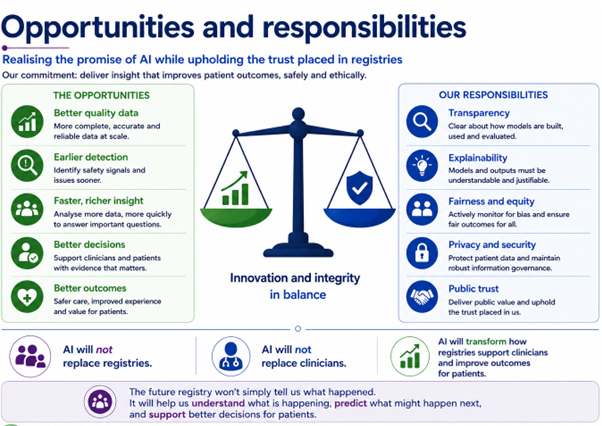
AI is moving quickly, and nobody knows exactly how it will change healthcare over the next decade. There will be plenty of new ideas, and not all of them will stand up to scrutiny.
For us, the priority is straightforward. We’ll continue exploring where AI can improve the registry, evaluate new approaches carefully and adopt them where they make a real difference. The aim is the same as it has always been: using high quality data to improve patient safety and support better care.”
Further resources from HQIP
- Innovation webinar and other webinars from Clinical Audit Awareness Week 2026 – recordings and slides available
- Discover more about how HQIP supports organisations to use clinical audit and healthcare data to drive improvement – from strategy development to implementation or training
- Guidance and other resources to support improvement
- Reports and infographics
- Benchmarked results, searchable by project name, trust, hospital or unit
Other news

National Cancer Plan: From strategy to improvement
As part of Breast Cancer Awareness Month, we take another look at the National Cancer...

Finding the missing millions: Driving improvements in cardiovascular disease prevention
In light of World Heart Day on 29 September 2026, we revisit the CVD Modern...

Health Foundation NHS Productivity Commission report calls for focus on outcomes
A new report from the Health Foundation’s NHS Productivity Commission calls for a greater focus...