Leadership vacancy: Director of Operations, NJR

23 Dec 2025

Following the news of the retirement of Elaine Young, Director of Operations at The National Joint Registry (NJR), we are seeking an outstanding leader to oversee the operational delivery and strategic development of the NJR, which is hosted by HQIP.

This is a rare opportunity to lead one of the UK’s most important national programmes for patient safety and healthcare improvement. The National Joint Registry (NJR) is internationally recognised, and holds around 4.5 million joint replacement records, making it the largest registry of its kind in the world and an exemplar of an implantable medical device registry. Its insights improve care, strengthen clinical decision-making, support rapid learning, and help patients and clinicians to choose the right treatment with confidence.

The successful candidate will lead the NJR’s day to day delivery and performance. They will lead operational delivery, financial management and commercial performance, and will oversee a high-performing directorate that delivers through strategic delivery partners. They will also be a senior ambassador for the Registry, building trusted relationships across the NHS, independent sector, professional bodies, regulators, and patient and public stakeholders. Above all, they will ensure that NJR outputs are credible, usable, and acted upon.

Closing date: 31 January 2026.

Find out more and how to apply

Tender: Seizures and Epilepsies in Children and Young People

22 Dec 2025

Applications closing date: 20 Feb 2026 (deadline extended).

HQIP is seeking to commission the delivery of the Seizures and Epilepsies in Children and Young People Audit.

The contract will initially be delivered for NHS-funded care in England, Wales, and publicly funded care in Jersey for a period of 3 years. There is potential to extend the contract for up to two additional years.

Further details can be found on HQIP’s tenders webpage.

Latest news: December 2025 eBulletin

18 Dec 2025

The December edition of HQIP’s eBulletin is out now! It features the latest news and updates relating to clinical audit, outcome reviews and data-informed healthcare improvement, including: What’s new?
  • BMJ Leader article: Why clinical audit is key to improvement and efficiency in healthcare
  • #CAAW25 case study on engaging patients to improve mental health services
  • Lived experience shapes our new National Audit of Eating Disorders
  • HQIP Trustees’ Report and Accounts 2024-25

A chance to revisit:

  • Latest reports
  • Updated guide to managing ethical issues in quality improvement and clinical audit projects
In other news:
  • Jersey joins the National Joint Registry
  • HQIP Project Manager vacancy
Read HQIP’s latest eBulletin here.
Don’t forget to sign up: Keep up to date with our latest news, events and work programmes by subscribing to our mailing list today. You can also follow us on: LinkedIn and X: @HQIP

Each Data Point Represents a Person and Their Family

15 Dec 2025

How lived experience is shaping HQIP’s new National Audit of Eating Disorders. 

It’s estimated that at least 1.25 million people in the UK live with an eating disorder. Behind every statistic is a person whose daily life, and the lives of those who love them, is profoundly affected. The emotional and physical pain impacts patients, families, partners, and friends alike. Eating disorders can also be life-threatening: Anorexia Nervosa has the highest mortality rate of any mental health disorder, underscoring the urgent need for better care and support.

The new National Audit of Eating Disorders (NAED), commissioned by HQIP and delivered by the Royal College of Psychiatrists, aims to improve identification, management, and overall quality of care for people with eating disorders. In its first year, the audit has mapped services across England to understand the breadth and depth of current care, achieving an outstanding 97% participation rate from eligible teams and publishing a Service Mapping report that outlines what has been discovered.

Crucially, the audit has placed the voices of people with lived experience at the very centre of its work, ensuring that those who use eating disorder services, and those who care for them, directly shape how data is gathered, analysed, and shared. HQIP champions patient and public involvement in all national audits within the National Clinical Audit and Patient Outcomes Programme (NCAPOP) to ensure that improvement is not just theoretical, but grounded in the realities of those who are in need of care. Their perspectives ensure that recommendations become changes that make a difference to patients and their families, and save lives.

True co-production in action

Lived experience is never an add-on; it is a key foundation of the NAED team’s work. The principle that each data point represents a person and their family underpins the entire project.

By combining clinical expertise with lived experience insight, and supported by HQIP’s expertise in patient involvement, quality and governance, the audit aims to enhance the identification, management, and quality of care for people of all ages with eating disorders. This inclusive approach ensures that future service improvements will be guided by the realities of people’s lives, and help to translate data into meaningful, person-centred actions that can improve outcomes and save lives.

Alongside representatives from many partner organisations, two Lived Experience Advisors sit on NAED’s Implementation and Steering groups. These groups provide the project team with expertise from multiple backgrounds to plan, structure, produce, and interpret the results of the audit fully and without bias. Importantly, the Lived Experience Advisors ensure that the perspectives of people with direct experience of eating disorders are consistently heard and acted upon in every key decision.

This commitment to patient engagement is applied to all aspects of the audit’s work. Service users who are under the age of 16 are being asked what’s important to them via a survey, and the audit also has a dedicated Service User and Carer Advisory Group (SUCAG), which brings together a diverse range of people with personal or caring experience of eating disorders. Co-facilitated with the charity Beat, the SUCAG works alongside the Steering Group, as well as clinicians, researchers, and HQIP representatives who provide oversight, guidance, and ensure that patient input is meaningfully integrated throughout the audit process. The SUCAG helps shape the direction of the audit, set its metrics and ensure that it reflects issues that matter most to patients and families.

The SUCAG’s input goes far beyond consultation too. Members reviewed the clarity and accessibility of the Service Mapping report and a forthcoming data dashboard to ensure they are inclusive and genuinely useful. Their feedback even informed how findings were presented, including designing posters for eating disorder service waiting rooms with QR codes linking directly to the national report to make the results accessible to patients and their families.

What the data reveals

Exceptional engagement, successfully mapping 297 eating disorder teams across 209 service providers in England, has resulted in the most detailed national picture of eating disorder service provision to date. Still only one year in from inception, this work lays the groundwork for future audit phases and offers new insights into both strengths and challenges, from access and staffing to treatment availability and waiting times.

The audit found high levels of multidisciplinary working and strong uptake of NICE-recommended therapies, reflecting good practice across many teams. However, it also revealed significant variation in access, service configuration, and waiting times across regions and age groups.

  • Waiting times ranged widely. The median wait for assessment for children and young people (CYP) is 14 days, compared to 28 days for adults. CYP typically wait 4 days for treatment, whereas for adults this median wait is 42 days – and some teams report waits of up to 700 days.
  • Diagnostic coverage varied. While over 90% of teams treat Anorexia Nervosa, only 60% of adult teams and 66% of CYP teams treat Binge Eating Disorder (BED), and fewer than half currently treat Avoidant/Restrictive Food Intake Disorder (ARFID) – 29% of adult and 45% of CYP teams.
  • Workforce pressures and variation in adult versus CYP service capacity were also highlighted, with adult teams managing 89% higher patient demand than CYP teams.

These findings offer vital insight into areas requiring targeted improvement and provide a benchmark for tracking progress in the next phase of the audit.

Looking ahead

The service mapping undertaken by the NAED lays the foundation for the core audit phase beginning in 2026, which will assess services against 12 national metrics. For HQIP, as we have seen with other audits as they mature, we are confident that this will be a milestone in informing changes that will lead to improved care and patient outcomes. As such, the NAED – with its patient-focused approach – will play a key role in demonstrating the continued value of national audit in strengthening quality assurance, accountability, and patient partnership across healthcare.

Find out more

New resources published December 2025

11 Dec 2025

We are pleased to announce that the following NEW RESOURCES to support improvement in healthcare, from HQIP’s audits, registries and programmes, have been published:

  • Cardiovascular disease prevention: Annual audit report 2025, CVDPREVENT. Contains key findings relating to hypertension, cholesterol, and chronic kidney disease.
  • Eating disorders: Service Mapping Report 2025, National Audit of Eating Disorders (NAED). In its first year, the audit focused on mapping services to understand the breadth and depth of current provision.
  • Emergency paediatric surgery: Right Place, Right Time, Right Team, Child Health Clinical Outcome Review (NCEPOD). Reviews the quality of care provided to children needing emergency surgery.
  • Paediatric critical care: Summary report 2025, Paediatric Intensive Care Audit Network (PICANet). Describes key metrics and outcomes related to transport and admission events in order to monitor the delivery and quality of care against agreed standards, and evaluate clinical outcomes, to inform national policy in paediatric critical care.

All reports: All HQIP-commissioned reports can be accessed via our dedicated reports webpage. Stay up to date: Join our mailing list to receive notifications when new reports are published.

NEW case study on using audit to improve postnatal contraception uptake

3 Dec 2025

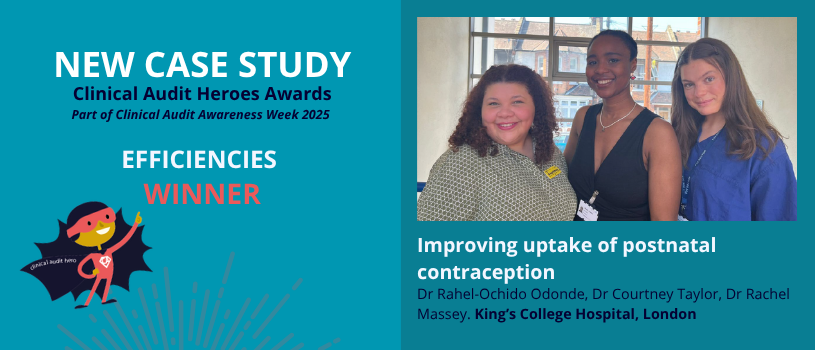
This case study by the 2025 Clinical Audit Hero Awards Efficiencies category winner, King’s College Hospital, London, showcases how they used audit data to improve provision, and uptake, of postnatal contraception.

Led by Dr Rahel Odonde, Consultant Obstetrician and Gynaecologist, the project supports antenatal and postnatal discussions about contraception, with the aim of providing chosen methods within 48 hours of birth or before discharge.

This case study highlights the importance of early, proactive contraceptive planning, and demonstrates how audit-driven, clinically-led collaboration can improve postnatal care pathways. It outlines how their innovative approach supports individual choice, reduces unplanned pregnancies, and enhances operational efficiency through coordinated multidisciplinary involvement.

Download the case study: Improving uptake of postnatal contraception at King’s College Hospital

This case study was developed as part of Clinical Audit Awareness Week 2025 (which took place 2–6 June 2025, #CAAW25). You can explore other available #CAAW25 resources by heading over to the #CAAW25 main webpage.

HQIP’s impact in 2024-25 – annual report

3 Dec 2025

The 2024-25 HQIP Trustees’ Report and Accounts has been published. Focusing on our activities from 1 April 2024 to 31 May 2025, it shares our vision, achievements and a financial update, as well as highlights of our impact on healthcare improvement.

There is a moral obligation to use the data that is already available, for the benefit of patients” Phil, NHS patient,” HQIP patient representative

We are proud to work with a multitude of others across healthcare to deliver our vision of improved health outcomes for everyone through evidence-driven healthcare. By running the largest suite of national clinical audits, outcome reviews and registries in the UK, we make high quality data on a wide range of clinical disciplines available to all; an essential tool for supporting efficiencies, reducing inequalities and, importantly, improving patient care and outcomes.

Highlights for the year 2024-25 include:

  • Impact of clinical audit in neonatal care – In just four years, the use of Deferred Cord Clamping (DCC) for preterm babies (as promoted by the National Neonatal Audit Programme, NNAP) rose from less than 29% in 2020 to almost 70% in 2023.
  • The importance of data sharing from a patient perspective – For patient representatives, contributing to our Data Access Request Group (DARG), is both
    meaningful and rewarding: “I believe that data provides a sound rationale for why we offer care in the way we do…I joined DARG to make sure that it is used primarily for the benefit of patients,” Phil, a DARG representative and long-time NHS patient.
  • How patient voice supports improvement in respiratory care – Find out how commissioned National Respiratory Audit Programme (NRAP) works with patients on an on-going basis to identify improvements that they themselves have prioritised – which, in turn, leads to meaningful changes to care.
  • Audit data helps to close the gap in maternity care – A landmark retrospective study demonstrated how national clinical audit data can lead to better outcomes in maternity care, highlighting the critical importance of these programmes.

Read in full: We hope that you will take a moment to read our report, and find out more about how the data and insights commissioned by HQIP have supported change that has a real impact on patient outcomes.
Healthcare data: The key to improvement and efficiency

3 Dec 2025

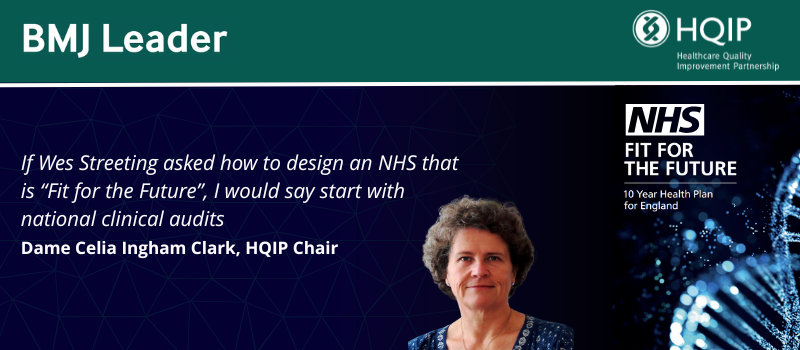
HQIP’s Chair and former NHS England deputy Medical Director, Dame Celia Ingham Clark, features in BMJ Leader this month, sharing why clinical audit must play a key role in designing an NHS that is “Fit for the Future”. 

“The challenges that the NHS faces are not new.  With an ageing population and staff shortages, we are faced with daily news headlines about soaring costs and long waiting lists. The 10 Year Plan Fit for the Future describes the pressing need to ensure a sustainable, financially-viable future for our NHS, focusing on community care, digital technologies, and prevention.  For local and national clinical leaders the real challenge comes in how to achieve this. These three ‘shifts’ need to be delivered alongside improving care quality and reducing costs. For me, the key lies in using the rich data source that is clinical audit. By measuring the quality of care, it enables us to see what is working well, and what is not, against recognised standards. It identifies where change would have the greatest impact, driving the targeted use of resources. As such, clinical audit is a critical tool in delivering efficiencies that will lead to the most important measures, improving and saving lives.

National clinical audit – the primary example of which is the National Clinical Audit and Patient Outcomes Programme (NCAPOP) – goes from strength to strength. Commissioned by the Healthcare Quality Improvement Partnership (HQIP), on behalf of NHS England and others, the NCAPOP comprises circa 40 audits and outcome reviews. These cover a wide range of services including cancer, mental health, and maternity care. NCAPOP has been running for decades, and measures care in line with standards set by NICE. Its programmes are trusted by clinicians and patients alike, not least because they are co-developed with both clinicians and patients. The NCAPOP has developed a robust and reliable approach to data collection, analysis and reporting, with many delivering quarterly data online updates and annual ‘State of the Nation’ reports. These reports provide readily accessible summary infographics and a focused number of recommendations for improvement that are developed with clinical, patient and commissioner input.

There are many examples of excellent audits out there; as a former colorectal surgeon I have a particular interest in the National Bowel Cancer Audit (NBOCA). Initially established by the Association of Coloproctology of Great Britain and Ireland (ACPGBI), this audit has a long-standing history of clinical engagement. It is now part of the National Cancer Audit Collaborating Centre (NATCAN) – a collaboration between the Royal College of Surgeons of England and the London School of Hygiene and Tropical Medicine – that covers ten different types of cancer, and is commissioned through the NCAPOP. The NBOCA focuses on surgical outcomes, non-surgical treatments, and new approaches to care such as genetic testing. The latter is significant as it aims to identify which patients are most likely to benefit from chemotherapy, and avoids the futile use of potentially toxic and costly treatment for patients with particular genetic profiles.

The NBOCA has reported improvements across a range of care and outcome measures over time, for example, 90-day postoperative mortality has almost halved over the past decade. There has also been a significant improvement in the two-year postoperative survival rate, resulting in approximately 1,150 additional people surviving two years after surgery1 (2021/22 saw a 5-percentage-point increase compared with 2012/13). These statistics highlight advancements in treatment pathways and multidisciplinary patient care across the sector. They also reflect another important aspect of clinical audits. By making data publicly available, and actively working with the healthcare community to support peer review, they identify areas for improvement. Audits operate an ‘outlier process’ which identifies where indicators at a Trust level fall significantly outside the expected range2. NHS England and the Care Quality Commission are notified of confirmed outliers, so that remedial actions can be taken. This is an extremely valuable process for Trusts, who often welcome the opportunity to understand where changes would have the greatest impact. One recent example is an NHS Trust that increased patient telephone follow-up on discharge to reduce unplanned emergency department attendances, following such a notification.

Clinical audits also support initiatives to improve care pathways directly. For example, patients who have had rectal cancer surgery are recommended to have their ileostomy closed within 18 months of first surgery, and this is currently the case for only 62% of patients1. As such, Close it Quick (a collaboration between NBOCA, the Royal College of Surgeons of England and the Association of Coloproctology) was launched to promote timely stoma closure, improve quality of life, and reduce the risk complications.

Another aspect of care where clinical audits are invaluable, is in shining a light on inequity. There are many examples where the data helps us to understand what is happening, so we have an opportunity to improve care for everyone. A highly reported example in recent years is maternity care. When looking at 2014-16 data, the MBRRACE-UK programme (part of the NCAPOP) found that women from Black ethnic backgrounds had five times the risk of maternal mortality, compared to white women. This finding emphasised the need for a continued focus on actions to address this disparity. By 2021-23, this statistic had reduced to around double. There’s still much work to be done, but, using data in this way provides clarity and shines a light on issues, leading to improvements like this.

So, what does all this mean for healthcare leaders, both providers and commissioners? Having been in a leadership role in the NHS for many years, I’m fully aware of the constant pressures to maintain and enhance quality of care while reducing avoidable costs. On a daily basis, you are having to ask ‘where should I allocate my resources to deliver maximum benefit to patients and the Trust?’. Clinical audits also provide assurance regarding clinical services through Quality Accounts, and in terms of performance against process and outcome metrics. Furthermore, they offer robust data that clinicians can include and reflect on in their annual appraisal.

If Wes Streeting called me tomorrow and asked my view on how to drive quality improvement when designing an NHS that is “Fit for the Future”, I would say ‘start with national clinical audits’. But, I would quickly follow that up with ‘don’t take my word for it, ask our patients’. Katrina Attwood, Chair of the NBOCA Patient and Public Involvement Forum, sums it perfectly, when she says: “I know first-hand how useful it is to have data. Audit is not a tick-box exercise – it’s driving real improvements for patients, and demystifying care, as well as shining a light on places where we need to do better.”

Notes:

1) Source: NBOCA State of the Nation report, published 9th Oct 2025

2) To 3 standard deviations