
Safety in numbers

17 Jan 2023

Tina Strack, Associate Director for Quality and Development (NCAPOP), HQIP

  • There is much collaboration between the programme and a number of maternity safety initiatives. For example, the Clinical Negligence Scheme for Trusts (CNST) maternity incentive scheme, which allows trusts to recoup some of their annual CNST fees if they can demonstrate that they meet the required safety standard. This includes a requirement to notify all eligible perinatal deaths to the programme within seven working days, and ensure that all required information is completed within one month of death.
  • Cardiac disease remains the leading cause of women’s deaths during and after pregnancy and the programme has made many recommendations around cardiac care. Working with the Resuscitation Council, the Obstetric Anaesthetists Association developed an Obstetric Cardiac Arrest Quick Reference Guide which addresses several recommendations from the programme’s findings regarding modifications required for the resuscitation of pregnant women as well as causes of cardiac arrest.
  • The 2020 report, Saving Lives, Improving Mothers’ Care, highlighted a statistically significant increase of Sudden Unexpected Deaths in Epilepsy (SUDEP) in pregnant and recently pregnant women, and reviewed these cases in detail. The report made several recommendations for how care for women with epilepsy could be improved, including a call for them to receive risk minimisation advice as well as support to ensure that medications are optimised to control seizure frequency. This work was noted as an important case study in the government policy paper Data Saves Lives. In addition, the pro gramme has been working with the charity SUDEP Action to present findings from Saving Lives, Improving Mothers’ Care to several groups, including the All Party Parliamentary Group on Epilepsy.
  • The programme’s 2015 report Just Say Sepsis! highlighted issues relating to the prompt identification and treatment of sepsis. This work led to the publication of Improving outcomes for patients with sepsis: A cross-system action plan and the follow-up 2017 Second Sepsis Action Plan by NHS England.
  • Based on recommendations from its Know the Score 2019 report, further research was undertaken to incorporate the use of artificial intelligence to standardise CT pulmonary angiogram (CTPA) reporting. Their study was well received and published as a peer-reviewed article in European Radiology, which prompted some acute trusts to consider utilising this software.
  • At the request of the Medical Director of NHS England and NHS Improvement, the authors of the programme’s Delay in Transit 2020 report were invited to the National Quality Board to discuss findings and consider how improvements could be made. The development of pathways for acute bowel obstruction, working alongside other Royal Colleges, is also being considered.

This article was originally featured in HQIP’s quality improvement magazine, CORNERSTONE volume 1

Cornerstone article patient safety

The invisible power of health data

17 Jan 2023

Yvonne Silove, Associate Director (NCAPOP), HQIP

My friend’s elderly father has had a tough time recently, with a run of serious health problems that landed him in hospital on and o for most of the year. We’ve had many telephone conversations during this time, but there is a limit to how often you can ask ‘how are you feeling?’ when things are taking so long to improve.

So, on one recent call, we talked instead about his data and how it impacts the quality of patient care. Did he know, I wondered, that he now featured in a whole smorgasbord of national data collection programmes and audits that aim to improve healthcare? “I had no idea,” he said, and I could detect a sense of pride. “What do you mean?” So I told him…

When you fell at home and broke your hip, your data went to the National Hip Fracture Database and helped the hospital to understand whether: you were admitted to the recommended ward; saw the specialist for older people; had the right operation at the right time; and whether steps were taken to consider medication to protect you from future fractures.

  • When they operated on your hip, you had a replacement joint fitted, so that data was also sent to the National Joint Registry. The serial numbers of your new hip were checked by the Registry to make sure they were the right ones for you, and the unique codes were stored safely, so that if any problem is identified with a component in the future, the hospital can be told and you can be reached. Your information will also be used by the hospital and the Care Quality Commission (CQC) to check that the hip replacement service at your hospital is performing safely and well.
  • After your hip operation, you needed an emergency laparotomy to fix a sudden blockage in your bowel caused by radiotherapy you’d had for bowel cancer some years ago. You quickly became quite unwell and the bowel surgeons were called to your ward. They used a special ‘calculator’ built into the National Emergency Laparotomy Audit to measure whether your life was at risk and to help them decide how quickly to operate. By using the audit as they planned your care, they could check and record that you went to theatre quickly enough and the right seniority of surgeon and anaesthetist were booked for your operation. The calculator also helped them to confirm that you needed a bed in the High Dependency Unit afterwards. Combined with data from similar patients, the audit plays an important role in helping hospitals, commissioners and regulators review and sustain good survival rates from this serious operation.
  • And before all this, when you had your original cancer treatment, your data was again used to check and report on the quality of care you, and patients like you, received. This contributed to greater under standing of healthcare services for your type of cancer as part of the National Disease Registration Service and it was also included in the National Bowel Cancer Audit.

He was amazed. It hadn’t occurred to him that his data could be so useful. As a scientist himself, he loved that he was providing evidence that helped both him and other patients in the future. I mentioned how interested people are these days in where their data is held and how it is used, and how people generally find it easier to understand how their personal details and health information are shared so they can receive treatment. They tend to be less aware of these other types of important uses, although most people seem delighted when they realise that their data can be so powerful.

By way of example, we talked about his new hip again. I explained that the National Joint Registry also uses his identifiable information so that if, for example, he has a complication with his new hip treated in another hospital, then his Registry record can be updated through a process of ‘data linkage’ using data submitted from other hospitals and from national datasets such as the national register of deaths. For now, the audits and registries use things like his name, date of birth and NHS number to link up the records coming from different places (though his personal details are removed before the data is analysed and reports are written).

He then asked if people wonder whether they gave consent for their data to be shared and used, and if not, was it still included? Answering that question is fairly complicated. Where possible, people are asked for their consent, but taking consent for so many, sometimes quite ill patients, often can’t be achieved in practice without disrupting their medical care. So, there are provisions in law to allow that ‘duty of confidentiality’ that all patients are owed, to be legally set aside (in fact, HQIP made a film about how that works!). Sensing some confusion, I ploughed on, trying to explain as clearly as I could…

Data that identifies us that is used for our own, individual health care can be used without asking for our consent because it is recognised that is what patients reasonably expect would happen. But when data is used in national projects to help measure and improve the services that treat us, then either people must be asked for their consent or there must be a specific legal provision that means the requirement to ask for consent will not apply.

However, there is a way for people to register to exclude themselves from one of these legal provisions, and so prevent their data being used for planning and research without their consent. This is known as the national data opt out. But this can be problematic, because the ‘line’ is sometimes really hard to draw. By preventing data being used for research and planning, it is possible that the mechanisms to safeguard the person’s own, safe care or the safe care of others could be compromised. This is why HQIP, our audits and the National Joint Registry made the case that national data opt-out out should not apply to our national audits and registries in cases where this might happen.

I paused, trying to think how to relate this back to my friend and his own experience. “If your team couldn’t use your data to learn that the number of deaths in the emergency bowel surgery service was creeping up, or to calculate whether theatres were sta ed correctly and ITU beds were available, then how could they take the steps they needed to make sure the next patient’s care was delivered safely? After all, given your penchant for popping up in so many of the audits, that next patient might be you!” He laughed, and then sighed: “Right, well you’ve lost me now with all this consent, setting aside and opting out. I think I’m just going to focus on how my data can help save my life and that of other patients in the future. I guess I hadn’t thought about the sorts of things that might not happen if my data couldn’t be used. I know some people are really worried about their data, but I’m also worried about being treated by a service that doesn’t have all the data it needs to keep doing a great job.” I agreed: ‘‘Data saves lives – and the government thinks so too, as that’s what they have named their new 2022 health and social care data policy.”

”I’m so glad,” he said. “Over all these months of the NHS looking after me, I’ve been helping them too – and I didn’t even realise!”

Further information and resources

This article was originally featured in HQIP’s quality improvement magazine, CORNERSTONE volume 1

Cornerstone article_the power of data

National Clinical Audit: Change, improvement and impact

17 Jan 2023

Q: First, for those who are less familiar, please explain the National Clinical Audit and Patient Outcomes Programme (NCAPOP)? 

A: The NCAPOP comprises of circa 40 audits and programmes on a range of clinical disciplines that collate healthcare data and other evidence, and are commissioned by the Healthcare Quality Improvement Partnership  (HQIP) on behalf of NHS England, the Welsh Government and, in some cases, other devolved authorities. These programmes align closely with the aspirations of the NHS Long Term Plan. 

Q: What are the benefits of the NCAPOP to patients and the healthcare service? 

A: The programme will only flourish if it continues to show that, by its presence, outcomes for patients continue to improve. To do that, it needs to continue to provide the knowledge-base that our patients and others, such as clinicians, service providers and commissioners, need in order to effect meaningful change. We keep a record of improvements, as do the audit providers. The impact of these benefits can be viewed on four levels: National; system; local; and public.  

Q: Can you be more specific about, for example, the national improvements that have been realised as a result of programme? 

A: Sure; here are some examples:  

  • Interventional: 1. An increase in the numbers of breast cancer patients with positive oestrogen receptors having surgery which implies increased surgery in the elderly; 2. Decreasing mortality after bowel cancer surgery with an increasing use of robotic techniques; and 3. In response to NICE guidance, 96% of patients with prostate cancer received specialist radiotherapy while increased numbers received specialist chemotherapy. 
  • Patient outcomes: 1. Maternal deaths have dropped due to hypertensive pregnancy disorders; 2. The wait for stroke patients to see a consultant has dropped by 4.5 hours; and 3. There has been an improvement in the attainment of the three key standards for inflammatory arthritis. 
  • Use of Data: 1. Hip fracture services have developed SPC charts showing units their performance both at high and low levels; 2. COVID-centred data has been used by PICANet to characterise the disease in children; and 3. We have seen an increased uptake of the audit and data acquisition in psychosis. 
  • Process improvements: 1. A doubling of access to palliative care at the end of life; 2. Transition for those with epilepsy improved with involvement of adult neurologists; and 3. 91% of patients rated their prostatic cancer treatment as 8/10. 

Q: What changes are taking place in the NCAPOP? 

A: During the early days of the pandemic, we undertook a critical review of the programme and considered if it was still fit for purpose, asking if it was ready to move into the truly digital era? In consultation with our audits and data providers, we concluded that some things needed to change, to make it more effective at supporting improvement in patient outcomes. These were: 

  • Reducing burden: 1. Reducing the number of metrics down to ten and, if there is a requirement for more than this, requiring justification; and 2. Ensuring that routine data is used if at all possible (currently 67% of input is routine). This requires linkage with NHS Digital to ensure the smooth flow of such data and linking with electronic patient records in the future.  
  • Outputs: 1. Changes to slim down annual reports so that they are much more succinct, more easily readable, and focused on a major finding from the latest review (with complementary websites used to display more in-depth findings and data); and 2. Increasing impact by using infographics and getting outputs out via as many different partners as possible. 
  • Timeliness: A further output from the review was the need to get data back to the service as quickly as possible. This was hotly debated, as faster data is likely less assured. But we have reached a solution, with getting prompt data out (which may be subject to subsequent adjustments), while still having the assurance of annual data. Specifically, we are specifying that, whilst there should be an annual report focusing on the main message of the year, quarterly online data outputs should also be made available. 
  • Patient outcomes: There are very important outcomes currently included such as mortality, post-operative sepsis and readmission, but there are omissions and we intend to help audit providers to bridge this gap as we re-commission audits within the NCAPOP. In addition, we need to include many more patient reported outcomes in the programme. 

Q: Which developments in the healthcare system will the changes to NCAPOP address?  

A: We have made these changes to respond to a wide number of developments across the system in recent years, including: The merger of NHS England and NHS Improvement; NHS Digital and X moving into NHS England; the move of Public Health England to the UK Health Security Agency; the transfer of the National Disease Registration Service from PHE (as was) to NHSD (as was); and the transfer of the National Cardiac Audit Programme, including TAVI, run by NICOR, from Barts, to be managed by Arden & Gem CSU. However, above all, the changes to NCAPOP come in response to the COVID-19 pandemic.  

Q: Why was the COVID-19 a key factor in changing the NCAPOP? 

A: It was inevitable that the effect of the pandemic and, in particular, what we learned about the use of data, would escalate change. For example, it proved the necessity for more immediate data (as was necessary with the National Child Mortality Database (NCMD), which moved to live surveillance during the COVID-19 pandemic). We are now able to determine how, with strategic thinking, we can reap important benefits for our patients by the wise use of such data. These lessons have led to this wholescale reorganisation. 

Q: Why are the changes to the NCAPOP important?  

A: Change is only useful if it leads to improvement and, for us, that means better outcomes for patients. We monitor outcomes and, to be honest, these improvements are often now minimal, as big gains as a result of national clinical audit have often been realised. There is one key exception to this: Health inequalities and, more specifically, the influence of ethnicity and deprivation on healthcare outcomes. That is something that we, in national clinical audit, believe we can have a positive impact on, working with data providers to highlight differences exposed by the pandemic and enabling us to tailor services to address them.

This article was originally featured in HQIP’s quality improvement magazine, CORNERSTONE volume 1.

Congratulations on your engagement!

17 Jan 2023

Kim Rezel, Head of Patient and Carer Engagement, HQIP 

Has the way we engage with patients, carers, people and communities changed? Well, the first thing to say is that I hope so! There are some great examples of best practice across health and social and community care, but they’re not widespread. So, how can we learn from these exemplars and what are the reasons and benefits behind engaging with patients, carers, people and communities?  

When I first started working in the area of ‘service user involvement’ it was in social care, and the focus was on service users advocating to be involved in their own long-term treatment plans, and having a role in improving the services they use. On moving into healthcare – and specifically quality improvement (QI) – I realise that the same role can apply to patients and carers. However, we can go even further; helping patient advocates by giving them the knowledge, data and resources to improve their own care, and champion improvements, both locally and nationally. 

We can ask the question ’what are the areas of concern for you?’ and incorporate their responses into national clinical audits, so that the results support patient champions on the ground. Their involvement ensures that the services provided are meaningful to those who use them, and it enriches the work we do. And this is mutually beneficial. Adrian Hardy, a member of HQIP’s Service User Network (SUN) comments: “Being involved in improving the quality of our care and services makes me feel like I’m making a difference for not only myself but for other patients and carers. I believe that my experience brings a relevance to what could otherwise be considered as meaningless numbers. It can also ensure that recommended actions have a real impact on patient care and outcomes.” 

In fact, there are a number of well-documented reasons as to why it’s important to work with the people and communities that we serve. The NHS England statutory guidance Working in partnership with people and communities builds on HQIP’s guide to patient and public involvement in quality improvement regarding the benefits of involvement, namely: 

  • Improved health outcomes – Ensuring that the care provided meets people’s needs can improve both experience and outcomes. We all have knowledge and skills to contribute to our own health and wellbeing, and working in partnership with service users contributes to shared aims that meet the needs of the communities we serve. This is particularly relevant in reducing health inequalities. 
  • Value for money – Engaging people to design the care and services they use will more effectively meet their needs, and is therefore a better use of NHS resources. This improves health outcomes, reducing the need for additional care or treatment because needs weren’t met the first time around. 
  • Better decision-making – When insight from local people is used alongside financial and clinical information to inform the case for change, it adds practical ‘weight and context’ to data and fills gaps through local intelligence and knowledge. 
  • Improved quality and safety – Community engagement results in services that are designed and delivered more appropriately, and personalised to meet needs of local people (you can’t make the right changes without their insights). It also improves safety by giving people a voice to raise problems which can be addressed early and consistently. 
  • Accountability and transparency – Organisations should be able to explain how decisions are made and how people’s views have been taken on board. Getting patients involved in governance helps to make the service providers accountable to communities. 
  • Participating for health – Involving patients can reduce isolation, increase confidence, and improve wellbeing. Involvement in your own care can be the start of wider involvement at service or organisational level, and can even lead to employment in services. Being part of a community and in control is good for our health. 

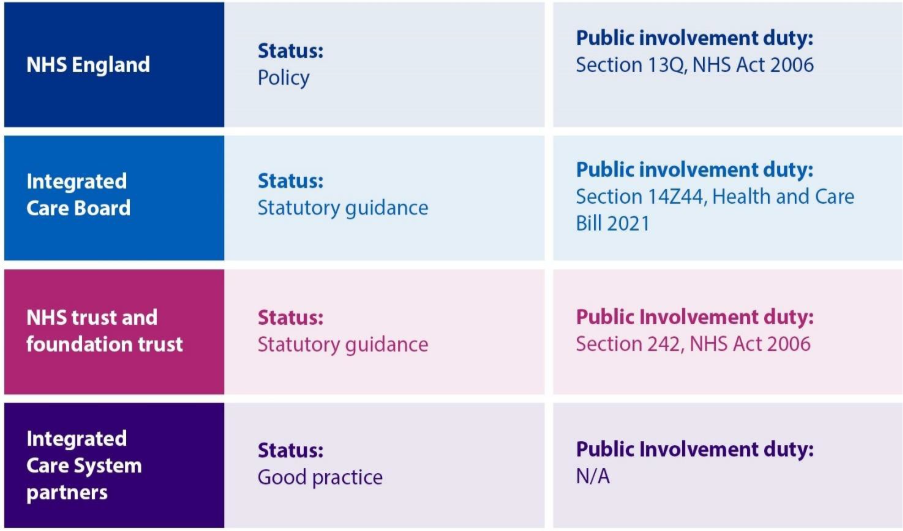
All of these benefits encourage patients to speak up and legitimises their views, but we must then ensure that their voices are heard and actions followed. If that isn’t enough reasons, we also have a legal duty to engage with patients, people and communities.  In fact, failure to do so risks legal challenge and substantial costs, not to mention damaging relationships between providers and the communities they serve. The following table is reproduced from NHS England’s Working in partnership with people and communities guidance and is a useful reminder of our duty of care in relation to public involvement: 

Table

So, that’s the ‘why’, but what about the ‘what’? Let’s bring our attention back to those examples of best practice we referred to at the beginning. For some fantastic case studies, take a look at the Patient Experience Network National Awards or the NHS England resources. Here are a few choice examples that relate to recent trends in healthcare… 

Firstly, healthcare inequalities. We are more aware than ever that people experience health care differently, so more effort is being made to ensure that people from marginalised communities are involved to support better understanding of how all people experience care. 

SPOTLIGHT: Healthcare inequalities – The Health and Wellbeing day for the Black community in Lambeth offered residents the chance to receive COVID-19 and flu vaccinations, key health checks, and important advice and support – all at an event aimed at bringing people together. Music, food stalls and family activities kept things fun and feedback from the event in October 2021 was so positive that the organisers hope to do it regularly. 

Next, there’s digital inclusion. While there have been some real benefits to moving online and being able to receive healthcare services without leaving our homes, we need to ensure that those who are digitally excluded are taken into consideration. 

SPOTLIGHT: Digital inclusion – Through the Picture This project, the Mental Health Foundation created fun ways to teach basic IT skills to people through art and drawing. Focusing on training people over 65, the project teaches them how to send an e-mail, how to connect with family and friends remotely and attend events, how to use Facebook and other social media channels, and how to order shopping online. These skills enhanced social interactions for participants, and supported mental wellbeing. 

Then, there is a growing trend around reward and recognition. Much involvement work offers out-of-pocket expenses only (which is the least that should be done when working with volunteers). However, there is a trend towards changing how we pay people for their time eg many organisations have offered varied honorariums for certain types of work. Guidance from the National institute for Health and Care Research (NIHR) from 2021 should be considered in the project design. 

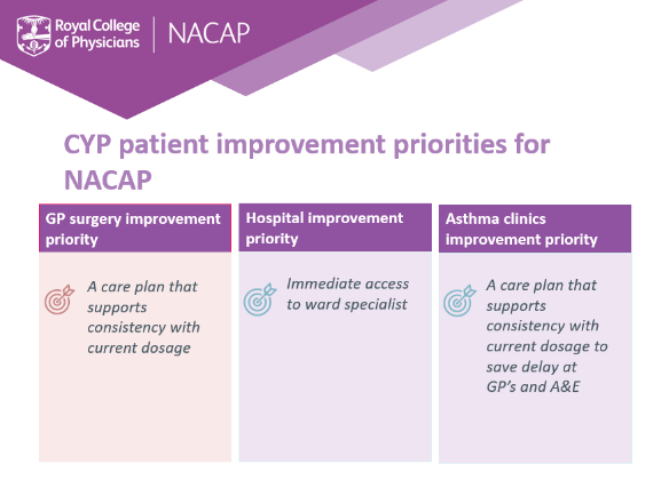
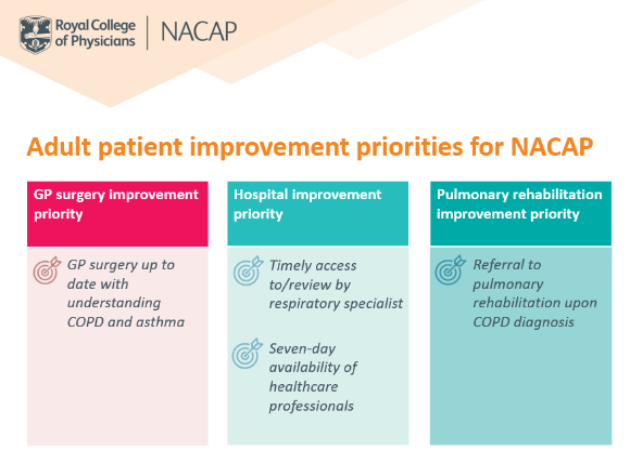
HQIP’s programmes have seen some fantastic examples of involving patients and carers. The National Asthma and COPD Audit Programme (NACAP, now NRAP), is an example that has demonstrated a genuine collaborative approach to working with charities, forums and patient panels. NACAP asked their patients and carers about what matters to them, and produced the following resources to empower patients of all ages to know what to expect from their care (which, in turn, improves the quality of the care they receive): 

Finally, I want to finish with a few words from a patient (this is all about patients and carers, after all!). This quote, from a patient representative in the NACAP award entry, sums up perfectly why we should put patients and carers at the heart of healthcare design, and reminds us that their health is the very reason for the service in the first place: “The surgery is my first port of call when my asthma is playing up, and I need to be sure that the doctors and nurses are going to be able to give me the best care possible. I want to get the most I can out of life despite having a lung condition, and I know that if the GPs are up to speed with new interventions and treatments, I have a better chance of doing so”.  

How to engage patients and carers 

How do we go about effectively involving patient, carers and communities in the healthcare services they receive? In HQIP’s guide Developing a patient and public involvement panel in quality improvement, we outline some simple steps to engage communities (and this can be used as the basis for an action plan): 

Leadership buy-in 

  • Make sure you have all your ‘ducks in a row’ before taking a proposal/business plan to senior teams. 
  • Consider what you want to involve people in. 
  • Draft out the process of how the involvement will work. 
  • Consider what it will cost. 
  • Talk to patients and other key stakeholders, and ask what they might want from this involvement. 

Recruitment 

  • Where will you find people to involve? 
  • What communication channels already exist that you can use initially? 
  • Where can you share information (posters/bulletins/leaflets/events) that will enable you to reach out to wider communities?  
  • Again, talk to people; what will people want and gain from being involved, and ask community leaders to support recruitment. 

Training – it’s very important to measure the impact of patient and carer involvement to demonstrate success and identify lessons learned for: 

  • the project 
  • the team 
  • the people involved, and 
  • for the long term (can the project be repeated or extended to other areas of work?). 

Patient and Carer Engagement at the Healthcare Quality Improvement Partnership – HQIP is committed to involving, engaging and informing patients and their representative organisations throughout our work. We ensure that patients and carers are reflected in all aspects, from commissioning programmes through to resource development: Find out more about how HQIP engages patients.

This article was originally featured in HQIP’s quality improvement magazine, CORNERSTONE volume 1.

Mind the (health) gap 

17 Jan 2023

Dr Josie O’Heney, 2021/22 National Medical Director’s Clinical Fellow, HQIP 

As a clinician, the human response is to focus on the problems right in front of you – the patient that has just arrived, the lack of beds or staff to care for people, the crisis in the moment et cetera… However, it is also important for healthcare providers to be aware of data. Unless you understand where there are problems, you can’t work towards solving them. Data informs us about the strategic changes that we need to make to improve care pathways and, importantly, reduce inequalities.  

Findings from MBRRACE-UK (Mothers and Babies: Reducing Risk through Audits and Confidential Enquiries across the UK) reports show stark differences in mortality rates amongst women from black-ethnic backgrounds compared to white women. While there has been greater investment in both research and policy changes (with the hope of improving outcomes for disadvantaged groups), we are still a long way from ‘levelling up’. However, without the data to highlight the problem, it is highly unlikely that we would have even started. 

The reports mentioned above were produced as part of the National Clinical Audit and Patient Outcomes Programme (NCAPOP), which is commissioned by HQIP – and this is one of the tools that has been instrumental in identifying health inequalities. The National Child and Mortality Database (NCMD) is another, with its data also highlighting stark inequalities. For example, over a fifth of all child deaths might be avoided if children living in the most deprived areas had the same mortality risk as those living in the least deprived.

To tackle this issue, NHS England has developed the Core20PLUS5 approach to health inequalities, which focuses on areas where stark inequalities in outcomes have been identified (in maternity, continuity of care for black, Asian and minority ethnic communities and those from the most deprived groups has been prioritised). The PLUS in Core20PLUS5 relates to identifying who in your local population is experiencing poorer than average health access, experience and/or outcomes, and targeting intervention to address it. While most healthcare professionals will have a broad understanding of this issue, it is important to scrutinise local data to really understand it. For example, is a particular population group missing appointments? Then they need to work out why, and target interventions accordingly. In other words, to reduce inequalities we need to start thinking smarter.   

The Health Inequalities workspace on the FutureNHS platform is another useful tool. It has excellent resources, including recorded webinars that explain the priority areas in addition to examples of good practice. The Health Inequalities Improvement Dashboard is also helpful, and can support the creation of actionable insights for reducing health inequalities. It enables you to review your data by region and by Integrated Care System (ICS), broken down by ethnicity, age and deprivation – helping you to identify where inequalities exist.  

We have always known that inequalities exist, and COVID-19 has shone an even more intense light on them (for example, black and South Asian people were “hit hardest” by the pandemic). So, think of this article as a call to arms for all healthcare colleagues… Think about your clinical area and where the inequalities may lie. Look at your local data, and ensure you are breaking down by ethnicity, deprivation and other protected characteristics. Above all, where inequalities exist, think about why, and what each and every one of us can do to instigate change for the better. 

In 2022, HQIP hosted a series of four online workshops with audit and clinical outcome review programme providers and other guests including patients, NHS England, the Care Quality Commission (CQC), NICE and NHS Digital. We explored collaboratively how we can use our audits and programmes – specifically the National Clinical Audit and Patient Outcomes Programme (NCAPOP) – to identify, measure and address health inequalities. We heard evidence of inequalities revealed by the NCPAOP, for example: 

  • A lower proportion of people of Asian and black ethnicity, as well as those living with deprivation, with type 1 diabetes are prescribed insulin pumps (recommended).  
  • Hypertension prevalence was 3.4 percentage points higher in the most deprived group of the population, compared with the least deprived.  
  • Effective treatment for hypertension was lower in black (63.9%) and mixed-race people (63.6%), compared with Asian (71.7%) and white people (68.2%). 

This webinar series identified seven themes: 

  1. There is plenty of opportunity for impact  – The evidence tells us that there is room for improvement in reducing health inequalities. Data from the NCPAOP can help to identify this, and distinguish between healthcare services. 
  2. There is widespread support for the work – The NHS Long Term Plan commits to tackling health inequalities, and all the NCAPOP projects were in support. 
  3. Addressing health inequalities is a broad challenge – System-wide developments are required, from data collection and coding, through to analysis and reporting. 
  4. We need to tackle the challenge of missing data – Chasing missing data is time-consuming and difficult. 
  5. Data quality could be improved – We need to be consistent about what the NCAPOP is collecting and how it is presented, and we need up-to-date information and census data. 
  6. Obtaining and using routine data presents challenges – Data and analysis are costly and requires skilled people, so consideration needs to be given to how we might unblock barriers. 
  7. We need to support the use of outputs by healthcare services – The data presented needs to be reliable and relevant for local populations, while healthcare services need the capacity to act on the data received. 

HEALTH INEQUALITIES: Spotlight on the Early Years. This report from HQIP aims to identify cross-cutting lessons relating to early years healthcare with a focus on health inequalities and variation in care, by reviewing a selection of audit reports from the National Clinical Audit and Patient Outcomes Programme (NCAPOP). Read in full: www.hqip.org.uk/resource/spotlight-on-the-early-years.

This article was originally featured in HQIP’s quality improvement magazine, CORNERSTONE volume 1

When is data the ‘right data’?

17 Jan 2023

Using the right data to support robust healthcare services.

Mirek Skrypak, previously Associate Director for Quality and Development, HQIP

“As I was gearing myself up to write this article about using data to develop robust healthcare services, I took receipt of a rather unusual delivery: A golden microphone with Bluetooth and a voice synthesiser. It proved momentarily inspirational, though how is that relevant, you might ask? Well, it prompted me to think about change and, in particular, how using the right data can support the right change.

On seeing my delivery (which was a present for someone else, by the way), I was struck by how much microphones have changed. I researched early microphones. Although it still performs the same essential function as the original from 1878, my new microphone differs significantly. This golden one with buttons, Bluetooth and charging cable etc shows many visible signs of change, most of which are in response to modern-day needs. Which led me to think about change in healthcare services.

The NHS is about 70 years younger than the microphone. Just like the microphone, you could say that it still performs the same function (to improve outcomes for those needing medical care). It also needs to change in order to respond to current need (not least in response to an increasingly ageing population). But how do we ensure that any change implemented is relevant, targeted where it’s needed most, and meaningful to service users? In response, I will share some learning that I think is invaluable in relation to data-informed service design within healthcare…

First, practice won’t change if you don’t have the right data. Whatever tools or techniques you use – whether process improvement, error reduction, waste trimming, agile scrum meetings etc – all of it needs to be done within context. In addition, you need to be curious; you need to ask questions and have ideas. Assuming you have all that, knowing what and how to measure is crucial. Simple right? Well, no! There are a number of variables, models, systems, frameworks and contexts etc that you also need to think about. However, I suggest that there is one other consideration that that is more important than all others: There should be no data without stories and no stories without data. The percentages or figures in charts, tables, recommendations and p values etc are all people. Think about it in terms of this fictional example… Let’s say that there is a national target of 80% for a particular process measure which evidence suggests will improve outcomes. There are circa 170 NHS sites, and let’s assume that 75% are achieving this 80% target for a particular clinical area and pathway. Then, let’s say that, in this pathway, there are 100,000 people who receive this care per year. That means 60,000 patients will achieve the target. But, what about the other 40,000? Suddenly this is not so positive. I know which side – or cohort – I would like to be on as a patient.

So how can we improve these numbers? Here at HQIP, we help service providers to find the right data, to take an effective approach to measuring, and to use that knowledge to build consensus for change. We strongly advocate the synchronisation of Quality Improvement (QI) with national clinical audit and confidential enquiries to enable improvement in outcomes at a national level. Find below what I hope is a useful summary of the key questions that need to be addressed by healthcare leaders and their teams when doing this…

As a manager or clinician:

  • Have you collected the data in the right way to be able to identify trends?
  • Do you have the right roles reviewing the data? Who owns it?
  • Do you know your audience? What is it they need to know?
  • Are you at risk of decision makers reacting unnecessarily?
  • How are you presenting your data? Have you presented the data to show a true picture over time?
  • Is there variation, and is this normal or the result of an exceptional circumstance?
  • Do you need to consider if it’s actually the system that needs reviewing, or does the target need to change?
  • Do you need to measure for a longer duration?

As a team or service:

  • Do we know how good we are?
  • Do we know where we stand relative to the best?
  • Over time, where are the gaps in our practice that indicate a need for change ie improvement?
  • In our efforts to improve, what’s working (and what isn’t)?
  • Do we know/understand where variation exists in our organisation?
  • Why are we measuring all this and what difference is this actually going to make to the quality of services?

That’s a lot of food for thought. And I don’t suggest, for one moment, that it’s an easy task. But it is necessary. While I’m not sure that we need a golden, ‘Bluetooth-enabled’ (or the equivalent) healthcare service, we do need to instigate change. I’m convinced – and I wish I had my gold microphone to hand to make this point – that the right data is the way forward in ensuring that those changes are relevant, meaningful and, above all, deliver maximum impact. However, I’m going to give a final word of caution to the renowned statistician David Spiegelhalter, who says: “Signals always come with noise: It is trying to separate out the two that makes the subject interesting.”

This article is one of a number of articles written for CORNERSTONE, HQIP’s free publication, designed to support Quality Improvement. It was featured in the 2023 edition, which features other articles on patient engagement, patient safety, and the importance of health data (among other topics). For more information, go to Healthcare improvement magazine – HQIP.

Cornerstone article on data