Latest news: April 2025 eBulletin

24 Apr 2025

April’s edition of HQIP’s eBulletin is available now. It features the most recent clinical audit and quality improvement updates, including:
  • Latest reports
  • Article: Using data to maximise resources
  • Clinical Audit Awareness Week 2025: awards deadline 27 April and initial events line-up announced!
  • 2025-26 Directory
  • Meet the HQIP team at NHS ConfedExpo and Picker Symposium events
  • The National Joint Registry (NJR) Patient Board representative role
  • The British Society for Rheumatology (BSR) – Patient Voices course
  • HQIP a finalist for three procurement UK National Go Awards
  • Article: Patient and Public Engagement in practice
Read the eBulletin here.
Don’t forget to sign up: Keep up to date with our latest news, events and work programmes by subscribing to our mailing list today. You can also follow us on LinkedIn and X: @HQIP

Clinical Audit Awareness Week 2025 – events & activities programme announced!

23 Apr 2025

We’re pleased to share the initial line-up of FREE events and resources taking place during Clinical Audit Awareness Week 2025 (#CAAW25, 2 – 6 June), run in collaboration with N-QI-CAN. As well as the return of the popular Lunch & Learn online events (where we will announce the winners of the 2025 Clinical Audit Heroes Awards), we also have several other exciting events and activities exploring key themes in clinical audit and quality improvement. Here’s what’s coming up (click the links below to register for webinars in advance):

Monday 2 June 2025

  • 10.00am: NEW video release on HQIP’s website – Improving sepsis care through clinical audit, with HQIP’s Chair Dr Celia Ingham Clark & Clinical Fellow Dr Ollie Burton
  • 12.30pm–1.30pm: Online Lunch & Learn – Patient Safety, hosted by NQICAN and featuring the Patient Safety award announcement (use this link to REGISTER IN ADVANCE)
  • 2.00pm–2.30pm: Live Q&A on HQIP’s X account – Balancing learning in clinical audit and quality improvement with patient safety, with HQIP’s Clinical Fellow, Dr Ollie Burton

Tuesday 3 June 2025

  • 10.00am: NEW video release on HQIP’s website – Real stories of Patient & Public Involvement (PPI), with HQIP’s Head of Patient Engagement, Kim Rezel, and members of HQIP’s Service User Network
  • 12.30pm–1.30pm: Online Lunch & Learn – Patient & Public Involvement (PPI), hosted by NQICAN with HQIP’s Head of Patient Engagement Kim Rezel, and featuring the PPI award announcement (use this link to REGISTER IN ADVANCE)
  • 2.00pm: NEW blog release on HQIP’s website – My Data, My Health (Patient engagement in data access), featuring patient members of HQIP’s Data Access Request Group

Wednesday 4 June 2025

  • 10.00am: NEW podcast release on HQIP’s website – Addressing healthcare inequalities through clinical audit, with Dr Aoife Molloy, Senior Clinical Advisor for Healthcare Inequalities Improvement, NHS England & Danny Keenan, HQIP Medical Director
  • 12.30pm–1.30pm: Online Lunch & Learn – Healthcare Inequalities, hosted by NQICAN with HQIP’s Professor Danny Keenan, and featuring the Healthcare Inequalities award announcement (use this link to REGISTER IN ADVANCE)
  • 1.45pm–2.30pm: Webinar and Q&A – Better cardiovascular care through data, with CVDPREVENT’s Dr. Peter Green, Liz Corteville & Dr Veena Raleigh (use this link to REGISTER IN ADVANCE)

Thursday 5 June 2025

  • 11.00am–12 noon: NHS IMPACT & HQIP webinar and Q&A on Healthcare Improvement, featuring NHS IMPACT’s Jody O’Brien (Collaboration and Partnerships Lead) & Amy Hodgkinson (Head of Deployment)
  • 12.30pm–1.30pm: Online Lunch & Learn – Influencing Change, hosted by NQICAN and featuring the Influencing Change award announcement (use this link to REGISTER IN ADVANCE)
  • 2.15pm–3.00pm: Webinar – Data-Driven Improvements in Maternity Care: A Regional Medical Director’s Perspective, with NHS England’s Dr Edward Morris CBE FRCOG & HQIP Associate Director Tina Strack (use this link to REGISTER IN ADVANCE)

Friday 6 June 2025

  • 10.00am–11.00am: Webinar – Clinical Audit Heroes Commendation Awards, with presentations by winning projects that 1) use NCAPOP data to drive healthcare improvements, and 2) communicate effectively (use this link to REGISTER IN ADVANCE)
  • 12.30pm–1.30pm: Online Lunch & Learn – Efficiencies, hosted by NQICAN and featuring the Efficiencies award announcement (use this link to REGISTER IN ADVANCE)
Remember, you can also support quality improvement in healthcare by organising your own events during Clinical Audit Awareness Week. Use our FREE toolkit of resources to support #CAAW25 activities in your organisation. Do keep a lookout for further announcements on speakers and activities on the dedicated #CAAW25 webpage; or follow HQIP and N-QI-CAN on X, and HQIP’s LinkedIn using the hashtag #CAAW25.

Clinical Audit Heroes Awards 2025 – now open!

10 Apr 2025

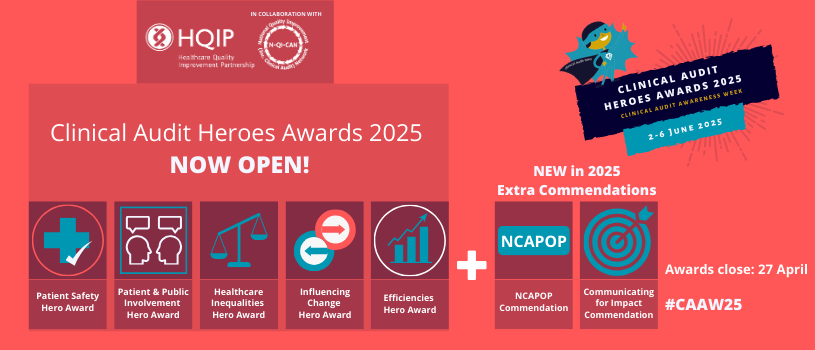
HQIP is thrilled to announce that the Clinical Audit Heroes Awards, part of Clinical Audit Awareness Week 2025 (#CAAW25, 2nd – 6th June), are officially NOW OPEN for nominations! Run in collaboration with the National Quality Improvement (incl. Clinical Audit) Network (NQICAN), these prestigious awards celebrate excellence in clinical audit and quality improvement across healthcare. This year, the awards recognise outstanding projects across five main categories: Additionally, two brand-new commendations have been introduced: the NCAPOP Commendation for projects using National Clinical Audit Patient Outcomes Programme (NCAPOP) data, and the Communicating for Impact Commendation for excellence in project communication. The winner(s) of each award will be announced during a series of #CAAW25 Lunch & Learn online events, running daily throughout 2nd– 6th June, from 12:30 – 1:30pm. These sessions will feature expert speakers discussing key themes on effectively utilising clinical audit to prevent patient harm, engage and inform patients and the public, improve healthcare inequalities, drive change, and make healthcare sustainable. You can register to attend these Lunch & Learn events by visiting the main #CAAW25 page. Entering the awards is quick and easy! Go to the Clinical Audit Heroes Awards page for details on the criteria, eligibility and online nomination forms for all awards. The deadline for nominations is Sunday 27th April 2025 (23:59). You can follow updates on the wider campaign on the dedicated Clinical Audit Awareness Week 2025 page, as well as on social media using #CAAW25.

New resources published in April 2025

10 Apr 2025

We are pleased to announce that the following new resources from HQIP-commissioned audits and programmes have been published. They include infographics, data and recommendations to support quality improvement:
  • Type 2 diabetes spotlight audit report – National Paediatric Diabetes Audit (NPDA) This report covers the care provided to children and young people (CYP) with Type 2 diabetes by paediatric diabetes units (PDUs) in England and Wales between 1 April 2023 and 31 March 2024.
  • Lung cancer 2023 patient cohort report – National Lung Cancer Audit (NLCA/NATCAN) This report covers the care received by people diagnosed with lung cancer in England and Wales during 2023. In addition to describing the patterns of care received, it focuses on the overall national figures, and incorporates cancer waiting times and genomics testing. It also contains five recommendations for improvement.

Further data

The following additional data have been released by HQIP-commissioned programmes:
  • Cancer – In addition to the above lung cancer output, the National Cancer Audit Collaborating Centre (NATCAN) also released quarterly updated performance indicators for all ten cancer audits, via interactive dashboards. Find out more here.
  • Stroke – The Sentinel Stroke National Audit Programme (SSNAP) quarterly report covering data for Oct – Dec 2024 has been published, and can be found here.

All reports: All HQIP-commissioned reports can be accessed via our dedicated reports webpage. Stay up to date: Join our mailing list to receive notifications when new reports are published.

HQIP a finalist for three UK National Go Awards

7 Apr 2025

HQIP is delighted to be a finalist in three categories at the UK National Go Awards, taking place 21 May 2025: Best Procurement Team, Best Procurement Delivery, and Next Generation.

The awards ceremony celebrates the very best procurement achievements from across the UK’s public, private and third sector organisations. The Best Procurement Team nomination recognises HQIP’s unique approach to value-based procurement, combining expertise in procurement, patient engagement and quality improvement. It also notes the support that HQIP’s procurement specialists offer to other organisations, helping them to improve the value and outcomes of their procurement. The Best Procurement Delivery nomination focuses on the creation of the National Cancer Audit Collaborating Centre (NATCAN) to host all NHS national cancer audits. HQIP proposed an innovative umbrella approach to tendering, rather than commissioning individual projects.  NATCAN has made excellent progress in the two and a half years since the start of contract, enabling the NHS to identify and address areas of variation in patient care. Jon Williams, Senior Procurement Manager at HQIP, is also a finalist in the Next Generation award category, recognising the tenacity and innovation that he has brought to his role since joining the organisation in 2021 and his commitment to social value. Judith Hughes, Associate Director of Procurement at HQIP, comments: “I am proud that our thoughtful, value-based approach to procurement has been recognised by the Go Awards. We believe that integrating patient input into procurement can be transformative in driving greater value across the supply chain. That’s why we embed patient voice not only through our own commissioning, but also support and inspire other healthcare organisations to do the same.”

Our specialist healthcare procurement team provide:

  • Expert consultancy and bespoke training to embed quality, value, and patient voice into procurement
  • Flexible resourcing, from needs definition to contract award
  • Stakeholder, patient, and supplier engagement to shape procurement strategies and improve outcomes
Find out more about our Procurement+ approach or contact the team directly on workwithus@hqip.org.uk

The value of audit in identifying health inequalities

6 Apr 2025

Multiple inequalities in diagnosis and treatment are identified by the National Prostate Cancer Audit (NPCA)

What has the NPCA found?

The NPCA’s most recent State of the Nation report, published in January 2025, included a section which focused on inequalities in prostate cancer diagnosis and treatment. More specifically socioeconomic, demographic and ethnic differences between people diagnosed with prostate cancer between 2020 and 2023 in England. What they found showed that the inequalities identified in previous studies persist. Here they explain more… Inequalities at diagnosis: 90% of men diagnosed with prostate cancer had their ethnicity recorded and of these 90% were white, 5% Black and 2.4% Asian. 84% of men diagnosed with prostate cancer were between 50 and 79 years old and 24% lived in the least deprived areas. When adjusting for the size of the male population, white, Black or Asian, the Black population has the largest number of new diagnoses compared to the white and Asian groups, with 17 new diagnoses per 1000 men in black men aged 70-74. 79% of diagnoses had a stage recorded and of those, Black ethnic groups had a higher proportion of new diagnoses per 1000 men at stage 1 than other ethnic groups. We found stage 4 cancer to be the most common diagnosis in white men aged 85 years and over, which highlights late diagnosis in older men. These findings are limited by the low data completeness (49%) of stage for white men aged 85 years and over. Inequalities in treatment: 68% of black men aged 60 to 69 years with high-risk/locally advanced cancer received radical treatment compared to 82% white men of the same age and disease stage. We found a difference in radical treatment between least and most deprived areas, from 83% to 75% for men aged 60 to 69 years. A final finding was that treatment declines significantly from the age of 75 and that younger patients are more likely to receive treatment. In men with prostate cancer that has already spread at diagnosis, Black men were 24% less likely than white men to receive chemotherapy or additional hormone treatments. The same difference (24%) was observed when comparing men living in the most deprived areas than in the least. The special report on inequalities highlights a need for specific interventions to improve prostate cancer care so that it is equitable across all patient groups.

How can these findings be used to improve standards of care?

Results from the NPCA, in both our annual State of the Nation Reports and in our research articles, serve to highlight unwarranted differences in diagnoses and treatment at the population level which can be used as real-world evidence if national prostate cancer care guidelines are revised. Subsequent changes in wording would raise awareness of potential variation and provide support for patients to access equitable care at every step of their journey. This would ultimately lead to improved outcomes for people diagnosed with prostate cancer, regardless of when or where they were diagnosed and treated. There are many factors which influence the differences in prostate cancer care which we have described, whether alone or in combination, some of which may relate to patient choice and preference. These are complex in nature and different approaches by multiple groups and decision makers will be required to ensure men diagnosed with prostate cancer are offered and receive optimal care, ultimately resulting in improved outcomes. The NPCA, being commissioned by the English NHS and the Welsh Government, work closely with clinical leads to provide evidence of where improvements are needed and our stakeholders include professional bodies across the care pathway and colleges with influence on national level policy making.

What is the National Prostate Cancer Audit?

The National Prostate Cancer Audit is part of the National Cancer Audit Collaborating Centre (NATCAN), commissioned by Healthcare Quality Improvement Partnership (HQIP), on behalf of NHS England and the Welsh Government, as part of the National Clinical Audit and Patient Outcomes Programme (NCAPOP).

What does the NPCA do?

The aims of the NPCA, and audits within NATCAN, are to provide cancer services in England and Wales with regular updates on their performance against national standards (when these exist) and other providers, through annual and quarterly reports. This means that we can also evidence whether different patterns of care are seen in different trusts or health boards. By shining a light on these differences, the audits enable NHS services to reflect on their provision and identify changes needed in order to provide equitable access to treatments for all patients, regardless of where they present. The NPCA, and audits within NATCAN, don’t ‘collect’ clinical data, we receive it from the National Disease Registration Service (NDRS) in NHSE and the Wales Cancer Network in Public Health Wales, with whom we work to improve data completeness. We have access to information on the diagnosis, treatments and outcomes of all patients newly diagnosed with prostate cancer in England and Wales as recorded by the providers themselves. This includes staging, how the patient presented, what their health is like generally, and what procedures they underwent, including surgery, radiotherapy or if they received systemic treatment such as chemotherapy or hormonal treatment.

What are the aims of the NPCA?

The NPCA redefined the scope of its work in 2023 and alongside that, identified key Quality Improvement goals in 2024 which ensure patient benefit continues to be at the heart of the work of the audit. Among these, reducing variation in prostate cancer management among NHS providers and improving experience of care among men with prostate cancer.

How does the NPCA achieve this?

The NPCA summarises the information received from routine data collections and produces an annual report (since 2014) which provides a national picture of the state of prostate cancer care in England and Wales. This means we have been able to monitor variation and changes in prostate cancer care for over a decade and make targeted suggestions to providers and commissioners on how to improve care. The audit feeds back information and recommendations to each provider so that they can truly reach the clinicians who can act on it, through the use of local action plans. Since 2024, we also produce quarterly reports, and since April 2025, a data dashboard updated quarterly is available collating data quality of key items and one performance indicator. Prior research undertaken by the audit reported on variation in care by ethnicity, age, socioeconomic status, and geographic location such as our report on treatment of men with high-risk or locally advanced prostate cancer. This identified differences in receipt of treatment for black and socio economically more deprived men. Short reports in 2020 and 2022 separately highlighted variation in diagnosis and care by ethnicity, age and socioeconomic status, so a comprehensive update on these findings was warranted to be able to identify the reasons behind the variation. A research study published in April 2025, looking at the geographic, socioeconomic and demographic inequalities in the incidence of prostate cancer which has spread at time of diagnosis identified unwarranted variation in England (2018-2022). Key findings include:
  • Regional annual rates of prostate cancer diagnoses where it has already spread (metastatic) were found to vary between 4 and 7 per 100 000 men
  • Higher rates of metastatic prostate cancer were seen in regions with lower rates of prostate cancer diagnosis overall
  • Higher rate of metastatic prostate cancer and a lower rate of prostate cancer overall was also seen among men living in more deprived neighbourhoods
In the future, the NPCA will aim to monitor the incidence of prostate cancer which has already spread at time of diagnosis considering these findings. This would provide an opportunity to assess improvements in timely diagnosis (and the ensuing ramifications for national policy about screening and early detection) more thoroughly than by just reporting the proportion of men diagnosed with prostate cancer who have metastatic disease. The programme of research of the NPCA is embedded in the audit activities and is key to the NPCA’s aim to get a better understanding determinants of variation and propose ways to ensure men diagnosed with prostate cancer at any stage benefit from equitable care.

What else is the NPCA doing?

The NPCA will be running a quality improvement initiative aiming to improve rates of treatment for men diagnosed with prostate cancer that has spread. We have already found that older men and Black men (when compared to white men) are less likely to receive treatment during earlier stages of the disease. We hope to understand the barriers to treatment which exist and by working with our partners at local and national levels, propose recommendations which will improve care, and ultimately outcomes, for men diagnosed with prostate cancer that has spread. Further information – links:
  • National Prostate Cancer Audit (NPCA)
  • The National Cancer Audit Collaborating Centre (NATCAN).
This article was shared as part of Clinical Audit Awareness Week 2025. Have your say on #CAAW25: Feedback form.


Clinical Audit Awareness Week 2025: Lunch & Learn events – sign up now!

2 Apr 2025

We’re pleased to announce the return of our popular Lunch & Learn online events during Clinical Audit Awareness Week 2025 (#CAAW25, 2nd – 6th June)! These sessions will take place daily from 12:30 to 1:30 PM and will feature a different theme. Please note that attendees are required to register in advance for each event. Click the links below to sign up.
  • 2 June: Patient Safety – Effectively utilising clinical audit to prevent avoidable harm
  • 3 June: Patient & Public Involvement (PPI) – Effectively utilising clinical audit to improve health and care by involving, engaging and informing patients and the public
  • 4 June: Healthcare Inequalities – Effectively utilising clinical audit to address inequalities in health and care
  • 5 June: Influencing Change – Effectively utilising clinical audit to influence change
  • 6 June: Efficiencies – Effectively utilising clinical audit to make healthcare sustainable.
Keep an eye out for the speakers that will be announced over the next few weeks. We’ll also be sharing updates on other events and activities throughout April and May! Details of all activities, events and daily Lunch & Learns being planned by HQIP, NQICAN and other partners will be shared over the coming weeks – you can stay up-to-date using the following channels: Online: Details on how to get involved in the Clinical Audit Heroes Awards and the wider #CAAW25 campaign will be made available on both HQIP and N-QI-CAN’s websites, as it becomes available. Newsletter updates: We will share updates in HQIP’s monthly eBulletins, while N-QI-CAN will provide updates via their enewsletter and ‘Forum’ (National Network and Sharing Forum, NNSF). Social media: You can also follow HQIP and N-QI-CAN on X, and HQIP’s LinkedIn, where information will be posted (look out for and use #CAAW25).

Benchmarking data available: National Ophthalmology Database Audit

2 Apr 2025

The National Ophthalmology Database Audit is the latest dataset to be published on the National Clinical Audit Benchmarking (NCAB) website. This data was updated on NCAB 12 February 2025 from the NODA report 2023 published on 2 May 2024 covering data from 1 April 2022 to 31 March 2023.

NCAB is an online portal, hosted by HQIP, which provides access to national audit performance data. Users do not need to register, and can access audit benchmarked data searchable by speciality, Trust, hospital or unit. For all datasets currently published, go to the NCAB site.