Introducing NCA-ACE: a new national collaboration for clinical audit and effectiveness

30 Apr 2026

The National Clinical Audit and Clinical Effectiveness Collaborative (NCA-ACE) is being launched by the Healthcare Quality Improvement Partnership on behalf of NHS England.

A dedicated workspace on NHS Futures will provide a national hub for clinical audit and effectiveness professionals to connect, share best practice, and align local work with national audit and registry programmes. National stakeholders will join a biannual meeting to share the wider work being undertaken, for example, CQC, HSSIB, NICE.

NCA-ACE will support collaboration, reduce duplication, and strengthen the use of data to drive quality improvement across the NHS.

All eligible members will receive an invite and a full calendar of events for 2026 is now available.


Keep up to date with our latest news, events and work programmes by subscribing to our mailing list today. You can also follow us on: LinkedIn and X: @HQIP

Latest news: April 2026 eBulletin

30 Apr 2026

The April edition of HQIP’s eBulletin is out now! It features the latest news and updates relating to clinical audit, outcome reviews and data-informed healthcare improvement, including:

  • Clinical Audit Awareness Week – Webinar registration open
  • Share your #CAAW26 plans
  • Introducing NCA-ACE: A new national collaboration for clinical audit and effectiveness
  • New version of The Directory for 2026-27
  • HQIP welcomes new Medical Director
  • HQIP data features in NHS Model Health System
  • Survey now open: Inform our system analysis of Patient and Public Involvement and Engagement (PPIE) in Health Data
  • A unique perspective: Seeing both sides of the story
  • Measure, learn, improve: Audit data and continuous learning in the NHS
  • HQIP job opportunity: Procurement Support Officer
  • Tender: National Paediatric Critical Care Audit

Read HQIP’s latest eBulletin here.


Don’t forget to sign up: Keep up to date with our latest news, events and work programmes by subscribing to our mailing list today. You can also follow us on: LinkedIn and X: @HQIP

Registration open: free Clinical Audit Awareness Week webinars

22 Apr 2026

Registration is now open for a national series of webinars forming the centrepiece of Clinical Audit Awareness Week 2026 (#CAAW26), offering clinicians, clinical audit, improvement and other healthcare professionals a unique opportunity to explore how data-driven insight can transform patient care.

Running from 22 – 26 June 2026, the annual campaign, organised by Healthcare Quality Improvement Partnership (HQIP), aims to improve and save lives by promoting the value of clinical audit and quality improvement across the health system.

Discover the 2026 webinar programme

This year’s programme features a packed schedule of online sessions across five themed days, all free to attend, with a focus on turning insight into action and showcasing innovation, collaboration, and real-world impact.

The week opens on Monday with a strategic look at how clinical audit supports major NHS priorities, including the three shifts of the NHS 10-Year Plan. The session will explore how audit can translate national ambitions into measurable improvements in patient outcomes, while also helping reduce variation and prioritise resources.

On Tuesday, attention shifts to patient involvement and equity, highlighting how meaningful engagement with patients and communities can lead to more inclusive services and better outcomes. Sessions will examine patient and public involvement at both local and national levels, alongside a dedicated discussion on tackling inequalities in maternity care.

Midweek, Wednesday focuses on innovation and transformation, exploring how new tools and technologies are reshaping clinical audit and improvement practices.

The programme continues on Thursday in partnership with Patient Safety Learning, looking at patient safety and examining how robust data and clinical audit can be used to identify risks, reduce harm and build safer systems of care. Presenters include Professor Henrietta Hughes OBE, Patient Safety Commissioner; Dr Jacqueline Andrews, Executive Medical Director, Harrogate and District NHS Foundation Trust and HQIP Trustee; Chris Boulton, Director of Operations, National Joint Registry; Faith Sheils, Director of Midwifery, Northern Care Alliance NHS Foundation Trust; and Dr Colin Dunkley, Consultant Paediatrician, Sherwood Forest Hospitals and Epilepsy12 Clinical Lead.

On Friday, the final day turns to data-informed improvement and impact, exploring how evidence is translated into real-world change. The sessions consider how national audits, registries, and patient-focused data drive real improvements in care, from strategic outcomes and NICE EVAR alignment to local CAMHS services. Presentations will explore patient perspectives, data quality challenges, and practical lessons from regulators, while a panel and resident doctor share insights on turning audit into meaningful change for patients and services.

Presenters at the Friday webinars include Dame Celia Ingham Clark, HQIP Chair and former NHS England Deputy Medical Director; Professor Ted Baker, Chair of Health Services Safety Investigations Body (HSSIB); John McGrath, National Clinical Director, Robotics Registry; Kate Cullen, National Paediatric Diabetes Audit (NPDA) patient representative; Tom Hunter, Mental Health Nurse and Plymouth CAMHS; and Dr Karina Allan and Philippa Nunn, National Audit of Eating Disorders (NAED).

Across the week, lunchtime sessions will also showcase winners of the Excellence in Clinical Audit Awards, celebrating best practice from across the sector.

Timely and practical support for those working to improve care quality

The webinars are designed to support clinicians, healthcare planners, and audit and quality improvement professionals in making better use of healthcare data. By sharing insights, case studies, and emerging approaches, the sessions aim to help professionals raise standards, reduce unwarranted variation and ultimately ensure patients receive the best possible care.

Clinical audit remains a cornerstone of healthcare improvement, enabling professionals to systematically evaluate practice against standards and identify opportunities for change. Clinical Audit Awareness Week provides a platform not only to share learning but also to strengthen collaboration across disciplines and organisations.

With growing demands on health systems and increasing emphasis on data-driven decision-making, the 2026 webinar series offers timely and practical support for those working to improve care quality. Free access and a diverse programme of topics make it a valuable opportunity for professionals at all levels.

REGISTER FOR #CAAW26 WEBINARS

HQIP welcomes new Medical Director

20 Apr 2026

We are delighted to announce that Professor Tom Wilkinson has been appointed as HQIP’s new Medical Director, following the retirement of Professor Danny Keenan.

Professor Wilkinson was most recently the Senior Clinical Lead for the National Respiratory Audit Programme (NRAP), which is managed by the Royal College of Physicians and is part of the HQIP-commissioned programme of national clinical audits. Alongside his role at HQIP, Tom will continue as Professor of respiratory medicine at the University of Southampton and honorary NHS consultant physician at University Hospital Southampton NHS Foundation Trust.
This wealth of healthcare and research experience, together with an in-depth knowledge of clinical audit, means that Professor Wilkinson understands not only the systemic challenges facing healthcare today, but also the difference that patient-centred, evidence-informed improvement makes. His insights will be pivotal when supporting clinical audits to work in partnership with healthcare commissioners and providers, to translate data into tangible improvements in care.

Commenting on his appointment, Tom said: “I am passionate about using data to provide actionable insights into how services are organised, and to identify and help address variations in outcomes. I look forward to working with the wider healthcare community to help drive improvements in care across the breadth of NHS services.

With over 20 years’ experience in asthma and Chronic Obstructive Pulmonary Disease (COPD) research and clinical service development, Professor Wilkinson leads the Southampton COPD research group as well as the airways disease theme of the NIHR Southampton Biomedical Research Centre, and is a long-time champion of the value of healthcare data in saving and improving lives. This appointment presents a significant opportunity to maximise the impact that data has on patient outcomes across a wide range of care areas, and is particularly timely in light of the aims of the NHS 10 Year Plan and more recent healthcare strategies, such as the new National Cancer Plan.

Chris Gush, HQIP Chief Executive, underlines the importance of this key appointment: “Tom will provide senior clinical leadership across HQIP’s portfolio of national programmes. He is well placed to represent the voice of both clinicians and patients in national discussions around clinical audit, registries and quality improvement, leading to strategic partnerships that support those providing care to change outcomes for patients for generations to come.”

Professor Wilkinson will take up the position of HQIP Medical Director from 1 May 2026. Professor Danny Keenen – to whom we would like to extend our gratitude for many years of service, supporting evidence-informed improvement in healthcare – will retire on 8 May 2026.

Find out more about the work of NRAP

Tom Wilkinson

Survey now open: Inform our system analysis of Patient and Public Involvement and Engagement (PPIE) in Health Data

17 Apr 2026

Your opportunity to share how patients and the public are involved in health data work

We are carrying out a UK-wide project to understand how patients and the public are involved in decisions about how health and care data is used beyond direct care. This includes data used for research, service planning, evaluation, and improvement.

Who are we asking to take part?

Why take part?

We’re building a national picture of what’s really happening in practice – what works well, what doesn’t, and where things need to change. Your input will help:

  • Identify what meaningful involvement looks like in practice
  • Surface common challenges and barriers
  • Highlight opportunities to strengthen involvement across the UK.

Complete the survey

All responses are anonymous and will directly inform national insight and future policy and practice. The survey takes around 10 minutes and will close on Monday 18 May 2026.

Who is running this?

This project is led by HQIP on behalf of Understanding Patient Data (UPD). If you have any questions, please contact PPIEinhealthdata@hqip.org.uk

What will happen to your responses?

  • Your responses will be anonymous
  • Data will be securely stored and handled by HQIP
  • Findings will be used to inform future policy and practice.

You can read HQIP’s Privacy Notice to find out more on how your data will be used and protected.

Thank you for helping shape the future of public involvement in health data.

We would be grateful if you could also share this with your networks and contacts.

Measure, Learn, Improve: Audit data and continuous learning in the NHS

15 Apr 2026

Across the NHS, clinicians and teams collaborate every day to provide safe, effective, and compassionate care. Drew Smith, HQIP Associate Director, argues that what turns this collective effort into a system that continuously learns and improves is not intention alone, but evidence…

Clinical audit and outcomes data provide that evidence. They allow us to see clearly how care is delivered, where variation exists, and what difference improvement efforts make over time. In short, successful learning and improvement are built on audit data, resulting in the most valuable of outcomes: improving and saving patients’ lives.

Interest in learning health systems is growing internationally as a means of solving problems and driving continuous improvement. In the UK, the Ten Year Plan for the NHS in England anticipates that “data will fuel continuous learning”. A learning health system is one in which data from routine care are systematically collected, analysed, and fed back to those delivering and planning services, creating a continuous cycle of learning and improvement. Audit and outcomes data sit at the heart of this cycle. They bring together high-quality, standardised data across organisations and care pathways to measure patient care against nationally-recognised standards.

What turns the NHS “into a system that continuously learns and improves is not intention alone, but evidence”

But at their best, audits do more than measure compliance with standards. They ask meaningful questions about quality: Are patients receiving the right care, at the right time, in the right place? Are outcomes improving, and are improvements experienced by everyone? Have changes to service delivery actually made a difference to what matters to patients?

Transparency is a critical mechanism through which audit data drive improvement. When data are fed back in a timely, accessible, and clinically credible way, they prompt reflection and dialogue. Teams can benchmark their performance, identify unwarranted variation, and learn from peers who are achieving better outcomes. Creating the conditions for curiosity and shared learning is as important as quality assurance.

Audit data also support improvement by enabling prioritisation. Health systems face constant pressure on time and resources. Robust outcomes data help leaders and clinicians focus improvement efforts where they will have the greatest impact for patients. They provide a basis for difficult decisions and help ensure that improvement activity is aligned with objective evidence rather than subjective assumptions.

“At their best, audits do more than measure compliance with standards; they ask meaningful questions about quality”

Importantly though, learning does not happen through data alone. It happens when data are interpreted in context and combined with clinical expertise, patient experience, and improvement capability. This is why projects commissioned by HQIP through the National Clinical Audit and Patient Outcomes Programme (NCAPOP), make quality improvement support available alongside measurement. Providing tools, case studies, and networks for shared learning helps translate insight into action and accelerates the pace of change.

For example, the National Audit of Care at the End of Life (NACEL) breaks the quality improvement journey down into six phases and signposts to resources at each stage. Alongside this, NACEL offers inspiration through an impact compendium and regular QI webinars.

Audit and outcomes data also play a vital role in addressing health inequalities. By disaggregating data by factors such as age, sex, ethnicity, deprivation, and geography, audits can reveal differences in access, treatment, and outcomes that might otherwise remain hidden. Making these differences visible is a necessary first step towards tackling them. A learning system is one that learns for all patients, not just the majority.

The pace of learning is another defining feature of a learning health system. NCAPOP audits are increasing the frequency with which data and quality improvement resources are made available, so clinical teams are able to test changes, see early signs of impact, and adapt more quickly.

“When we use audit and outcomes data wisely, we move closer to a health system that learns continuously”

Finally, audit and outcomes data help sustain improvement over time. One-off projects can deliver short-term gains, but without ongoing measurement it is difficult to know whether those gains have been sustained. Continuous audit provides a way to monitor progress, reinforce good practice, and adapt to new evidence or changing circumstances. To this end, many NCAPOP projects publish dashboards that track national and hospital performance over time, such as this dashboard on asthma in adults as part of the National Respiratory Audit Programme.

In the NHS, the ambition to become a learning health system is not abstract. It is rooted in the daily realities of care and the shared commitment to do better for patients. Audit and outcomes data give us the means to learn systematically from those realities. By investing in high-quality audits, focusing on meaningful outcomes, and supporting teams to use data well, we can create a virtuous cycle of measurement, learning, and improvement.

When we use audit and outcomes data wisely, we move closer to a health system that learns continuously – and one that delivers safer, more effective and more equitable care for everyone.

Further information 

Learning NHS article D Smith

The Directory 2026-27

15 Apr 2026

A new version of The Directory has been published.

This revised version is the result of a comprehensive review and includes updated provider organisation listings with information for 2026-27.

The HQIP ‘Directory’ is a publicly available guidance document that collates high level information supplied by the teams that manage national audit and quality improvement programmes. It is a tool/resource designed to assist healthcare service providers in planning their audit activity each year.


Stay up to date: Join our mailing list to receive notifications when new reports are published.

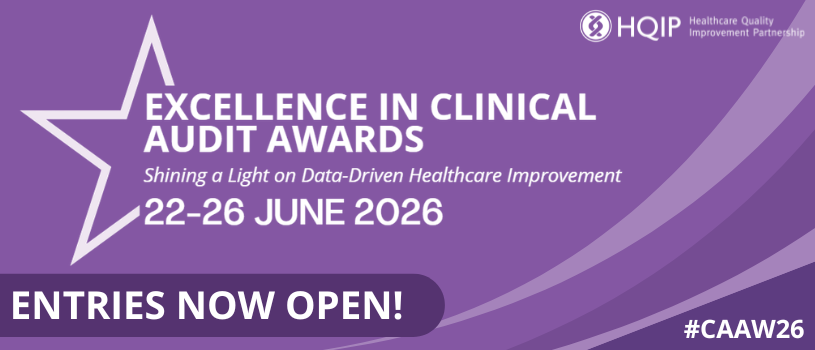
Last chance: Excellence in Clinical Audit Awards close 19 April

13 Apr 2026

Excellence in Clinical Audit Awards close for entries Sunday 19 April.

The Excellence in Clinical Audit Awards celebrate the individuals and teams who are transforming healthcare through rigorous clinical audit and evidence-informed improvement projects. They offer a chance to showcase your project and gain recognition for the difference you’re making.

Formerly the Clinical Audit Heroes Awards, the awards, which form part of Clinical Audit Awareness Week 22 – 26 June, have been renamed to reflect the professionalism, impact, and high standards demonstrated by recipients.
Each category has its own page with much more detail, including judging criteria, eligibility, and the entry form.
DEADLINE EXTENDED: Noting that we receive a number of entries at weekends, we have extended the deadline for entries from 17 April to Sunday 19 April 2026 (23:59) to support those who prefer to apply on a weekend.

Awards categories

In addition to the five main award categories, we will also be awarding two Commendations:
Click here for further details for each award category. Good luck, we look forward to receiving your entry!

New data, April 2026

9 Apr 2026

We are pleased to share that NEW DATA to support improvement in healthcare, from HQIP’s audits and programmes, is now available:

  • Stroke care: Sentinel Stroke National Audit Programme (SSNAP) – Quarterly Data October to December 2025
  • Cancer care: National Cancer Audit Collaborating Centre (NATCAN) – Quarterly Data from each of:
    • National Primary Breast Cancer Audit (NAoPri)
    • National Metastatic Breast Cancer Audit (NAoMe)
    • National Ovarian Cancer Audit (NOCA)
    • National Pancreatic Cancer Audit (NPaCA)
    • National Non-Hodgkin Lymphoma Audit (NNHLA)
    • National Kidney Cancer Audit (NKCA)
    • National Bowel Cancer Audit (NBOCA)
    • National Oesophagogastric Cancer Audit (NOGCA)
    • National Prostate Cancer Audit (NPCA)
    • National Lung Cancer Audit (NLCA)

All reports: All HQIP-commissioned reports can be accessed via our dedicated reports webpage. Stay up to date: Join our mailing list to receive notifications when new reports are published.

Tender: National Paediatric Critical Care Audit

8 Apr 2026

Closing date: 8 May 2026 at 12:00

HQIP is seeking to commission the delivery of the National Paediatric Critical Care Audit.

The contract will initially be delivered for NHS-funded care in England for a period of 3 years. Further details can be found on HQIP’s tenders webpage.

A unique perspective: Seeing both sides of the story

7 Apr 2026

Meg uses her dual experience of maternity care and as a service user representative to explain why both patient voice and data must form the cornerstone of healthcare improvement.

Meg, who has been part of HQIP’s Service User Network (SUN) for a number of years, offers an interesting patient perspective. As an antenatal teacher in her professional life, she has a wealth of experience in maternity improvement at local, regional and national levels. So, with a ‘foot in both camps’, we were keen to know what Meg has to say about the value of patient voice and data in improving healthcare…

Her involvement began more than a decade ago with her local Maternity Services Liaison Committee, which later became a Maternity and Neonatal Voices Partnership. Over the years she chaired her local network, contributed to regional maternity systems, and participated in national projects centred on patient safety, coproduction and service improvement. This experience nurtured a deep belief that “healthcare can only improve when the people who use it are actively shaping it.”

The power of patient voice

As such, Meg is a long-time advocate for embedding service user voices into every layer of healthcare – from individual care experiences to national policy and audit. She summarises it simply: “understanding lived experience helps the system to ask the right questions, and avoids floundering in the dark.” Co-production, in particular, is something that Meg is keen to stress has many benefits for service providers and patients alike.

“Working collaboratively with patients to design services helps to get things right the first time, reducing costs and inefficiencies. It also ensures that people can access the right care in the right way, helping to address inequalities.” Importantly, Meg can see that it could play a key role in one of the biggest issues currently affecting healthcare: “By working together, we can identify risk early and prevent harm; particularly in areas like maternity, where safety concerns have been so prominent.”

The greater power of patient voice and evidence

This brings Meg to data. She feels that patient voice brings context to data, offering insight into what is happening ‘on the ground’. With patients involved in designing care, people “have trust in data and the decisions made,” she says. More generally, Meg stresses the value of using healthcare data when developing services, but suggests its value is more nuanced than that: “The true value of data lies in not only answering the questions we already have, but also in its ability to provide insights into the issues we never realised existed.”

The MBRRACE-UK maternal mortality findings loom large as an example. When looking at 2014-16 data, this HQIP-commissioned programme found that women from Black ethnic backgrounds had five times the risk of maternal mortality, compared to white women. After a national focus and targeted strategies, prompted by the data, the disparity was reduced to around double 2021-23“Still unacceptable, but evidence of significant progress. But, without data it would still be five times – or worse!” Meg is keen to stress how widely trusted MBRRACE-UK data is, and how midwives, obstetricians and a variety of others working in maternity depend on it: “Its reliability and careful methodology mean it informs everyday clinical decisions as well as national improvements.”

From data to action

For Meg, collecting data is only the beginning. “We need to use it,” she emphasises – not just analyse endlessly. She points to the way that maternal mortality data has been translated into equity strategies across England’s ICBs, quoting the following examples:

  • More culturally competent care
  • Specific clinical conversations, such as guidance around vitamin D
  • Training to challenge structural and personal biases
  • Changes to how care is delivered in communities where risks are highest.

This, she says, is a powerful example of data “moving from spreadsheet to strategy to real-world change”.

The power of the SUN

Meg describes discovering HQIP during a period of postgraduate study in public health, and being drawn to the chance to broaden her involvement beyond maternity. The idea of contributing to work that cuts across healthcare appealed to her. What she found confirmed her hopes. “Voices are constantly being asked for,” she explains. “It feels like a genuinely embedded part of HQIP’s work.” Knowing that service user perspectives are both sought and meaningfully included has built her trust in the outputs – even for projects she hasn’t personally worked on.

Since joining the HQIP ‘s Service User Network (SUN), Meg has taken part in a wide range of activities, including:

  • Judging the HQIP Clinical Audit Awards, which allowed her to see outstanding practice in diverse areas such as patient safety and sustainability
  • Inputting into audit development and contributing to national audit work
  • Speaking to clinicians and stakeholders about coproduction, helping reinforce why it matters and how it can transform services.

Across these experiences, Meg emphasises how valuable it is to work with a well-run, responsive network. One of the strongest positives she identifies is the absence of tokenism. “It feels meaningful,” she says. “It’s not a tick-box exercise.” Knowing that her contributions will influence real work and real outcomes gives her a sense of purpose. Meg also stresses the wider societal benefit: “involving people with lived and diverse experiences helps to ensure that healthcare is genuinely usable, equitable and trustworthy.”

In terms of challenges, she raises one note of potential concern: namely, the need for audits to steer clear of ‘political’ influence. While she acknowledges that this is common across many sectors, she emphasises how crucial it is – especially in healthcare – for audit voices to be able to tell the full story: “otherwise the system risks missing opportunities to prevent harm.”

Looking ahead to the future

Meg is hopeful about the progress that has been made through a combination clinical audit and patient engagement, in maternity and beyond. However, she is cautious about repeated cycles of inquiries, saying that there needs to be an equal emphasis on acting quickly with what is already known.

But her overall message is clear: service user involvement, high quality audit and meaningful use of data are all fundamental to safer, more equitable and more compassionate healthcare. And she believes networks like HQIP’s SUN are crucial to making that happen.

Further information

Benchmarking data published

6 Apr 2026

The following dataset was recently published on the National Clinical Audit Benchmarking (NCAB) website, HQIP’s online portal which provides access to national audit performance data.

NCAB is an online portal, hosted by HQIP, which provides access to national audit performance data. Users do not need to register, and can access audit benchmarked data searchable by speciality, Trust, hospital or unit. For all datasets currently published, go to the NCAB site.