Welcome to the latest round-up of clinical audit and quality improvement news from HQIP, sent out to subscribers in December 2024. Contents of this edition include:
New resources published in December
How can HQIP support quality improvement?
New CVD resources available online & webinar
Reminder: Perioperative care tender
HQIP closure dates
Read the eBulletin here.
Don’t forget to sign up: Keep up to date with our latest news, events and work programmes by subscribing to our mailing list today. You can also stay up-to-date by following us on X: @HQIP.
17 September 2026 marks World Patient Safety Day, a global campaign led by the World...
New resources published December 2024
12 Dec 2024
We are pleased to announce that the following new quality improvement resources from national clinical audits / outcome review programmes have been published today. Commissioned by HQIP, they include reports, infographics, data and other outputs to support quality improvement:
These reports are available to view and download using the links above, while summaries about all of these reports can be read online here.All reports: All HQIP-commissioned reports can be accessed via our dedicated reports webpage.
Stay up to date: Join our mailing list to receive notifications when new reports are published.
17 September 2026 marks World Patient Safety Day, a global campaign led by the World...
Quality improvement resource (CVD) available online
12 Dec 2024
CVDPREVENT, which focuses on the prevention of cardiovascular disease, has made a quality improvement resource available online, to coincide with the release of their 2024 annual report (details below). The ICB-level data packs, which have already been disseminated to ICB CVD Leads directly, are now available on the CVDPREVENT Data & Improvement Tool.
The packs include insights into four key metrics, showing bespoke benchmarked data for each ICB including variation between practices within an ICB. Alongside the data, users have access to tips and resources for each of the featured indicators to support improvement. Of particular note, are the links contained within the packs – each chart has a link that goes directly to that same chart on the Data & Improvement Tool, enabling users to undertake further investigation. Hester Girling, Project Manager for CVDPREVENT, hopes that these features “inspire people to take the data and consider the ‘so, what next?’”, translating data into meaningful quality improvement.
Julia Trusler, an Associate Director at HQIP, who commissions the outcomes workstream of CVDPREVENT, adds: “This is an important step in developing our understanding of the prevention of cardiovascular disease. Making these packs available online helps everyone in an ICB to understand what they are doing well, but also where improvements can be made.”
How to access the data packs: The QI data pack for your local ICB can be downloaded from the CVDPREVENT website here.
CVDPREVENT annual report, 2024
As mentioned above, this news coincides with the release of CVDPREVENT’s latest annual report, which summarises the key national findings and recommendations from the March 2024 prevalence and care processes data and January 2023 – December 2023 outcomes data. In addition to key messages relating to hypertension, cholesterol and atrial fibrillation, it also contains findings relating to outcomes indicators developed earlier this year, eg:
Looking at patients with a diagnosis of hypertension as of 1st January 2023, the CVD mortality rate for the most deprived quintile was 2 times higher when compared to CVD mortality rate for the least deprived quintile
Looking at patients with CVD, mortality from stroke was highest in the black ethnic group and mortality from heart attack was highest in the Asian ethnic group.
Thurs 30th Jan 2025; 11am – 12noon
Do you want to hear more about the CVDPREVENT findings and how you can use the data to inform quality improvement? Join their webinar on 30th January 11am – 12noon, and get involved in the conversation. To register, go to the CVDPREVENT website.
We are pleased to announce that the following NEW RESOURCES to support improvement in healthcare,...
Latest news: November eBulletin
28 Nov 2024
Welcome to the latest round-up of clinical audit and quality improvement news from HQIP, sent out to subscribers in late November/early December 2024. Contents of this edition include:
HQIP Trustees’ report and accounts 2023-24
Statement on data burden published
New resources published in November
Job opportunity: Communications Officer
Patient voice in procurement: The hottest topic at HCSA 2024
Early heads up: HQIP’s holiday closure dates (25 Dec – 1 Jan)
Read the eBulletin here.
Don’t forget to sign up: Keep up to date with our latest news, events and work programmes by subscribing to our mailing list today. You can also stay up-to-date by following us on X: @HQIP.
17 September 2026 marks World Patient Safety Day, a global campaign led by the World...
HQIP’s impact in 2023-24 – annual report
26 Nov 2024
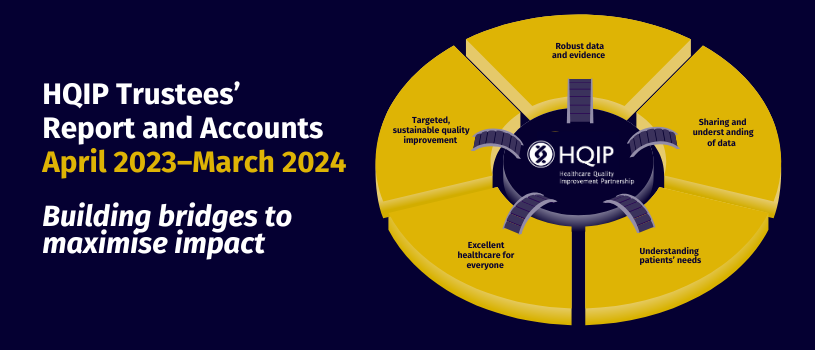
We are proud to share that the 2023-24 HQIP Trustees’ Report and Accounts has been published. Focusing on our activities in 2023-24, it shares our vision, achievements and a financial update, as well as details of our impact on healthcare quality.
“I needed to know that I wasn’t alone. I needed answers…it was great to feel heard,” patient participant in HQIP project
As we continue to work in partnership with others across the healthcare sector to achieve evidence-informed, patient-centred improved services and health outcomes for everyone, this report shows the impact our work has had in 2023-24. Highlights include:
A cross-disciplinary, collaborative approach to clinical audit: The National Cancer Audit Collaborating Centre (NATCAN)
The “jewel in the crown of patient safety initiatives”: The National Joint Registry
Involving the public in access to data
Improving health inequality data in national clinical audit
Listening to marginalised voices in maternity care.
We hope that you will take a moment to read our report and find out more about how the data and insights commissioned by HQIP helps to deepen understanding of healthcare services and enable change that has a real impact on patient outcomes.
17 September 2026 marks World Patient Safety Day, a global campaign led by the World...
Patient voice in procurement: The hottest topic at HCSA 2024
25 Nov 2024
It was a pleasure to connect with so many procurement professionals at HCSA 2024. There’s a lot happening in the healthcare procurement world right now. Enthusiasm to deliver better outcomes was evident from everyone we met at this event.
There was one topic that we discussed with almost every delegate who visited our stand… how to embed patient voice into procurement. This is something that we are passionate about at HQIP, having seen how transformative embedding the patient view in our work has been.
Have you seen our recent blog that outlines key considerations for developing a strategic approach to integrating the patient voice in your organisation’s procurement? Discover top tips on creating a structured, impactful and inclusive process; read the blog here.
HQIP’s Procurement+ service delivers better quality and value through our unique combination of patient engagement, quality improvement and procurement expertise. Contact our team on workwithus@hqip.org.uk for a free, no-obligation conversation on how we could help you.
17 September 2026 marks World Patient Safety Day, a global campaign led by the World...
Job opportunity
20 Nov 2024
Communications Officer
Closing date for applications: 3 Dec 2024 at 17:00
Location: HQIP is a homeworking organisation with excellent IT support. Travel into central London is required on an occasional basis for scheduled corporate activity
Salary: Circa £32,000 – £38,000 FTE, depending on experience
Details: Full time (37.5 hours per week), flexible hours will be considered; permanent contract
Ready to put your communication skills to work for a mission that improves lives? Join us and make a difference in patient care!
Key requirements of this position are to:
Manage the HQIP website
Manage internal and external email communications
Maintain HQIP’s social media accounts
Deliver other general communications and marketing activity as required.
17 September 2026 marks World Patient Safety Day, a global campaign led by the World...
New resources published November 2024
14 Nov 2024
We are pleased to announce that the following new quality improvement resources from national clinical audits / outcome review programmes have been published today. Commissioned by HQIP, they include reports, infographics, data and other outputs to support quality improvement:
Cancer: In addition, also note that the National Prostate Cancer Audit (NPCA) has released a quarterly update which reports on the performance indicator Emergency readmission within 90 days of radical prostate cancer surgery.
Find out more about these reports
These reports are available to view, or access, using the links above; however, further information about each report can also be found here.
All reports: All HQIP-commissioned reports can be accessed via our dedicated reports webpage.
Stay up to date: Join our mailing list to receive notifications when new reports are published.
17 September 2026 marks World Patient Safety Day, a global campaign led by the World...
Latest news: October eBulletin
31 Oct 2024
Welcome to the latest round-up of clinical audit and programme news, events and updates from HQIP and other relevant healthcare organisations, which was sent out on 31 October 2024. Contents of this edition include:
Read the eBulletin here.
Don’t forget to sign up: Keep up to date with our latest news, events and work programmes by subscribing to our mailing list today. You can also stay up-to-date by following us on X: @HQIP.
17 September 2026 marks World Patient Safety Day, a global campaign led by the World...
Blog: Increasing value by embedding the patient voice in procurement
28 Oct 2024
Clare Fountain, Associate Director of Quality Improvement
With 25% of the NHS budget allocated to procurement, the need to identify and act upon every opportunity to drive greater value across the entire supply chain is clear. Integrating patient input into procurement can play a transformative role here, shifting the focus to how the product or service contributes to patient care.
By embedding patient engagement into the procurement process, improvements can be made in relevance, patient-centeredness and efficiency, maximising both value for money and social value through better patient outcomes.
It’s undoubtedly the right thing to do – but now it’s also becoming an essential thing to do. With Lord Darzi highlighting that the patient voice is not loud enough in NHS England, plus the launch of Change NHS, patient engagement is under the spotlight. The Social Value Act and the UK Government’s Social Value Model mandate the inclusion of social value criteria in supplier selection and the Procurement Act 2023 is set to raise expectations even further.
Drawing on our years of specialist procurement experience, we outline key considerations for developing a strategic approach to integrating the patient voice in your organisation’s procurement. We also offer top tips for a structured, impactful and inclusive process.
1. Ensure your purpose for engaging patients is clear – and supported
For each procurement, consider how patient engagement could improve your decision-making. Use this understanding to identify a well-defined set of outcomes that you are looking to achieve. These outcomes should translate into specific patient engagement procurement goals and activities.
Ensure you have the support of senior leaders and other key stakeholders by clearly communicating the value of patient engagement. For example, patient engagement can help to:
Increase your social value metrics
Form part of the Procurement Act preliminary market engagement, to help providers understand and prioritise key criteria, features and functionality of goods and services
Future proof, by building aspirational intent into your procurement
Improve both quality of care and patient adherence with treatment by better meeting patient needs
Reduce risk
2. Engage early and throughout the procurement process
For engagement to be meaningful it needs to form a fundamental part of the commissioning process, not just be a formality. As with any other stakeholder engagement, start early and plan how you will engage throughout the procurement lifecycle. This might include:
Pre-market engagement to better understand needs and inform later procurement practices
Patients helping to set supplier selection criteria and/or questions in the Invitation to Tender process
Inviting patient participation in tender evaluations to influence bid scoring
Incorporating measures for patient engagement in the contracts and ensuring continuous involvement throughout the project lifecycle, to help maintain a focus on patient outcomes
Patients co-designing contract management metrics, to monitor supplier progress and compliance
Ongoing engagement for continuous refinements in service delivery
Embedding patient involvement at each stage of the process:
3. Develop structured and inclusive engagement plans
Structured, multi-dimensional planning up-front helps maximise the benefits of engagement, ensuring clarity of roles, streamlined communication and compliance with best practices. Getting this right from the outset can often prove challenging. Some key points to consider are:
Your engagement model:
Consultation – gathering input from patients and the public on specific issues
Collaboration – involving patients directly in decision-making processes, from policy development to care pathway design
Advisory – panels for regular feedback and contribution to strategic planning
Legal and confidentiality requirements:
Information Governance when collecting personal or sensitive data, e.g. consent, legitimate interest, privacy notices
Declarations of interest to protect both patients and the integrity of the process
Participation support
Valuing people’s time, including payment for involvement (using set criteria)
Using an experienced engagement facilitator – the benefits will easily outweigh the costs
Developing a code of conduct for both staff and participants
Safeguarding and emotional support
Participation of participants:
Ensure engagement reaches a diverse range of patients, including marginalised and underserved communities (you could use the CORE20PLUS5 list as a guide) to gather perspectives from different demographics and lived experiences
Tailor engagement formats and methods (e.g. larger fonts, translations, different communication formats) to remove barriers to participation, ensuring diverse voices are heard
Create realistic timelines for engagement to allow meaningful contributions
Communicate continuously and effectively:
Use various methods, like focus groups, surveys and social media, to keep patients informed and engaged throughout the procurement process, tailoring communication to their needs. Consider setting up feedback loops so that participants know how their input has been used to shape decisions – this reinforces the value of their involvement.
4. Ensure your team have the right skills –and your participants do too
Effective patient engagement not only involves equipping your team to engage with patients successfully, but also ensuring participants have the skills and knowledge for meaningful participation. You may wish to consider:
Training: Educate patients on procurement processes, bid evaluations and legal considerations
Resources: Use patient advisory councils, workshops and online platforms to provide necessary tools
Engagement toolkit: Create a toolkit with guidelines for evaluations and responsibilities
Education: Offer informational sessions and materials to clarify patients’ roles in healthcare
5. Recognise the importance of continuous improvement
Embedding patient engagement into procurement is a journey. If this is new to your organisation, we would recommend a) starting with involvement in part of a procurement process and b) selecting a procurement with clear benefit of patient involvement (a ‘quick win’). We would not suggest adopting all aspects we have outlined at the same time.
Ultimately patient engagement will become embedded in your ‘business as usual’, with engagement practices tweaked and improved over time.
Measuring procurement outcomes (i.e. the benefits enabled) from the outset and ensuring ongoing engagement with wider stakeholders and participants means that you will be able to take a structured, data-informed approach to continuous improvement.
At HQIP, we know that your procurement challenges are unique – that’s why our solutions are too.
Our value-based Procurement+ service combines expertise in procurement, patient engagement and quality improvement to ensure you achieve better value and outcomes.
Meg uses her dual experience of maternity care and as a service user representative to...
National Joint Registry: 21st Annual Report
11 Oct 2024
The NJR’s 21st Annual Report for the period of 1st April 2023 to 31st March 2024 contains full analysis of the shoulder, elbow and ankle joints available (hip & knee report sections to follow). It has been prepared in separate joint sections, due to ongoing work with the orthopaedic implant manufacturing industry to enhance the completeness of the NJR component database.
The Registry’s purpose is to record patient information and provide data on the performance and longevity of replacement joint implants, the surgical outcomes for the hospitals where these operations are carried out, and on the performance outcomes of the surgeons who conduct the procedures. This Annual Report summarises the NJR’s work and sharing of the analysis of data, visually in tables and graphs, for procedures across each of the joints, as well as implant and hospital.
Having collected data since April 2003, with the purpose of improving patient outcomes following hip, knee, ankle, elbow, and shoulder replacement, the Registry has now recorded over 4 million procedures. As a result of the increasing volume and quality of data, it is possible to make more accurate analysis available to all stakeholders. It is essential that as much good quality data as possible is captured to continue to improve clinical outcomes and patient safety.
The NJR has shown that orthopaedic surgery, as one of the main users of implant devices in the UK, is demonstrating the highest standards of patient safety in their use. A key message from the report is that safety and clinical outcomes continue to improve, as identified through the reduction of joint revision surgery.
These reports are available to view and download, along with all other reports, on our dedicated reports webpage.
In addition, the National Joint Registry Annual Report 2024 is now available on the NJR website.
Stay up to date: Join our mailing list to receive notifications when new reports are published.
17 September 2026 marks World Patient Safety Day, a global campaign led by the World...
Register for NHS Procurement Leaders’ Summit 2024
2 Oct 2024
Putting the Patient Voice into Procurement
Lord Darzi’s independent investigation of the English National Health Service shines the light on a crucial point: that the patient voice is not loud enough in shaping the NHS.
Procurement has a vital role to play here, ensuring that service user and community engagement is incorporated at every stage – in a meaningful way. How can procurement decisions better reflect the needs and experiences of patients, to ensure that care is delivered with dignity, compassion and respect?
Judith Hughes, HQIP’s Associate Director of Procurement, and Kim Rezel, HQIP’s Patient and Public Involvement Lead, will join Hannah Quinn-Hill, Michael Page, to deep dive into patient voice in procurement best practice at the NHS Procurement Leaders’ Summit, 9am 17 October.
This free to attend event in London offers attendees the opportunity to learn how to incorporate the patient voice in procurement decisions. Hear from industry experts and network with fellow NHS procurement professionals to share experiences and learnings.
Judith Hughes comments:
“With procurement spend being such a sizeable percentage of the overall NHS budget, we all have a responsibility to ensure that it results in value and excellent outcomes. Our event with Michael Page on 17 October promises to be an exciting and important opportunity for leaders to come together to learn, share and discuss patient voice in NHS procurement, to the benefit of our communities.”
Agenda highlights include:
9.10am – HQIP on Patient Involvement and Quality Improvement
9.40 am – HQIP on the Role of Procurement
10.10am – Hannah Quinn-Hill on Current Procurement Recruitment Trends and Pitfalls
Book your space at the event
This is a registration-only event, walk-in access will not be permitted on the day. Make sure to reserve your spot, as seats are limited and filling up fast. Register here!
17 September 2026 marks World Patient Safety Day, a global campaign led by the World...
NHS England Quality Accounts List 2025-26: Annual Scoping Survey
1 Oct 2024
REMINDER: NHS England Quality Accounts List 2025-26: Annual Scoping Survey
Deadline: Monday 14 October 2024
Providers of national audits and quality improvement projects that would like to be considered for inclusion in the NHS England Quality Accounts List 2025-26 are asked to complete the scoping survey linked below by Monday 14 October 2024.
(Projects commissioned by HQIP, as part of the NCAPOP, do not need to complete a scoping survey)