HQIP Associate Director wins health Information Governance award

24 Mar 2026

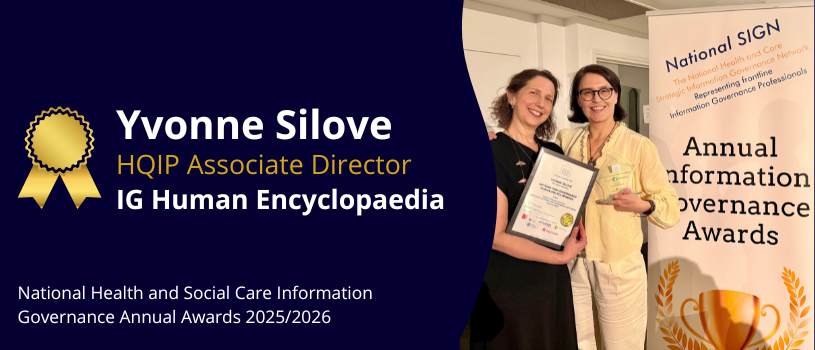
We are delighted to share that our colleague, Yvonne Silove, has won the IG Human Encyclopaedia category at the National Health and Social Care Information Governance Annual Awards 2025/2026, announced this week.

Supported by NHS England and run by the National Health and Social Care Strategic Information Governance Network (SIGN), these awards recognise excellence in information governance and data protection across UK health and social care. They recognise those working in Information Governance for their hard work and dedication, in keeping our health and social care data safe and ensuring data protection compliance.

The Information Governance Human Encyclopaedia category is designed to recognise those who are considered to be thefont of all knowledge’; the person you can go to for advice and they can always give you an answer, quote the relevant guidance and refer to it from memory. We are so proud of Yvonne, as the SIGN awards recognised what we already knew, that Yvonne is the epitome of this.

“I am honoured and humbled to receive this award. Patients trust the NHS with both their health and their data. I’m very proud to be part of the fantastic team at HQIP who, in partnership with our expert teams who deliver our national data programmes, take that trust incredibly seriously in all our efforts to improve patient outcomes.”

Yvonne Silove, HQIP Associate Director and IG Human Encyclopaedia 2025/26 (SIGN awards)

Desi Staykovska, Head of Information Governance (DPO) at HQIP, who nominated Yvonne for this award, explains: “The moment I saw the ‘IG Human Encyclopaedia’ category, I thought immediately of Yvonne. She has exceptional IG knowledge and understanding of the healthcare industry as a whole. Yvonne is the living history of HQIP and has a solution to any IG (and not only IG) problem!” 

HQIP’s National Medical Director’s Clinical Fellow, Dr Thomas Salisbury, agrees when he adds: “Nobody deserves this more. Working alongside Yvonne, I’ve seen firsthand just how deep her knowledge runs, and how generous she is in sharing it. Yvonne doesn’t just know IG inside out, she helps it make sense for everyone around her.

Congratulations, once again Yvonne!

Excellence in Clinical Audit Awards: Entries now open

16 Mar 2026

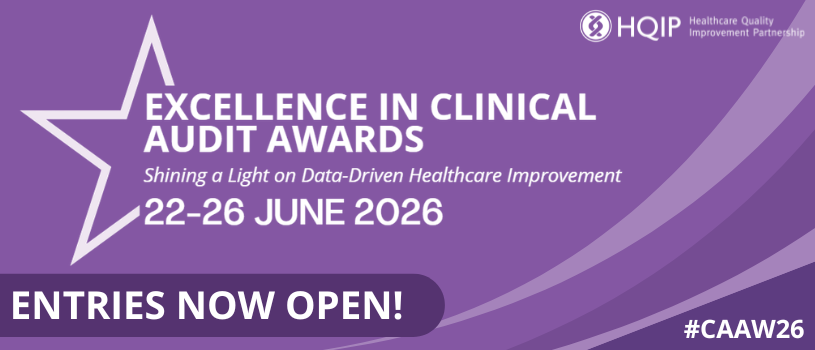
The Excellence in Clinical Audit Awards celebrate the individuals and teams who are transforming healthcare through rigorous clinical audit and evidence-informed improvement projects. They offer a chance to showcase your project and gain recognition for the difference you’re making.

Formerly the Clinical Audit Heroes Awards, the awards, which form part of Clinical Audit Awareness Week 22 – 26 June, have been renamed to reflect the professionalism, impact, and high standards demonstrated by recipients.
Each category has its own page with much more detail, including judging criteria, eligibility, and the entry form.
Entries close 17 April 2026 (23:59).

Awards categories

In addition to the five main award categories, we will also be awarding two Commendations:
Click here for further details for each award category. Good luck, we look forward to receiving your entry!

New resources published March 2026

12 Mar 2026

We are pleased to announce that the following NEW RESOURCES to support improvement in healthcare, from HQIP’s audits and programmes, have been published:

  • Paediatric diabetes: Care and outcomes 2024/25; National Paediatric Diabetes Audit (NPDA). Findings show that the number of children and young people receiving care from a paediatric diabetes unit rose to 35,801 in England, Wales and Jersey in 2024/25, marking a 29% increase in caseload across England and Wales over the past decade.
  • Maternity services: Multiple births report; National Maternity and Perinatal Audit (NMPA). Found that the mode of birth options differed, based on the number of babies, how many placentas and amniotic sacs there were, and if there were any complications. Other key findings relate to caesarean birth rates, postpartum haemorrhage, and preterm birth.

Further data

In addition, we are pleased to share that the following data is also expected to be shared by our programmes:


All reports: All HQIP-commissioned reports can be accessed via our dedicated reports webpage.

Stay up to date: Join our mailing list to receive notifications when new reports are published.

HQIP announces tender for innovative robotic surgery registry

11 Mar 2026

Closing date EXTENSION: Midday Monday 27th April 2026.

HQIP is seeking to commission the delivery of the National Registry of Robotically Assisted Surgery (NRRAS), to ensure that patient safety, equity and value remain at the centre of this rapidly expanding area of healthcare. A tender for the management of this programme is now open; further details of which can be found on the Tenders section of the HQIP website. Find out more about this exciting new area of healthcare, and the pivotal role of the new registry, below…

Robotically Assisted Surgery (RAS) is transforming the delivery of minimally invasive care across the NHS. Using advanced robotic platforms that translate a surgeon’s hand movements into highly precise micro-movements inside the body, RAS enhances dexterity, filters tremor and provides high-definition 3D visualisation in complex anatomical spaces.

Although RAS has been available for more than two decades, uptake within the NHS was initially limited by cost and largely confined to complex cancer procedures. This landscape is now changing rapidly. Robotic platforms are increasingly used across orthopaedics, urology, gynaecology and thoracic surgery, including for higher-volume and less complex procedures. By 2035, it is predicted that up to 500,000 procedures per year in England could be undertaken using robotic technology.

A rapidly evolving national landscape

In April 2025, the National Institute for Health and Care Excellence (NICE) issued Early Value Assessment (EVA) recommendations for robotic systems in cancer and orthopaedics. Eleven systems received conditional support for use within the NHS while further evidence is generated over a three-year period to demonstrate cost-effectiveness and patient benefit.

Shortly afterwards, in May 2025, NHS England’s Getting It Right First Time (GIRFT) programme published Implementation of robotic-assisted surgery (RAS) in England, setting out clear objectives and principles for service planning, workforce training, safe implementation and evaluation.

These recommendations establish a coordinated national approach: enabling innovation and patient access, while requiring companies to generate high-quality evidence, maintain regulatory approval and comply with NHS England’s Digital Technology Assessment Criteria (DTAC). NICE will review the guidance in 2029 to determine whether routine adoption across the NHS is justified.

The role of the national registry

Robotic surgery represents one of the most significant technological shifts in modern surgical care. As the NHS moves from selective adoption to large-scale implementation, robust national data will be essential. HQIP’s national RAS registry will provide the independent, clinically led assurance framework needed to support safe innovation — ensuring that as robotic surgery grows, it does so with clear evidence of benefit, value for money, and equitable access for patients across England.

Against this backdrop of rapid expansion and structured evaluation, the new registry will aim to:

  • Improve patient safety by tracking short- and long-term outcomes of robotic procedures
  • Capture key quality metrics aligned with NICE EVA evidence-generation requirements
  • Support standardisation of practice across providers
  • Identify variation in outcomes, including unwarranted variation and health inequities
  • Provide robust outcome evidence to inform clinical guidelines, commissioning and regulatory decisions
  • Enable research and innovation in robotic technologies and techniques
  • Assess equity of access to support future strategic planning
  • Provide near real-time data to evaluate effectiveness compared with conventional surgical approaches
  • Maintain close alignment with NICE guidance and national quality standards
  • Deliver timely, meaningful outputs tailored to clinicians, providers, commissioners, regulators and patients.

The registry will be clinically led, use robust methodological and statistical techniques, and link — where feasible and appropriate — to other national datasets at individual patient level. This will enable comprehensive outcome tracking and system-level insight from the outset.

Working in partnership to generate evidence

The registry will evolve alongside the expanding use of robotic surgery, working in close partnership with key stakeholders. Through this collaborative approach, the registry will ensure:

  • High-quality, independent evidence generation
  • Data availability to highlight poor outcomes or safety concerns
  • Identification of variation in care and inequitable access
  • Transparency and accountability as adoption accelerates.

Resident Doctors: Showcase Your Audit on a National Stage

10 Mar 2026

Call for Submissions: Turning Audit into Improved Patient Care.

Have you led an audit or audit-based quality improvement project that actually changed practice? Did your project go beyond data collection and lead to a real improvement for patients?

We are inviting resident doctors to submit examples of outstanding practice in translating clinical audit findings into measurable improvements in patient care.

The winning submission will be invited to showcase their work on a national stage during Clinical Audit Awareness Week (#CAAW26), the annual campaign that aims to improve and save lives by promoting and celebrating the critical role of clinical audit and data-driven healthcare improvement.

  • Gain national visibility for your work
  • Develop your presentation profile and CV
  • Demonstrate your contribution to healthcare improvement and patient outcomes.

Submission deadline: 30 April 2026 (12pm midday).

FIND OUT MORE AND APPLY

Benchmarking data published

9 Mar 2026

The following dataset has been published on the National Clinical Audit Benchmarking (NCAB) website, HQIP’s online portal which provides access to national audit performance data.

NCAB is an online portal, hosted by HQIP, which provides access to national audit performance data. Users do not need to register, and can access audit benchmarked data searchable by speciality, Trust, hospital or unit. For all datasets currently published, go to the NCAB site.

Programme tender: Paediatric diabetes

2 Mar 2026

Applications closing date: 01 Apr 2026 12:00. 

HQIP is seeking to commission the delivery of the National Paediatric Diabetes Audit.

The contract will initially be delivered for NHS-funded care in England, Wales and publicly funded care in Jersey for a period of 3 years.

Further details can be found on HQIP’s tenders webpage.

National Cancer Plan: Opportunity for change

2 Mar 2026

A catalyst for working together to deliver a step change in improvement.

A step change in cancer care will only happen if we act as one system, and make the very best use of our national clinical audit and outcomes data. Now the dust has settled following the release of the Government’s National Cancer Plan for England, HQIP’s Medical Director Professor Danny Keenan, offers some reflections on its importance in improving care and outcomes for those with cancer, and on the importance of working together and making the most of data, to deliver its aims…

“The National Cancer Plan is very timely and will be well received. We have already been consolidating activities related to cancer care, but now is the time to make a step change and improve the key indicators of long-term outcomes for all patients.

The building blocks are in place. We are surrounded by standards related to most cancers. In terms of clinical audit to measure against these standards, we now have structural, process and outcomes measures for many of the most common cancers (see the list of national cancer audits at the end of this article). However, we need to take this further. This is where the Cancer Plan will help. The areas where we can focus our efforts on working together, to deliver its aims, are:

Earlier diagnosis

This will not be solved by one sector, such as primary care, working alone, but by all areas contributing. The NHS Ten-Year Health Plan for England has placed great emphasis on the “Left Shift”. This is the move to collaboration between sectors, ‘knocking down the walls’ of hospitals, and all working together between sectors to move expertise to where it benefits patients most – so that they have the best experience of care. In relation to early diagnosis, this means the different sectors combining into a more seamless service and reaching out to the population to drive improvement.

This is where the other tool that is available to us comes in, Cancer Alliances. We already have strong alliances in place, and we need to capitalise on their strengths so that they, working between sectors (as they currently do), help to seek out and bring forward patients to tackle the problem of late diagnosis.

Following the data

The improvement that follows from audit and reviews of service, to understand how to help providers that are performing less well, should play a fundamental part in this step change in cancer care.

We have, with the increased funding into the cancer programme, more and extremely useful information concerning the performance of the sector. We need to capitalise on this excellent information. It needs to be more widely disseminated, and we need to address the “so what” question more aggressively.

To disseminate this information more widely is important. It needs, particularly, to be made available in easy-to-use formats to front-line clinicians. Colleagues absorb information in diverse ways, and therefore several mechanisms need to be used. Using dashboards, designed to be used with minimum fuss, alongside social media and traditional media are all important.

To address the “so what” question, the Cancer Plan uses quite strong language. While we all agree that we need to tackle “eradicating variation”, this needs to be managed in a supportive way. All clinicians are working flat out, and we need support to work more cleverly not harder. That is where we, with the National Clinical Audits, can help. Those who provide the audits can develop quality improvement messages and tools that clinicians can use in their day-to-day work, driving improvement in the services that they offer. That will lead to reduced variation and eventually to improved outcomes.

This is another area where the Cancer Alliances can help. They are in the best position to influence clinicians and drive many of these quality improvement initiatives flowing from the National Clinical Audit programme.

The Cancer Alliances also have a role in bringing patient voice to the forefront. We need to ensure that their voice is centre stage as we develop services. The “Left Shift” is likely to be applauded by patients, but they need to understand why and how any change is taking place – and that it is there to improve their experience of care, as well as improve outcomes.

Cancer is cancer

Finally, I want to make a point about what the Cancer Plan calls “rare cancers”. That is an unhelpful term, in my view. If you were unlucky enough to suffer from one of these, you would not feel that its likelihood of occurring is relevant. You would expect exactly the same treatment and support as anyone with a “mainstream cancer”. There are a multitude of audits and registries assimilating data on these cancers with little support nationally. The information is therefore variable. However, we need excellent data on these cancers, as we do with others. HQIP can help here, through the development of an Association of Clinical Audits and Registries (ACAR). We could use our knowledge and skills to support these registries and audits to maintain excellent governance, and ensure that the service and information that patients receive are second to none.

In summary, we in HQIP appreciate the National Cancer Plan for England. We look forward to working with a wide spectrum of colleagues, and with patients, to work collaboratively to use data to implement it. National clinical audits are the backbone of accountable improvement in cancer care, while Cancer Alliances are built to deliver change across pathways. Now is the time to use both with greater ambition. It is not enough to measure variation. We must translate insight and collaboration into action that improves care, and supports teams to make progress with the time and capacity they have.

If we can bring all this together then I, for one, can see that the National Cancer Plan for England will take us a (significant) step closer to vast improvements in cancer care and outcomes for everyone.

National cancer audits

HQIP-commissioned cancer programmes, all within the National Cancer Audit Collaborating Centre (NATCAN), are:


Patient and Public Involvement in Health Data: A New UK-Wide Mapping Project

27 Feb 2026

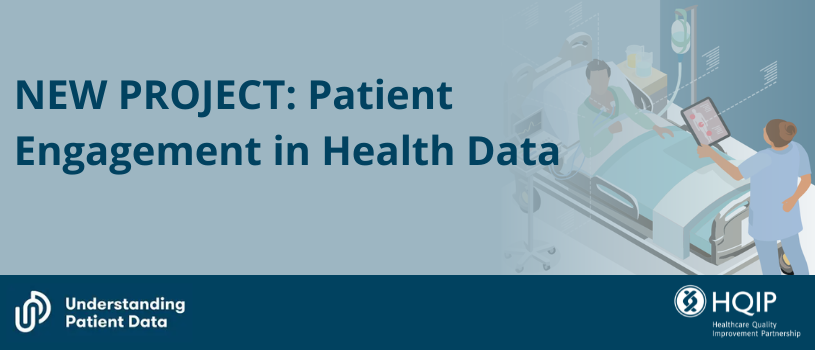
We are delighted to announce that HQIP has been commissioned by Understanding Patient Data to lead a new national project exploring how patients and the public are involved in decisions about health and care data.

Health data plays an increasingly important role in research, service planning, and quality improvement. This project will help ensure that these decisions are informed by meaningful patient engagement, strengthening public trust and improving how data is used for the benefit of patients and communities.

The project will build a whole-system understanding of who is involved in health data decision-making, how influence happens, what is working well, and where further support is needed. By mapping current practice and identifying opportunities for improvement, it aims to strengthen inclusive, transparent, and sustainable approaches to public involvement.

Clare Fountain, Associate Director at HQIP, said: “There is significant patient and public engagement in health data across the UK, but we don’t yet have the full picture. This project will support whole-system understanding of who is doing what, what is working well, and where the challenges lie.”

By combining Understanding Patient Data’s focus on transparency and public trust with HQIP’s expertise in quality improvement and data governance, the project will help ensure that patient and public insight genuinely shapes how health data is used.

Getting involved

The project will run over the coming months and will involve interviews, focus groups, and a UK-wide survey with organisations, professionals, and public contributors working in health data. Findings will inform practical recommendations and resources to support stronger, more consistent involvement across the system.

For updates on this project, and how to get involved, subscribe to our mailing list. You can also follow HQIP on LinkedIn and X: @HQIP.

If you work with health data, policy, or public involvement and would like to contribute, we would be pleased to hear from you. Please contact: PPIEinhealthdata@hqip.org.uk.

Latest news: February 2026 eBulletin

25 Feb 2026

The February edition of HQIP’s eBulletin is out now! It features the latest news and updates relating to clinical audit, outcome reviews and data-informed healthcare improvement, including:

What’s new?

  • Clinical Audit Awareness Week – awards categories announced and promotional materials
  • Patient perspective article: Why patients are the route to real results
  • Article: Integrating clinical audit and quality improvement to deliver impact for patients
  • Benchmarking data published.

A chance to revisit:

  • Latest reports and data
  • DHSC announces new National Cancer Plan
  • NHS England publishes Clinical audits and registries – A best practice guide.

In other news:

  • NJR’s contribution to the development of GIRFT’s new Greener pathways guide
  • NCMD webinar: Understanding consanguinity related child deaths
  • NRAP Senior Clinical Lead opportunity
  • NRAP Adult Lived-Experience Respiratory Panel opportunities.

Read HQIP’s latest eBulletin here.


Don’t forget to sign up: Keep up to date with our latest news, events and work programmes by subscribing to our mailing list today. You can also follow us on: LinkedIn and X: @HQIP

Benchmarking data published

19 Feb 2026

The following dataset has been published on the National Clinical Audit Benchmarking (NCAB) website, HQIP’s online portal which provides access to national audit performance data.

NCAB is an online portal, hosted by HQIP, which provides access to national audit performance data. Users do not need to register, and can access audit benchmarked data searchable by speciality, Trust, hospital or unit. For all datasets currently published, go to the NCAB site.

GIRFT Greener Pathways – a sustainability collaboration

13 Feb 2026

The National Joint Registry (NJR), hosted by HQIP, has been a key contributor to the development of GIRFT’s new ‘Greener Pathways’ guide to decarbonising the hip replacement pathway, which has been written to support the NHS to reduce environmental impact while improving patient care.

Development of the guide has been in collaboration with: Greener NHS, the Royal College of Anaesthetists, the British Orthopaedic Association, the British Association of Day Surgery, the British Orthopaedic Trainee Association, the British Hip Society, the Royal College of Surgeons of England (RCS), the Sustainable Health Systems Hub. The mix of collaborators has enabled the guidance to be shaped by input from leading clinical experts spanning primary to tertiary care, as well as having benefitted from the involvement of patients.

The guide lists 13 high-impact and practical clinical recommendations for decarbonising elective hip replacement surgery, covering every step of the patient pathway from community care and referral through to pre-, peri- and post-operative processes. For each recommendation, the potential annual emissions reduction, should the recommendations be carried out, is also given.

Each of the recommendations is supported with key actions to achieve carbon saving (for example, rationalising equipment in surgical tray sets and using absorbable sutures instead of staples), as well as a rationale for the changes and the benefits for both patients and the NHS.

Further information and the full guide are available on NJR’s website.

New resources published February 2026

12 Feb 2026

We are pleased to announce that the following NEW RESOURCES to support improvement in healthcare, from HQIP’s audits and programmes, have been published:

  • Child mortality: Understanding consanguinity related child deaths; National Child Mortality Database (NCMD). This report on the deaths of children who were born to parents who are blood related shows an increased risk of death from genetic conditions.
  • Lung cancer: Lung cancer State of the Nation 2026; National Lung Cancer Audit (NLCA, part of NATCAN). Contains key findings and recommendations related to care received by people diagnosed with lung cancer in 2024 in England and Wales.
  • Mental health: Suicide annual report, data 2013-2023; National Confidential Inquiry into Suicide and Safety in Mental Health (NCISH). A review of suicides by patients in the UK and Jersey over 2013-2023, which contains five clinical messages for healthcare providers.

Further data

In addition, we are pleased to share that the following data is also available:

  • Cardiovascular disease: CVDPREVENT has updated their Data & Improvement Tool and Quality Improvement Data Packs (for ICBs), which now include data to the end of Sept 2025 for the majority of metrics, plus outcomes data which is now updated with June 2025 data.

All reports: All HQIP-commissioned reports can be accessed via our dedicated reports webpage.

Stay up to date: Join our mailing list to receive notifications when new reports are published.

Patient Perspective: Why Patients are the Route to Real Results

12 Feb 2026

Patient representative, Sadia, tells us why patient voice and data must shape healthcare improvement.

When Sadia first came across HQIP’s Service User Network (SUN), she wasn’t particularly looking for a new commitment – but she was keen to make a difference. Having taken part in patient engagement activities for a local research initiative previously, she was ready to contribute to something broader; something that would have national impact. What she found was a community where her voice – and the voices of people like her – could help shape the quality of healthcare across the country for everyone. Here she explains why patient involvement is important, and why it goes hand in hand with sharing healthcare data.

“When I saw the SUN network, it sounded exactly what I was looking for.” What stood out to her first was the tone of the advert: welcoming and flexible. “It said I could be involved as much or as little as I wanted. That really reassured me; it meant that I could contribute as and when I was able.” She signed up immediately. It was the beginning of a relationship that brought benefit to HQIP’s programme of national clinical audits as well as wider healthcare. It was also a relationship that saw Sadia develop her understanding of the value of patient voice, and the use of data, in changing healthcare for the better.

Why patient voice matters

For Sadia, the case for involving patients in healthcare improvement is simple and powerful. “We’re the ones receiving the care. We’re the only ones who can tell you if it’s working or not.” She has seen first-hand how involving patients early can prevent problems later on, and save time and effort. “If you include patients in discussions around care initiatives, they’ll spot issues before you roll them out – and they’ll help you to fix them. It makes care relevant, more efficient, and ultimately supports staff too.”

Improving care for everyone

Sadia, who has premenstrual dysphoric disorder (PMDD, a condition that took 12 years to be diagnosed), speaks candidly about her healthcare journey. As a British-South Asian woman under 30, she has faced many assumptions about her and her care. But change, she says, is happening. In her case, she connects this directly to women’s involvement. “When I was growing up, most research was done by men, for men, about men. Now we’re seeing much more research led by women, and that is focused on women’s health – and the involvement of female patients has played a key role too.” She believes that change has been possible in part because patients have demanded to be part of the solution: “We go through this, you should be studying us with us.”

Today, when she visits her doctor, they immediately know what PMDD is and what emerging treatments are being explored. “It gives me hope. Five or ten years ago, that wouldn’t have happened, and I’m grateful – not just for me, but for all the others with my condition.”

How data shapes better care

Sadia is open about once feeling hesitant about consenting to sharing her health data. “Healthcare hasn’t always focused on people like me, so I was unsure if it would be of benefit. But, through being involved with HQIP, I can see that sharing [anonymised] data is an important part of creating better services and outcomes.” For her, data and patient voice are equally important: “You need both to understand how care is working and where improvements are needed.” She also sees data sharing as essential to equity. “If someone like me doesn’t share my data, there won’t be relevant information to shine a light on conditions that affect people like me.”

What does patient engagement mean in practice?

Since joining HQIP’s Service User Network (SUN), Sadia has taken part in a wide range of activities, including reviewing reports, contributing to the development of resources, speaking at conferences, and generally offering insights based on both her personal experiences and those of people for whom she cares. “My father has cardiovascular disease, and I have been able to contribute, not just as a patient but also as a carer. Being able to bring that perspective into a meeting, and see it valued, was fantastic.”

The variety of opportunities is something she genuinely appreciates. “I feel like I’ve only touched the surface, in terms of what I could get involved in. But the great thing is, if you aren’t selected for one opportunity, another comes along quite soon. It is always very rewarding.”

A shared journey to continuous improvement

While Sadia says that she wouldn’t have chosen to go through the healthcare journey she has, she recognises that it does put her in a unique position of being able to benefit others, through patient engagement. “It did lead me to something meaningful,” she reflects. She is comforted that she is helping to shape a healthcare service that listens, learns, and improves.

For HQIP, Sadia’s story embodies exactly why patient involvement is critical for patient-centred, evidence-informed improvement in care. It deepens understanding. It ensures relevance. And, ultimately, it leads to care that meets the needs of real people. Or, as Sadia puts it: “If you’re listening to your patients, you’re going to get things right more often.”

Further information

National Cancer Plan published

5 Feb 2026

The Government has published a new National Cancer Plan for England, which aims to ensure that patients will receive faster diagnosis, quicker treatment and the support to live well with cancer.

National cancer audits have a pivotal role to play in improving care and outcomes for people with cancer, by shining a light on where care is working well and where improvements would have maximum impact. This Plan acknowledges the “excellent work” of the HQIP-commissioned National Cancer Audit Collaborating Centre (NATCAN), which hosts the 10 national cancer audits covering a range of common cancers including lung, breast and bowel cancer.

NATCAN, which was established in late 2022 as a national centre of excellence, has worked closely with healthcare providers to deliver a number of significant improvements in care and patient outcomes. For example, the National Bowel Cancer Audit (NBOCA) has found that 90-day postoperative mortality has almost halved over the past decade. Another example from the NBOCA is a significant improvement in the two-year postoperative survival rate, resulting in approximately 1,150 additional people surviving two years after surgery (2021/22 saw a 5-percentage-point increase compared with 2012/13).

The National Cancer Plan provides an opportunity for the national cancer audit programme to build on this work, and HQIP will ensure that it is designed to meet the ambitions of, and contribute to the delivery of, the Plan – by, for example, giving “Cancer Alliances and trusts the data they need to drive improvement” (Action 13 from the Plan). By working together, to use the data and insights available through NATCAN’s online data dashboards to deliver real-world improvements, the clinical audit and healthcare communities can support the Government to achieve the aims set out in the Plan, offering cancer patients faster diagnosis and quicker treatment, and supporting them to live well.

Further information about cancer care data from HQIP

  • Bowel cancer report, published Oct 2025 (National Bowel Cancer Audit, NBOCA)
  • Kidney cancer report, published Sept 2025 (National Kidney Cancer Audit, NKCA)
  • Lung cancer report, published April 2025 (National Lung Cancer Audit, NLCA)
  • Metastatic breast cancer report, published Sept 2025 (National Audit of Metastatic Breast Cancer, NAoMe)
  • Non-Hodgkin Lymphoma report, published Sept 2025 (National Non-Hodgkin Lymphoma Audit, NNHLA)
  • Oesophago-gastric cancer report, published Sept 2025 (National Oesophago-Gastric Cancer Audit, NOGCA)
  • Ovarian cancer report, published Sept 2025 (National Ovarian Cancer Audit, NOCA)
  • Pancreatic cancer report, published Sept 2025 (National Pancreatic Cancer Audit, NPaCA)
  • Primary breast cancer report, published Sept 2025 (National Audit of Primary Breast Cancer, NAoPri)
  • Prostate cancer report, published Oct 2025 (National Prostate Cancer Audit, NPCA)

More information about NATCAN