
Blog: Yes we can

24 Jun 2024

The importance of national clinical audit in addressing health inequalities

Professor Danny Keenan, Medical Director, HQIP

We all know instinctively that health inequalities are complex. Why a person who lives in an affluent area, or is white, is likely to have better health outcomes than their more deprived, or non-white, counterpart (for example) is difficult to unpick. But unpick it, we must. However, in doing this, we are not faced with a blank sheet of paper. We have data, which can support a better understanding of the issues and help us to tailor solutions. And that’s where national clinical audit comes in. For HQIP, as commissioner of the National Clinical Audit and Patient Outcomes Programme (NCAPOP) on behalf of NHS England, we understand the potential value of this vast font of knowledge (the NCAPOP is the largest of its type in the UK) in addressing health inequalities. In November 2023, we published a report on Improving Health Inequality Data in the NCAPOP, to explore the barriers to health inequality data being routinely reported within the programme. Written by our then-Medical Director’s Fellow, Dr Alice Bradley, this report found significant variations in the reporting, analysis, and use of health inequality data among different audits. Now that a little time has passed since this report was published, I want to reflect again on its findings, to ensure that the important messages within are kept to the fore and, more importantly, that the recommendations are implemented.
This is a call to arms. We must utilise our collective initiative and resources to collect the data needed to enable insights in relation to ethnicity and deprivation
The report drew from two previous studies where we, with previous Fellows, looked at the outputs from a random group of NCAPOP audit reports, to identify which, if any, analyses were being performed in relation to the influence of ethnicity and deprivation on patient outcomes. Clearly, we were hoping to gain insights into any differing outcomes relating to these factors. However, we found there to be less focus on their influence than we had hoped. There was much good practice to support insights into the influence of gender and age – but much less in relation to deprivation, and even less, to ethnicity. Accordingly, we surveyed our audit providers to explore why this might be. From formal and informal discussions, we understood that they had much interest in understanding inequalities in relation to ethnicity and deprivation, but barriers persisted nonetheless. Alice piloted, and then undertook, a definitive survey to explore what these barriers might be. There was very good compliance in the survey from the audit providers, which supported a variety of findings. As might be expected, some issues are more easily solved than others. Therefore, it’s easier to consider them in terms of those that can be more easily overcome, alongside those that are more complex. Issues that can be more easily overcome can be summarised as follows:
  1. When using routine data sources:
    • Poor or incomplete coding
    • Difficulties with categorisation
    • Miscoding, with different codes used for the same patient on different occasions.
  2. When using bespoke data:
    • Time pressure on clinical staff
    • Engagement challenges with patients
    • Consent issues.
The more complex areas can be grouped as follows:
  1. Small numbers problem: At the analysis stage, this makes data analysis statistically inaccurate. Furthermore, there are concerns that small numbers at reporting stage may make data identifiable. There is currently a lack of guidance on how to aggregate small numbers.
  2. Population data: There is a lack of population statistics to allow comparisons to be made at the analysis stage.
  3. Costs: It was clear that detailed analysis along the lines of ethnicity and deprivation would increase the costs, increasing the resources required for clinical audits.
Several of these areas can be addressed together with our audit providers. This would include changing the specifications for new and renewed programmes within the NCAPOP, so that the recording of ethnicity and deprivation is paramount. However, as is clear from the findings, many of the themes will require multiple agencies working together to bring about change. This would involve a fundamental shift for all. However, this has been achieved previously and, if we work together, I believe we can do it again – when we were faced with the COVID-19 pandemic, everyone came together and made quick and significant strides to tackle difficult problems. The same approach is possible for health inequalities. While there are significant local projects that are making in-roads, this issue is worthy of a major push to update coding so that all involved, especially patients, will benefit from the targeted improvements that will arise from much more detailed information.
Data providers had much interest in understanding inequalities in relation to ethnicity and deprivation, but barriers persisted nonetheless
A digital solution is the obvious approach to take. We must not rely on frontline staff working harder. The systems we use routinely must be used to solve this problem. With the significant roll-out of electronic records, there must be a way of incorporating information about ethnicity linked to NHS number, and about deprivation linked to postcode? And if this could be extended to linking between primary and secondary care, there would be even greater benefits. NHS Digital, now incorporated into NHS England, has already improved coding. This was a very important step that enables us to pick out, not just the ‘big picture’ differences in care and outcomes between different ethnic and socio-economic groups, but also the more nuanced differences. If we work together with agencies such as NHS England, the Welsh Government, the Model Health System, the UK Health Security Agency and the Office for Health Improvement and Disparities, we can move on to develop strategies to address more complex issues, such as the small numbers problem associated with health inequality data outlined above.
When faced with the COVID-19 pandemic, everyone came together to tackle difficult problems. The same approach is possible for health inequalities
I want to end on a note of caution. Whatever strategies are developed, we must recognise that there will always be a population that is transitory or who want to remain private, for whatever reason. While difficult to include in national data collection, it is imperative that they are accommodated by whatever system we introduce to improve health inequalities. In summary, while there’s no denying that health inequalities are complex, appropriate data collection can help us to understand these complexities. As such, this blog is a call to arms. We must utilise our collective initiative and resources to gather the data needed to enable these insights to take place, particularly in relation to ethnicity and deprivation. Then we will be able to ‘blow the lid off’ health inequalities, and peer inside to understand why differences exist. More importantly, we can make changes to health and care – as well as other – services to transform and save many, many lives. I, for one, am ready for this challenge – and I know that the whole healthcare sector is too. Yes we can. This blog was released as part of Clinical Audit Awareness Week 2024; for more information, go to: www.hqip.org.uk/clinical-audit-awareness-week.

Further information

Publications paused in pre-election period

30 May 2024

HQIP will be following NHS England pre-election guidance for the National Clinical Audit and Patient Outcomes Programme (NCAPOP) workstream which is in part funded by NHSE.

As such we will pause publications from the 25 May 2024 to 05 Jul 2024 (00:01) or until the date at which a new government is formed. Clinical Audit Awareness Week (CAAW) will continue as business as usual.  The NCAPOP nine-month publication reschedule is here.

2024 Impact Report published

24 May 2024

We’ve just published our 2024 Impact Report.

You can view and download the report here, along with our In-Focus Impact Report here.

Tender: Child Health Clinical Outcome Review Programme (CH CORP)

20 May 2024

Applications closing date: 20 Jun 2024 12:00

The Healthcare Quality Improvement Partnership (HQIP) is seeking to commission an organisation that will support the delivery of the Child Health Clinical Outcome Review Programme (CH CORP). The programme will initially be delivered for NHS-funded care in England, Wales, Northern Ireland and Jersey but may later extend to include Guernsey, Scotland Isle of Man and other Devolved Nations/ Crown Dependencies. Further details can be found on the tenders webpage.

Tender: National Audit of Dementia

17 May 2024

Applications closing date: 14 Jun 2024 12:00

The Healthcare Quality Improvement Partnership (HQIP) is seeking to commission an organisation that will support the delivery of the National Audit of Dementia. The programme will initially be delivered for NHS-funded care in England, Wales, Jersey and the Isle of Man but may later extend to include Guernsey, Scotland, Northern Ireland and other Devolved Nations/ Crown Dependencies. Further details can be found on the tenders webpage.

New resource published May 2024

14 May 2024

We are pleased to announce that the following NEW resource has been published:
  • National Diabetes Foot Care Audit (NDFA) – State of the Nation Report 2018-2023
This report is available to view and download, along with all other reports, on our dedicated reports webpage.
Stay up to date: Join our mailing list to receive notifications when new reports are published.

Amended NHS England Quality Accounts List 2024-25 available from HQIP website

14 May 2024

The NHS England Quality Accounts List 2024-25 has been amended. The revised version of the List, dated May 2024 is available on our website, along with further information and guidance.

Avoiding ‘lost in translation’

4 May 2024

Using national healthcare data to support meaningful change

Jill Stoddart, Director of Operations (National Clinical Audit and Patient Outcome Programme), HQIP What keeps you awake at night? When I worked in clinical practice, questioning whether I’d provided the very best care for patients kept me awake. Now I commission national clinical audits and other patient outcome programmes, this is still a primary concern – but the focus is on whether the data we collect supports the best care for patients. How can we ensure that evidence derived at a national level is well received and implemented at Trust level? And, critically, are we really making a difference to patient care? I understand the pressure and challenges that Trusts face with increasing demand, financial constraints, bed shortages, recruitment freezes and preparing for winter pressures – all in addition to national and regional scrutiny. Against this backdrop, it can be extremely difficult to make sense, and practical use, of the vast array of national healthcare data available. Between April 2022 and March 2023, the National Clinical Audit and Patient Outcome Programme (NCAPOP), commissioned by HQIP, published 64 reports and 368 recommendations alone. Factor this up across the national clinical effectiveness landscape – including National Institute for Health and Care Excellence (NICE) guidance, Getting It Right First Time (GIRFT) reports, Healthcare Safety Investigation Branch (HSIB) investigations and multiple other national enquiries – and we can safely say that Trusts are awash with reports and recommendations.
Widely disseminate information about both negative and positive outliers – share the learning!
This is why, in 2023, HQIP reshaped its outputs. We undertook discussions with policy makers and healthcare providers, which identified a need to reduce the burden and increase the timeliness of data, culminating in:
  • Shorter user-friendly ‘state of the nation’ reports
  • Quality Improvement (QI) resources, replacing local recommendations in reports
  • A focus on approximately ten metrics, and
  • Near real-time dynamic reporting, refreshed at least quarterly.
However, while these changes were welcomed by healthcare providers, we know that information provision alone does not change behaviour. It takes much more than knowledge to leverage change. The starting point for transformation at a Trust level is to continually question the quality of care provided. Questions are vital, they do not mean resistance and should be actively encouraged. These questions can take many forms, and can help to clarify understanding. Questions that healthcare organisations can ask themselves about their performance* were highlighted in the 2023 edition of CORNERSTONE by Mirek Skrypak (pages 22-23) and are worth reiterating here, since they are the starting point for a Trust:
  1. Do we know how good we are?
  2. Do we know where we stand relative to the best?
  3. Do we know where, and understand why, variation exists in our organisation?
  4. Over time, where are the gaps in our practice that indicate a need for change?
  5. In our efforts to improve, what’s working?
Alongside asking key questions about clinical effectiveness performance, all Trusts need to also invest time in building an open and transparent data and quality improvement culture. NHS England’s approach to improvement is outlined in their NHS IMPACT (Improving Patient Care Together) programme. It includes five components which form the ‘DNA’ of all evidence-based improvement methods, and which underpin a systematic approach to continuous improvement:
  • Building a shared purpose and vision
  • Investing in people and culture
  • Developing leadership behaviours
  • Building improvement capability and capacity, and
  • Embedding improvement into management systems and processes.
NHS England also makes a wide variety of useful improvement resources available to health and other care providers. These include good practice pathways and guidance documents as well as cross-cutting workstreams such as GIRFT, intensive support and national clinical audit.
The starting point for innovation and change at a Trust level is to continually question the quality of care provide
So, what difference can clinical audit make? The audit cycle includes taking action to bring clinical practice in line with evidence based standards, to improve the quality of care and health outcomes. Healthcare providers need to consider the link between the evidence base, national policy, national clinical audit and local implementation. This can take many forms, but here are some top tips that are useful when considering how best to use data intelligently and achieve change at a local level:
  1. Share information widely across the Trust, understand variation, make data available and transparent but don’t stop there – discuss it and agree the changes required. Widely disseminate information about both negative and positive outliers – share the learning!
  2. Report by exception to the relevant assurance committees and Board – ensure regular Board airtime is given to discussing the data, its meaning and the required QI actions.
  3. Remove Trust level obstacles – bureaucracy stifles innovation.
  4. Remember the 80:20 rule (Pareto Principle) – 80% of outcomes (or outputs) result from 20% of causes (or inputs) for any given event.
  5. Always set deadlines and agree who is responsible for delivering actions, following up on progress. Set regular small milestones – these are much more likely to be successfully implemented.
  6. Action plans need to be robust and identify system actions which remove the reliance on individuals. Where possible, use standardised and permanent (physical or digital) designs to eliminate human error, sometimes referred to as ‘forcing actions’ (as cited in the Perinatal Mortality Review Tool (PMRT)’s infographic relating to their 2022 annual report).
  7. Be aware of national clinical audit publication schedules – and make plans to receive reports and data as they are published.
  8. Know your Trust plan and timetable for the national clinical audit programme.
  9. Monitor your own internal Trust data and take actions to unpick and explore early, using NHS England Making Data Count resources.
  10. Make an explicit Trust link between data and Quality Improvement (QI) and avoid silo working.
All seemingly obvious and sensible. But, in fact, it’s easy to get this wrong. The Kirkup report on maternity services at the East Kent University NHS FT was published in October 2022. It highlighted several important points when it comes to understanding variation, and presenting and interpreting data, stating “The unit-level information that is available tends to be presented in the form of ‘league tables’… These serve to conceal the variation between different units, with no indication of whether one or more units are outliers”. To address this, Kirkup noted two requirements: 1. From Section 6.9: The first [requirement] is the generation of measures that are:
  • meaningful – that is, related clearly to outcomes
  • risk adjustable
  • available – they are available from data already routinely collected
  • timely.
2. From Section 6.10: The second requirement is that the measures:
  • are analysed and presented in a way that shows both random variation and trends
  • use sound, statistically based approaches to detecting the signal among the noise
  • are presented graphically to show variation, significant trends and outliers in the form of statistical process control charts and funnel
  • plots are extended to clinically relevant outcome measures.
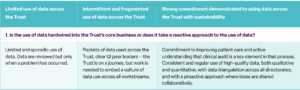
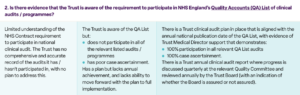
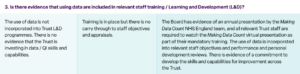
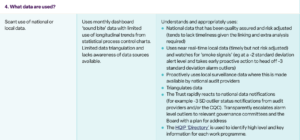
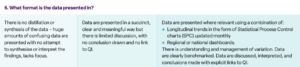
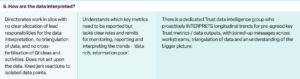
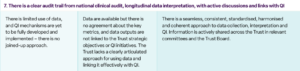
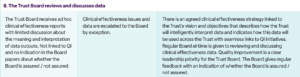
These, and many other messages in the Kirkup report, can be extrapolated and applied across Trusts and other healthcare providers. Data are everywhere, often difficult to interpret, can be complex and, at times, additional information is required to get a clear picture of what is happening. As such, it can be difficult for Trusts to understand where they need to improve. The following tools offer a suggested approach: Questions for Trusts to ask themselves about how they use data Trusts can either internally review these questions to judge where they might sit, or it may be helpful to ‘buddy’ with a peer Trust for independently reviewed opinions, such that a relevant professional team, external to the Trust / Board, provide ‘fresh eyes’ and an independent perspective. Translating national data into effective change at a local level isn’t easy. It may be littered with potential pitfalls and difficulties, but it is, of course, vitally important. So, I will leave you with just one takeaway thought, a lightbulb moment (neatly inspired by the inventor of the lightbulb, Thomas Edison): “I have not failed 700 times. I have succeeded in proving that those 700 ways will not work. When I have eliminated the ways that will not work, I will find the way that will work”. Here’s to continuing to work together, and supporting each other, to find the ‘right way’ to use national clinical data to support meaningful change at a local level. Further information and resources This article was originally featured in HQIP’s quality improvement magazine, CORNERSTONE – to see more articles on topics such as healthcare inequalities and sustainability in healthcare, go to: www.hqip.org.uk/wp-content/uploads/2023/11/HQIP_Cornerstone_2024.pdf.

Latest news: April eBulletin

26 Apr 2024

Welcome to the latest round-up of clinical audit and programme news, events and updates from HQIP and other relevant healthcare organisations.

Contents

Read the eBulletin here.
Don’t forget to sign up: Keep up to date with our latest news, events and work programmes by subscribing to our mailing list today. You can also stay up-to-date by following us on X: @HQIP.

Clinical Audit Awareness Week: Exciting updates

25 Apr 2024

We’re thrilled to announce some exciting updates for Clinical Audit Awareness Week 2024
  • EVENT: Wednesday 26 June 2024; 10-11am (online) NHS IMPACT and HQIP Quality Improvement
  • EVENT: Thursday 27 June 2024; 4-5pm (online) From Audit to Impact (A case study: National Cancer Centre)
  • EVENT: Friday 28 June 2024; 2.30-3.30pm (online) A conversation with Stella Vig, National Medical Director for Secondary Care and Quality, NHS England
  • VIDEO: The Mutual Benefits of Patient and Public Involvement (PPI)
  • BLOG: The importance of data gathering in addressing health inequalities
  • RESOURCES: HQIP will be resharing a number of resources to support clinical audit and quality improvement during Clinical Audit Awareness Week
Visit our dedicated Clinical Audit Awareness Week webpage for more information and to register for these events as we gear up for an incredible Clinical Audit Awareness Week! #CAAW24

HQIP selected as a finalist for the GO Awards

15 Apr 2024

We’re thrilled to share some exciting news! HQIP has been chosen as a finalist for the GO Awards 23/24 in the Best Procurement Delivery category. Our entry, the National Child Mortality Database, has earned this prestigious recognition, underscoring our commitment to excellence in procurement and our ongoing efforts to advance child health.

Judith Hughes, Associate Director of Procurement at HQIP, expressed her excitement, saying, “To be a finalist for the GO Awards for the best procurement delivery is a great achievement. The National Child Mortality Database tender was not just delivered by procurement but also our colleagues in the NCAPOP team and wider HQIP teams. If we are lucky to win this award, it will demonstrate what a skilled organization we are.”

The awards will take place on May 16th at the Titanic Hotel Liverpool.

Read more about our entry and the awards ceremony here.

New resources published April 2024

10 Apr 2024

We are pleased to announce that the following NEW resources have been published:
The reports are available to view and download, along with all other reports, on our dedicated reports webpage. Stay up to date: Join our mailing list to receive notifications when new reports are published.

NEW Benchmarking data available: National Hip Fracture Database

10 Apr 2024

The National Hip Fracture Database is the latest dataset to be published on the National Clinical Audit Benchmarking (NCAB) website. This data was updated on NCAB 9 April 2024 from the NHFD report 2023 published on 14 September 2023 covering data from January 2022 to December 2022.

NCAB is an online portal, hosted by HQIP, which provides access to national audit performance data. Users do not need to register, and can access audit benchmarked data searchable by speciality, Trust, hospital or unit. For all datasets currently published, go to the NCAB site

How do I compare thee?

4 Apr 2024

Professor Danny Keenan, HQIP Medical Director and Associate Medical Director to the Manchester University NHS Foundation Trust.

Benchmarking in healthcare is far more than mere comparison. It is a powerful tool that can support healthcare providers to identify opportunities for improvement and improve patient care. But, in a minefield of data and information, what are the key resources and developments in relation to benchmarking in healthcare, and what steps are HQIP taking to support effective measurement of performance? Our Medical Director, Professor Danny Keenan, provides a helpful overview…

Your first port-of-call should be audit and similar programme reports and outputs. Be familiar with what is available in your field, and understand how often – and when – data is shared. For HQIP commissioned audits and programmes, the reports and other outputs can be found on the HQIP website, while our publication schedule (which is updated monthly) is here. Importantly, our outputs were changed after the COVID-19 pandemic, following a series of webinars with the national audit providers to explore if the programme was ‘digital ready’. As a result, changes – such as shorter reports, less metrics and a move towards near real-time dynamic reporting – were introduced to reduce the burden on Trusts and healthcare service providers. It is also worth noting that, in addition to these commissioned summary reports, many clinical audit and outcome review programmes have websites where further background data can still be accessed.

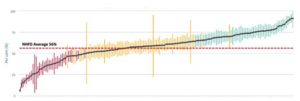
A benchmarking chart based on data from the National Hip Fracture Database (NHFD) showing ‘prompt surgery’ (surgery by the day following presentation with hip fracture) with confidence intervals. Each hospital is denoted on the x axis (not shown here):

Another starting point is the National Clinical Audit Benchmarking website (NCAB), which provides a visual snapshot of individual Trust audit data set against individual national benchmarks. There is no barrier to use, such as login or an NHS email address, so it’s easy to use and available to all – from healthcare professionals through to policy makers and patients. Created by HQIP in collaboration with the Care Quality Commission (CQC), this resource contains datasets on a variety of clinical disciplines, with additional data being added on an on-going basis (to receive notifications of new datasets as they are added, subscribe to HQIP’s mailing list). It provides a snapshot view of each healthcare provider, stating whether, for example, they are above, in line or below expectations for each measure. NCAB also enables Trusts to determine if there are any metrics for which they are a (positive or negative) outlier. This is important for highlighting when patient outcomes fall significantly outside of the norm of what is expected. In light of its significance and in response to the COVID-19 pandemic, HQIP has undertaken extensive consultation with stakeholders, including patients, to revise its guidance relating to outliers. The result is a ‘softer approach’ which retains the principles of benchmarking, and includes:

  • The introduction of a ‘nonparticipation category’ so that Trusts that should be contributing data towards national audits but are not, will be regarded as an outlier.
  • Changes to the notification of significant outliers. For key predetermined audit metrics, such as mortality, ‘alert’ level results will be notified directly to the CQC and NHS England. Other less significant metrics with alert outlier results would be available for review when annual reports are published.

In addition to these resources, HQIP is involved in a number of developments to support Trusts and other health and care providers to measure performance, starting with talking to clinicians and analysts to identify better ways of visualising HQIP and NHS outputs (to ensure maximum impact). Work in this area includes making more timely data available on NCAB, and looking at how we could standardise coding systems that are already in use. We are also talking to patient and service user groups as well as the independent sector, to include the latter in the National Clinical Audit programme. The Paterson review made it clear that all patients’ data should be included, no matter where their operation has taken place or how their care is commissioned. This will ensure that patient care is equally assured, and that their data is available for quality improvement initiatives irrespective of geography. Of course, performance measurement and benchmarking are of utmost importance to the NHS too. In 2023, I chaired a series of ‘National Clinical Audit for Improvement Implementation Group’ webinars run by NHS England. These explored the development of clinical effectiveness across the service and, in particular, looked at ways to support clinical audit colleagues who are very much on the frontline of this work, with initiatives such as NHS IMPACT, the Futures NHS platform and the Model Health System. To further support the sharing of innovation, they also coordinate the NHS Benchmarking Network, which helps members to improve patient outcomes, raise health standards and deliver quality health and care services through data excellence, benchmarking and the sharing of innovation.

The Paterson review made it clear that all patients’ data should be included, no matter where their operation has taken place or how their care is commissioned

One area that everyone is interested in (quite rightly), is how to address health inequalities; and audit data and performance measurement is proving to be a powerful tool for this, shining a light on where inequalities exist. The COVID-19 pandemic highlighted inequalities in health outcomes due to ethnicity and deprivation. As a result, HQIP is investigating how the National Clinical Audit programme can track patients’ outcomes better using markers such as ethnicity and deprivation. In particular, we sponsor a National Medical Director’s Faculty of Medical Leadership and Management (FMLM) Fellow each year, and they have led a series of reviews on this topic. The 2023 review, due for publication in late 2023, is a survey concerning the obstructions encountered in relation to health inequalities, and includes a number of strong recommendations concerning basic issues such as coding, use of postcode and how to manage small numbers in the audit programme (all of which could make a big difference). We are now working with the Health Inequalities team at NHS England, regarding the plans for implementation of these important recommendations.

Audit data and performance measurement is proving to be a powerful tool for… shining a light on where inequalities exist

All the tools and resources I have mentioned so far are available to support benchmarking here and now (and I do hope you will take a look at them, if you are not already doing so). But I will end on more of a nod to the future. Firstly, we must improve how we celebrate excellence. Currently HQIP works with audit providers to produce “scenarios” concerning units that appear at the ‘excellent end’ of benchmarking charts. But, we need to raise excellence across the board. One of the downsides of benchmarking is that units sitting in the middle of the chart can become complacent, whereas we all need to keep moving towards the excellent end. HQIP will work with audit providers on ways of celebrating excellence better, so as to promote a ‘move to the right’. Secondly, to support strategic- and forward-thinking around audit data and performance review in healthcare, HQIP runs a Methodology Advisory Group (MAG), comprised of a broad spectrum of stakeholders including policy makers, healthcare professionals, and patients. In 2023, we hosted a MAG webinar dedicated to Artificial Intelligence (AI) and machine learning. We reviewed the use of these technologies in relation to National Clinical Audit, and discussed what work was already taking place and how we could foster best practice in this area. As a result, we are now exploring how best to share current and proposed best practice using AI. Furthermore, we have also committed to investigate the use of ChatGPT-4, or alternatives, to explore current anonymous datasets to search for disease and outcomes linkages. I’m sure that you, as do I, await news on how these developments can support us in measuring performance and improving outcomes for patients with eager anticipation. Watch this space… 

Further information and resources

This article was originally featured in HQIP’s quality improvement magazine, CORNERSTONE – to see more articles on topics such as healthcare inequalities and sustainability in healthcare, go to: www.hqip.org.uk/wp-content/uploads/2023/11/HQIP_Cornerstone_2024.pdf.

Latest news: March eBulletin

28 Mar 2024

Welcome to the latest round-up of clinical audit and programme news, events and updates from HQIP and other relevant healthcare organisations.

Contents

Read the eBulletin here.
Don’t forget to sign up: Keep up to date with our latest news, events and work programmes by subscribing to our mailing list today. You can also stay up-to-date by following us on X: @HQIP.