
Avoiding ‘lost in translation’
4 May 2024

Using national healthcare data to support meaningful change
Jill Stoddart, Director of Operations (National Clinical Audit and Patient Outcome Programme), HQIP What keeps you awake at night? When I worked in clinical practice, questioning whether I’d provided the very best care for patients kept me awake. Now I commission national clinical audits and other patient outcome programmes, this is still a primary concern – but the focus is on whether the data we collect supports the best care for patients. How can we ensure that evidence derived at a national level is well received and implemented at Trust level? And, critically, are we really making a difference to patient care? I understand the pressure and challenges that Trusts face with increasing demand, financial constraints, bed shortages, recruitment freezes and preparing for winter pressures – all in addition to national and regional scrutiny. Against this backdrop, it can be extremely difficult to make sense, and practical use, of the vast array of national healthcare data available. Between April 2022 and March 2023, the National Clinical Audit and Patient Outcome Programme (NCAPOP), commissioned by HQIP, published 64 reports and 368 recommendations alone. Factor this up across the national clinical effectiveness landscape – including National Institute for Health and Care Excellence (NICE) guidance, Getting It Right First Time (GIRFT) reports, Healthcare Safety Investigation Branch (HSIB) investigations and multiple other national enquiries – and we can safely say that Trusts are awash with reports and recommendations.Widely disseminate information about both negative and positive outliers – share the learning!This is why, in 2023, HQIP reshaped its outputs. We undertook discussions with policy makers and healthcare providers, which identified a need to reduce the burden and increase the timeliness of data, culminating in:
- Shorter user-friendly ‘state of the nation’ reports
- Quality Improvement (QI) resources, replacing local recommendations in reports
- A focus on approximately ten metrics, and
- Near real-time dynamic reporting, refreshed at least quarterly.
- Do we know how good we are?
- Do we know where we stand relative to the best?
- Do we know where, and understand why, variation exists in our organisation?
- Over time, where are the gaps in our practice that indicate a need for change?
- In our efforts to improve, what’s working?
- Building a shared purpose and vision
- Investing in people and culture
- Developing leadership behaviours
- Building improvement capability and capacity, and
- Embedding improvement into management systems and processes.
The starting point for innovation and change at a Trust level is to continually question the quality of care provideSo, what difference can clinical audit make? The audit cycle includes taking action to bring clinical practice in line with evidence based standards, to improve the quality of care and health outcomes. Healthcare providers need to consider the link between the evidence base, national policy, national clinical audit and local implementation. This can take many forms, but here are some top tips that are useful when considering how best to use data intelligently and achieve change at a local level:
- Share information widely across the Trust, understand variation, make data available and transparent but don’t stop there – discuss it and agree the changes required. Widely disseminate information about both negative and positive outliers – share the learning!
- Report by exception to the relevant assurance committees and Board – ensure regular Board airtime is given to discussing the data, its meaning and the required QI actions.
- Remove Trust level obstacles – bureaucracy stifles innovation.
- Remember the 80:20 rule (Pareto Principle) – 80% of outcomes (or outputs) result from 20% of causes (or inputs) for any given event.
- Always set deadlines and agree who is responsible for delivering actions, following up on progress. Set regular small milestones – these are much more likely to be successfully implemented.
- Action plans need to be robust and identify system actions which remove the reliance on individuals. Where possible, use standardised and permanent (physical or digital) designs to eliminate human error, sometimes referred to as ‘forcing actions’ (as cited in the Perinatal Mortality Review Tool (PMRT)’s infographic relating to their 2022 annual report).
- Be aware of national clinical audit publication schedules – and make plans to receive reports and data as they are published.
- Know your Trust plan and timetable for the national clinical audit programme.
- Monitor your own internal Trust data and take actions to unpick and explore early, using NHS England Making Data Count resources.
- Make an explicit Trust link between data and Quality Improvement (QI) and avoid silo working.
- meaningful – that is, related clearly to outcomes
- risk adjustable
- available – they are available from data already routinely collected
- timely.
- are analysed and presented in a way that shows both random variation and trends
- use sound, statistically based approaches to detecting the signal among the noise
- are presented graphically to show variation, significant trends and outliers in the form of statistical process control charts and funnel
- plots are extended to clinically relevant outcome measures.
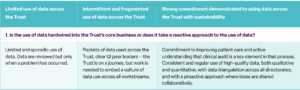
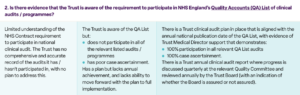
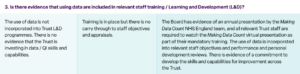
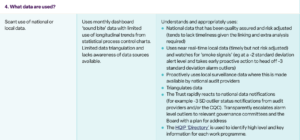
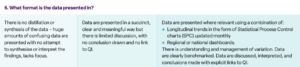
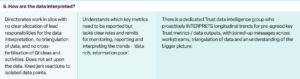
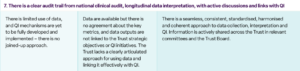
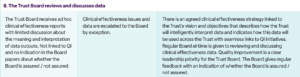 Trusts can either internally review these questions to judge where they might sit, or it may be helpful to ‘buddy’ with a peer Trust for independently reviewed opinions, such that a relevant professional team, external to the Trust / Board, provide ‘fresh eyes’ and an independent perspective. Translating national data into effective change at a local level isn’t easy. It may be littered with potential pitfalls and difficulties, but it is, of course, vitally important. So, I will leave you with just one takeaway thought, a lightbulb moment (neatly inspired by the inventor of the lightbulb, Thomas Edison): “I have not failed 700 times. I have succeeded in proving that those 700 ways will not work. When I have eliminated the ways that will not work, I will find the way that will work”. Here’s to continuing to work together, and supporting each other, to find the ‘right way’ to use national clinical data to support meaningful change at a local level.
Further information and resources
Trusts can either internally review these questions to judge where they might sit, or it may be helpful to ‘buddy’ with a peer Trust for independently reviewed opinions, such that a relevant professional team, external to the Trust / Board, provide ‘fresh eyes’ and an independent perspective. Translating national data into effective change at a local level isn’t easy. It may be littered with potential pitfalls and difficulties, but it is, of course, vitally important. So, I will leave you with just one takeaway thought, a lightbulb moment (neatly inspired by the inventor of the lightbulb, Thomas Edison): “I have not failed 700 times. I have succeeded in proving that those 700 ways will not work. When I have eliminated the ways that will not work, I will find the way that will work”. Here’s to continuing to work together, and supporting each other, to find the ‘right way’ to use national clinical data to support meaningful change at a local level.
Further information and resources
- HQIP commissioned audit and programme reports (subscribe to notifications here)
- Information and resources to support the use of the National Clinical Audit and Patient Outcome Programme (NCAPOP) to stimulate healthcare Quality Improvement (QI)
- Support with Developing a clinical audit programme
- NHS England Quality Accounts (QA) List of clinical audits/ programmes
- HQIP ‘Directory’ with high level and key information for each work programme
- National Clinical Audit Benchmarking (NCAB) website
- Article: When is data ‘good data’? HQIP CORNERSTONE magazine 2023 (pages 22-23)
- NHS IMPACT (IMproving PAtient Care Together) programme
- NHS England IMPACT resources and materials
- NHS England Making Data Count
Other news
5 May 2026
Mental health: Using evidence to improve care
HQIP’s CEO, Chris Gush, explains why data is pivotal to the national review of services...
15 Apr 2026
Measure, Learn, Improve: Audit data and continuous learning in the NHS
Across the NHS, clinicians and teams collaborate every day to provide safe, effective, and compassionate...
5 Jun 2025
#CAAW25: Key resources on Influencing Change in Healthcare
As part of Clinical Audit Awareness Week (#CAAW25), which is designed to share the value...