


8 Oct 2026
This report is an audit of care received by people diagnosed or treated with prostate cancer from September 2022 to March 2025 in England and Wales. In addition, it includes a description of national time trends in diagnoses, treatments, and survival outcomes from 2015-2025 in England, and 2022-2024 in Wales.
The report reviews diagnosis, treatment and outcomes for men with prostate cancer, and assesses overtreatment, undertreatment, complications following surgery and radiotherapy, trends in metastatic disease, and emerging treatment approaches including focal therapy.
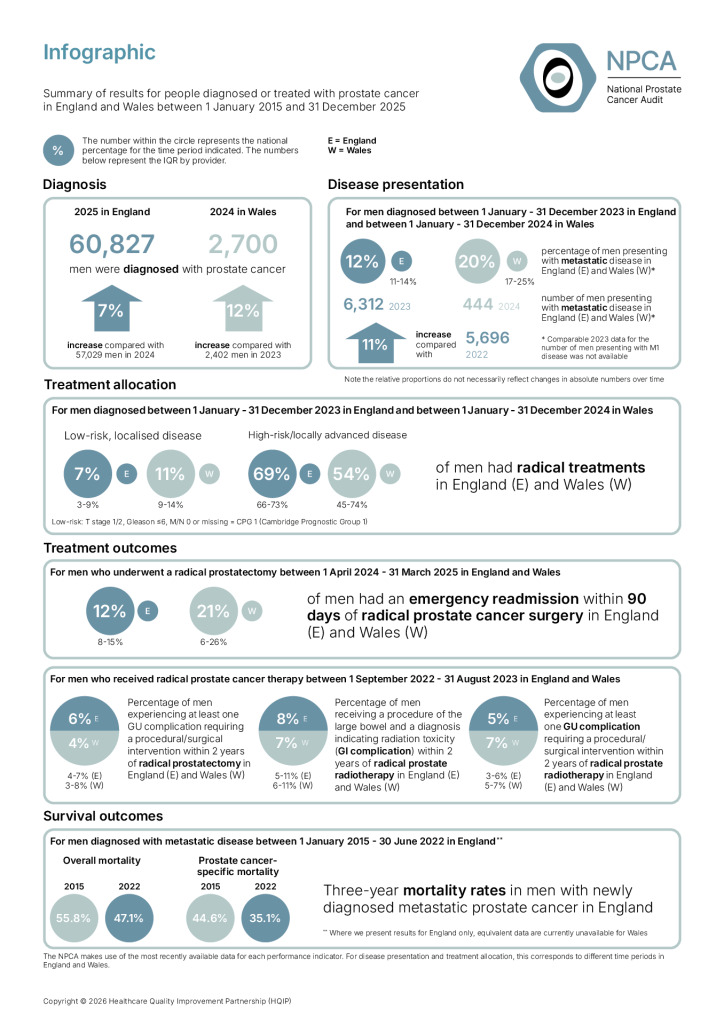
For the first time since NPCA data collection began, the number of men newly diagnosed with prostate cancer exceeded 60,000 in England in 2025 alone
The number of prostate cancer diagnoses continues to rise rapidly. In England, 60,827 men were diagnosed in 2025, a 7% increase on the previous year, while diagnoses in Wales rose by 12% from 2023 to 2024 to 2,700. Growth was particularly notable among men diagnosed with lower-risk, stage 1 disease.
The report found continued variation in treatment decisions. Around 7% of men with low-risk disease in England, and 11% in Wales, received radical treatment that may represent overtreatment, with variation between hospitals. At the same time, only 69% of men with high-risk or locally advanced disease in England, and 54% in Wales, received radical treatment, raising concerns about potential undertreatment.
Outcomes for metastatic disease have improved. Three-year overall mortality among men with newly diagnosed metastatic hormone-sensitive prostate cancer fell from 55.8% in 2015 to 47.1% in 2022, a change the audit attributes in part to wider use of treatment intensification. The report also describes increasing uptake of newer radiotherapy techniques and growing interest in focal therapies such as high-intensity focused ultrasound (HIFU).
Recommendations include:
- Continue promoting active surveillance for men with low-risk disease to reduce overtreatment.
- Investigate why men with high-risk disease are not receiving radical treatment when appropriate to reduce potential undertreatment.
- Review variation in post-treatment complications and readmission rates.
- Ensure treatment decisions are based on fitness and life expectancy, not age alone.
- Improve completeness of staging, PSA and Gleason score data.