

This report presents key findings on the quality of care provided to babies receiving neonatal care in England, Scotland, Wales and the Isle of Man during 2025. It examines partnership in care, neonatal care processes and neonatal outcomes, highlighting areas of improvement as well as opportunities to reduce variation and achieve more consistent, high-quality care for babies and their families.
While this report highlights opportunities to improve…we hope it provides a catalyst for sharing and learning from exemplary care and improvement interventions
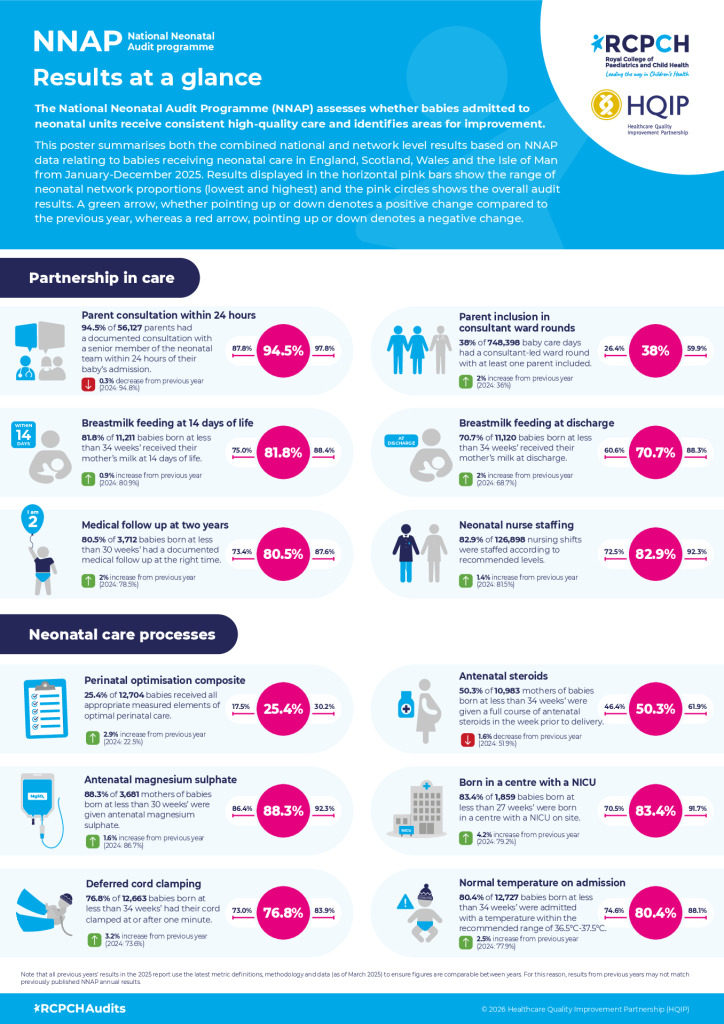
The report highlights continued improvement across several important measures of neonatal care. For the first time, mortality to discharge home among babies born at less than 32 weeks’ gestation fell below 6%. Rates of breastmilk feeding also continued to improve, with more babies receiving their mother’s milk in the first two days of life, at 14 days of age, and at discharge. Improvements were also seen in key elements of perinatal optimisation, including deferred cord clamping, birth in a centre with a neonatal intensive care unit (NICU), admission temperature, and use of antenatal magnesium sulphate.
A major theme within the report is variation in care and outcomes between different groups of babies and families. Differences by ethnicity were identified in several measures, including parental consultation within 24 hours of admission, parental involvement in ward rounds, breastmilk feeding and deferred cord clamping. The report notes improved completeness of ethnicity data and recommends that neonatal networks work with constituent units and families to better understand and address these disparities through locally designed quality improvement initiatives.
The report also highlights further improvements in neurodevelopmental follow-up, neonatal nurse staffing levels and screening for retinopathy of prematurity. However, substantial geographical variation remains in several areas, including optimal perinatal care, non-invasive breathing support, mortality and some neonatal outcomes. As such, it recommends a renewed focus on delivering evidence-based perinatal interventions consistently, strengthening early breastmilk feeding support, reviewing variation in mortality rates, and improving national standards for neonatal data collection and interoperability. These actions are intended to support continued improvements in outcomes for preterm and vulnerable babies.