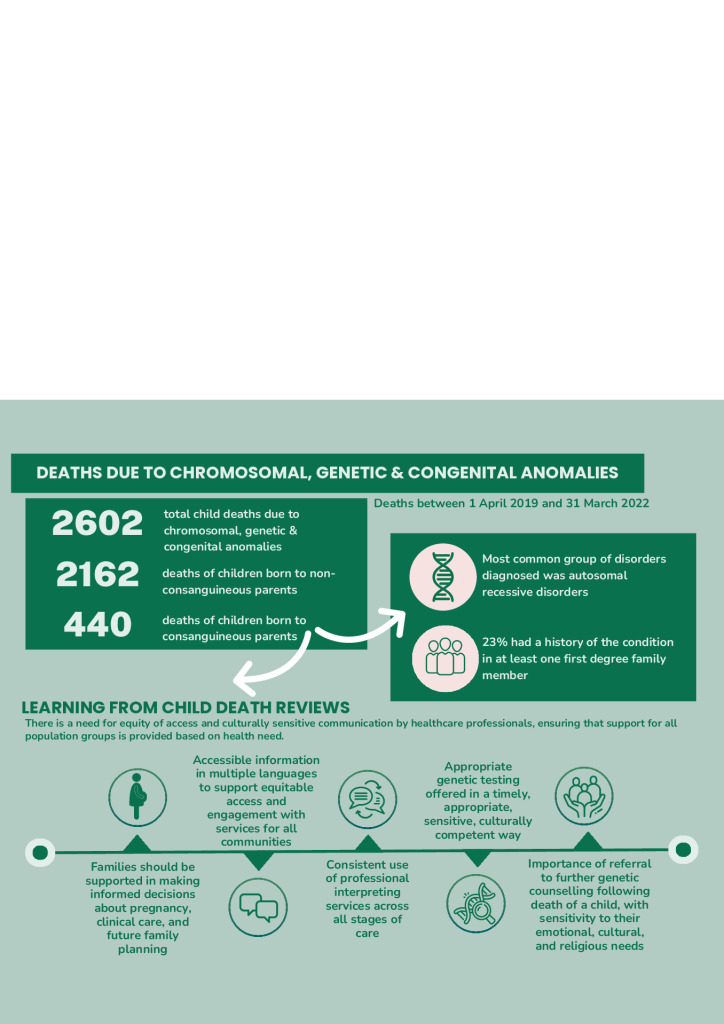


The National Child Mortality Database (NCMD) has published a thematic report on the deaths of children who were born to parents who are blood related. The data show that there was an increased proportion of deaths from genetic disease for those children whose parents were consanguineous, compared with those whose parents were not related. Based on data from April 2019 to March 2023 (to ensure that most deaths had been reviewed by a Child Death Overview Panel), it found that 7% of all child deaths (all causes) are of children who died and whose parents were related, with regional variation. The highest number of deaths of children born to consanguineous parents was in the neonatal (0–27 days) age group, followed by those aged 28–364 days.
This report will assist understanding of the risks associated with consanguinity
Overall, there were higher numbers of deaths of children in the most deprived neighbourhoods (this was the case for children born to both consanguineous and non-consanguineous parents). For children who died who were born to consanguineous parents, 52% were resident in the most deprived neighbourhoods, compared to 5% in the least deprived neighbourhoods. This may reflect the socio-economic disadvantage of mothers in consanguineous relationships.
In addition to a call for further investigation of the role of deprivation in child mortality and close relative marriage, this report includes five key recommendations for improvement:
- Ensure that all bereaved families, following the death of a child due to a suspected or confirmed genetic condition, are proactively offered culturally sensitive genetic counselling
- Improve awareness and consistency of pathways for early referral to clinical genetics by ensuring that antenatal and postnatal genetic testing is consistently offered when clinically appropriate
- Ensure consistent use of professional interpreting services across all stages of care
- Strengthen genetic testing pathways to improve awareness and consistency of antenatal and postnatal genetic testing
- Strengthen preconception and early-pregnancy conversations between healthcare professionals and women, by providing up-to-date, evidence-based and culturally sensitive training on genetic and family health factors.
Importantly, this report will assist understanding of the risks associated with consanguinity.
Every child who dies is a precious individual and their death represents a devastating loss for parents, siblings, grandparents, carers, guardians, extended family, and friends.
Read the full report: You can view the report by clicking the button below.
Stay up-to-date: For notifications of future reports from HQIP, sign up to our mailing list.