
My breast cancer story: From heartbreak to hope
1 Oct 2026

As part of Breast Cancer Awareness Month, patient representative, advocate and author of ‘Why Me? My Fight for Life From Heartbreak to Hope’, Sharon-Ann, talks to HQIP about her breast cancer journey, sharing her thoughts about the value of data and patient involvement in the design and delivery of breast cancer care. Watch the video, or scroll down to read the article…
“Although my breast cancer was diagnosed in 2020, my cancer journey started five years earlier. At that time, for around a year, I had been repeatedly misdiagnosed. Eventually, through the NHS Choose and Book system, I chose to go to St George’s in Tooting, where they identified what had previously been missed, and I was diagnosed with multiple myeloma and associated cardiac amyloid. One hospital sadly failed me, while another saved my life. During my subsequent treatment, my heart became severely damaged, leading to stage 2 heart failure and, at one point I was given just six months to live.
Data is extremely important, because it shows what’s working and what isn’t”
By 2020, my multiple myeloma was in remission but, during lockdown, I found a lump. In fact, I was prompted to check by Breast Cancer Awareness Month, and so I went to my GP. They referred me to a hospital within the necessary time frame and that was quickly followed by a lumpectomy, chemotherapy and radiotherapy. Thankfully, since entering the breast cancer pathway, everything has gone extremely well, and I’m pleased to say that I’m now cancer free. They took into consideration my background and heart failure. I felt as if my patient care and worries were noted pretty much throughout, and the overall care has been extremely good; the treatment was rapid.
From patient to patient advocate
As a result of my multiple myeloma, I wrote a book in 2018, to talk about the effects of misdiagnosis, as well as other factors such as (for me, at that time) issues around support given by a clinical consultant versus a Clinical Nurse Specialist (CNS). However, since then, I have contributed regularly to nurse training at St George’s over several years; and I have subsequently seen first-hand how things have changed for the better (when accompanying someone else who had been diagnosed with lymphoma on a hospital visit). With my multiple myeloma, the whole experience was very clinical; but 11 years on, the change was amazing. The consultant explained everything, and then she gave us time with the CNS for as long as we needed, in a separate room.
I feel like I can be the person behind the numbers”
Since writing my book, I have acted as a patient advocate, raised significant funds for Macmillan Cancer Support, and worked as an insights panellist for a number of organisations. In 2025, I started a Community Interest Company (CIC), Heartbreak to Hope, which grew out of my book and my own experiences. Through the CIC, I support people affected by serious illness, loss and major life changes, with a focus on early awareness, prevention and health inequalities.
The importance of patient voice AND data
I believe that data is extremely important in improving patient care and outcomes, because it shows what’s working and what isn’t. But, speaking to patients tells you something else; it tells you what it feels like. I think that it’s so important to have both, in order to improve care. I feel like I can be the person behind the numbers.
Personally, I’ve always questioned pretty much everything that I’ve been told. I was advised to have a mastectomy and, for me, it wasn’t what I wanted. I was supported in that decision by my consultants, and we went down a different pathway. While the doctors can give you medical advice, as patients, we know ourselves. It’s important that the patient is involved in their own healthcare.
Speaking to patients tells you something different; it tells you what it feels like”
As a Black woman, I’m also very conscious of inequalities in healthcare, with people having spoken to me about differences in their experiences of care. I think this is another area where data is important, because it can help us see where those differences exist. But we need to use that information, alongside what patients are telling us, to make changes.
Treat the person, not the condition
With my breast cancer care, I had multiple additional issues that needed to be taken into consideration. As mentioned, I was in remission for multiple myeloma, and had severe heart failure. So, for a long period, I was navigating different cancer teams as well as the cardiac team. And they don’t necessarily fit into any one pathway. Therefore, I think we need to look at the whole person, because they are often juggling so many different things. Again, we need the data to steer treatment; but it needs to be more joined up.
Breast Cancer Awareness Month: early detection saves lives
Finally, I’d like to encourage everyone to know what is normal for their breasts, and check themselves regularly this Breast Cancer Awareness Month, and every month! Finding a problem early can mean prompt diagnosis and treatment (one of the slogans for 2026 is Early detection saves lives). That was certainly the case with my breast cancer. I saw something on social media during the campaign that reminded me that we need to check ourselves, and that’s how I found the lump. It’s so important to use these awareness events to encourage people to check themselves. I do it on a monthly basis, but October is a good opportunity to remind everyone. If I didn’t find the lump when I did, I probably wouldn’t be here today. Self-detection does indeed save lives.
Further resources
- HQIP’s Breast Cancer Awareness Month hub
- Heartbreak to Hope CIC — Cancer Awareness, Emotional Support & Advocacy
- Article: How clinical audit is helping the NHS improve the entire breast cancer pathway
- Primary breast cancer State of the Nation report 2026
- Metastatic breast cancer State of the Nation report 2026
- More about cancer care from HQIP
- National Cancer Plan for England
Other news
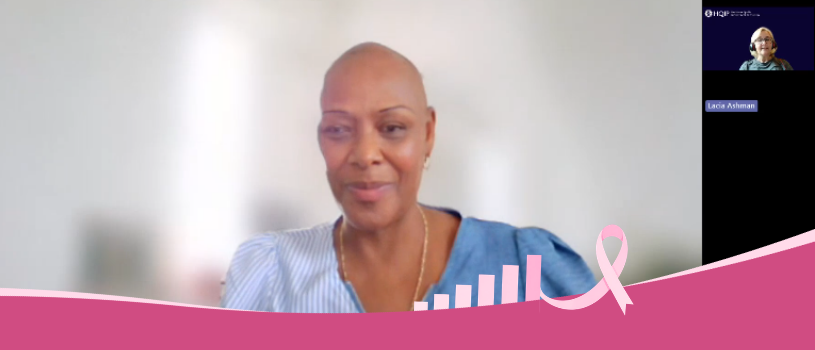
New patient video: My breast cancer story
To mark Breast Cancer Awareness Month, HQIP is sharing the full video interview with patient...
National Cancer Plan: From strategy to improvement
As part of Breast Cancer Awareness Month, we take another look at the National Cancer...
New breast cancer care hub launched for Breast Cancer Awareness Month
As part of Breast Cancer Awareness Month, HQIP has created a new breast cancer care...