
Case study (strategic impact): Thrombolysis in Acute Stroke Collaborative
22 Jul 2026
Excellence in Clinical Audit Awards, part of Clinical Audit Awareness Week 2026, Strategic Impact joint runner-up
Thrombolysis in Acute Stroke Collaborative (TASC) is a national, data-driven improvement programme designed to improve the safe and timely delivery of thrombolysis for acute stroke patients. Quantitative data was complemented by qualitative evidence and a range of quality improvement initiatives, to demonstrate clear and sustained improvement (thrombolysis rates improved nationally from 10.7% to 14.9% for the first time in 10 years) – and so directly supports the NHS Long Term Plan’s ambition to improve outcomes for its six named conditions. Discover much more about the impact of this work in the case study below:
TASC is a partnership project with NHS England and NHS Elect (national improvement organisation) working collaboratively to design and deliver a large-scale improvement network with the aim of improving access to thrombolysis.
The programme has worked with 18 sites across Cohorts 1 and 2 and is now working with a further 12 sites in Cohort 3. Frontline project teams at site level include stroke consultants and physicians, Emergency Department clinicians, stroke specialist nurses and Advanced Clinical Practitioners (ACPs), radiology teams, therapists (AHPs, including occupational therapists, physiotherapists and speech and language therapists), data/SSNAP administrators, Quality Improvement (QI) teams, ambulance services (including NWAS, SWAST and LAS) and executive sponsors and Trust leadership.
Who is the project designed to support?
The programme’s primary audience is NHS acute services, commissioners and primary care. Secondary audiences include Trust leadership and executive teams, integrated stroke systems and networks, ambulance services and patients (indirectly, through improved care pathways).
The ultimate beneficiaries are patients with suspected or confirmed ischaemic stroke. The programme leads to more people surviving stroke and to disability following stroke being much reduced.
Cohort 1 sites include Torbay Hospital, Eastbourne District General Hospital, Lincoln Hospital, Lister, East and North Hertfordshire NHS Trust, Royal Hampshire County Hospital and Royal Preston Hospital.
Cohort 2 sites include Queens Medical Centre, Nottingham University Hospital (NUH), Royal Derby Hospital, Norfolk & Norwich University Hospital NHS Foundation Trust, Arrowe Park Wirral, Hereford County Hospital (Wye Valley NHS Trust), University Hospital Dorset (Bournemouth), Russells Hall Hospital, The Dudley Group NHS Foundation Trust, Southmead Hospital, North Bristol NHS Trust, Northampton General Hospital, Scunthorpe General Hospital, North Lincolnshire and Goole NHS Trust, Blackpool Teaching Hospitals – Acute Stroke Centre and Princess Royal University Hospital, Bromley.
What did it set out to achieve?
The primary aim of the programme is to increase thrombolysis rates across participating sites. TASC’s initial aim was to achieve the national ambition of ‘by 2025 aiming for thrombolysis to be given to at least 20% of patients who could benefit from the intervention’. In Cohort 3, the scope has expanded to include improving access to mechanical thrombectomy. The aim is now ‘to increase thrombolysis and thrombectomy rates for patients who can benefit from the intervention’.
The wider aims of the programme are to improve the timeliness and reliability of acute stroke pathways, increase access to thrombectomy, reduce unwarranted variation (especially out-of-hours) and improve the experience of stroke patients and staff working in stroke services. The programme also aims to improve door-to-needle times and door-in door-out (DIDO) times, while embedding sustainable QI capability.
The programme’s strategic ambition is to ‘deliver clot-busting thrombolysis to twice as many patients’.
When did the project start?
The TASC programme started with Cohort 1 in 2023. Each cohort delivers a 12-month programme of support and learning for participating sites. The programme has now entered its third year with Cohort 3, which started in April 2026.
How did the project work?
TASC’s approach is a coordinated improvement model that integrates structured knowledge sharing, robust data analytics, rapid dissemination of best practice and multidisciplinary collaboration. It enables NHS stroke teams to systematically identify variation, implement targeted changes, and scale effective interventions across the system.
The key components of the approach include multidisciplinary site visits and diagnostics, involving clinical, QI and measurement leads. These site visits include reviews of pathways, workforce and data.
Measurement and data analysis form a core part of the programme and include the use of SSNAP data and opportunity analysis, including variation and delays. This enables teams to understand variation in thrombolysis rates, identify delays and bottlenecks in pathways, and monitor changes over time and assess impact. The programme also introduces Statistical Process Control (SPC). Progress is tracked using a balanced framework of outcome measures (for example, thrombolysis rates and patient outcomes), process measures (for example, door-to-needle time) and balancing measures to monitor unintended consequences.
The programme provides QI coaching and support through fortnightly calls with sites and a dedicated QI coach, clinical lead and measurement lead. A collaborative learning model is delivered through national learning events, the sharing of best practice across sites and cross-site peer learning. Testing and implementation of change is supported through the use of Plan–Do–Study–Act (PDSA) cycles, with a focus on pathway improvement.
The programme also uses an experience-based design approach, understanding patient and staff experience to drive improvements that matter to them.
Did the project involve changes to processes in order to implement?
Yes, significant process changes were a core part of the programme.
Common changes include the introduction of direct-to-CT pathways, adoption of pre-hospital video triage (for example, video triage), faster imaging workflows, changes to culture and decision-making processes, improved thrombectomy referral pathways and standardisation of Emergency Department (ED) triage and stroke alerts. The programme has also supported increased administration of thrombolysis, reduction in disability post stroke and the development and extension of existing roles within the stroke team.
Other system-level changes include workforce redesign (for example, Advanced Clinical Practitioner (ACP) roles and stroke nurse leadership), the introduction of structured multidisciplinary team (MDT) case reviews and improved system working between ambulance services, acute stroke centres and comprehensive stroke centres. The programme has also supported more effective use of data to understand stroke pathway flow.
Did the project succeed and, if so, what is the evidence?
Cohort 3 is ongoing and remains in progress.
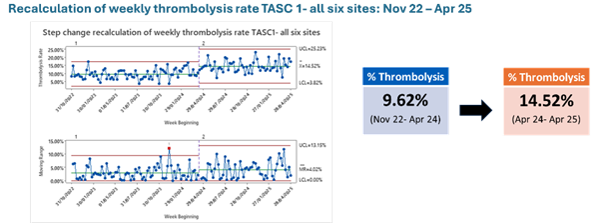
Early evidence from the TASC programme overall has demonstrated improvements in thrombolysis rates. In Cohort 1, thrombolysis rates increased from 9.62% pre-TASC (November 2022–April 2024) to 14.52% during and after TASC (April 2024–April 2025).
For Cohort 3, outcomes are in progress and continue to be measured.
“Participating in TASC has enabled us to create opportunities for collaborative clinical discussions in a psychologically safe environment to challenge deep set beliefs, resulting in culture changes in the department, and it has taught us to use data more smartly to drive change.” Zehra Mehdi, Consultant Stroke Physician, Hampshire Hospital
Other insights or learning points
Key learning from across sites has shown that culture has been a theme across all sites. Decision-making and promoting psychological safety are key to changing practice, while improving front-door reliability remains the main objective. Out-of-hours care continues to drive most variation. Strong leadership and multidisciplinary team (MDT) engagement already exist across sites and existing stroke data can be more effectively utilised to drive improvement.
Other supporting materials:
- TASC Toolkit
- Case studies from Cohort 1 Hampshire and Torbay and vignettes from Cohorts 1 & 2 (How TASC Sites Are Making a Difference)
- TASC website